Browser Calling Coverage by Region: Comparison
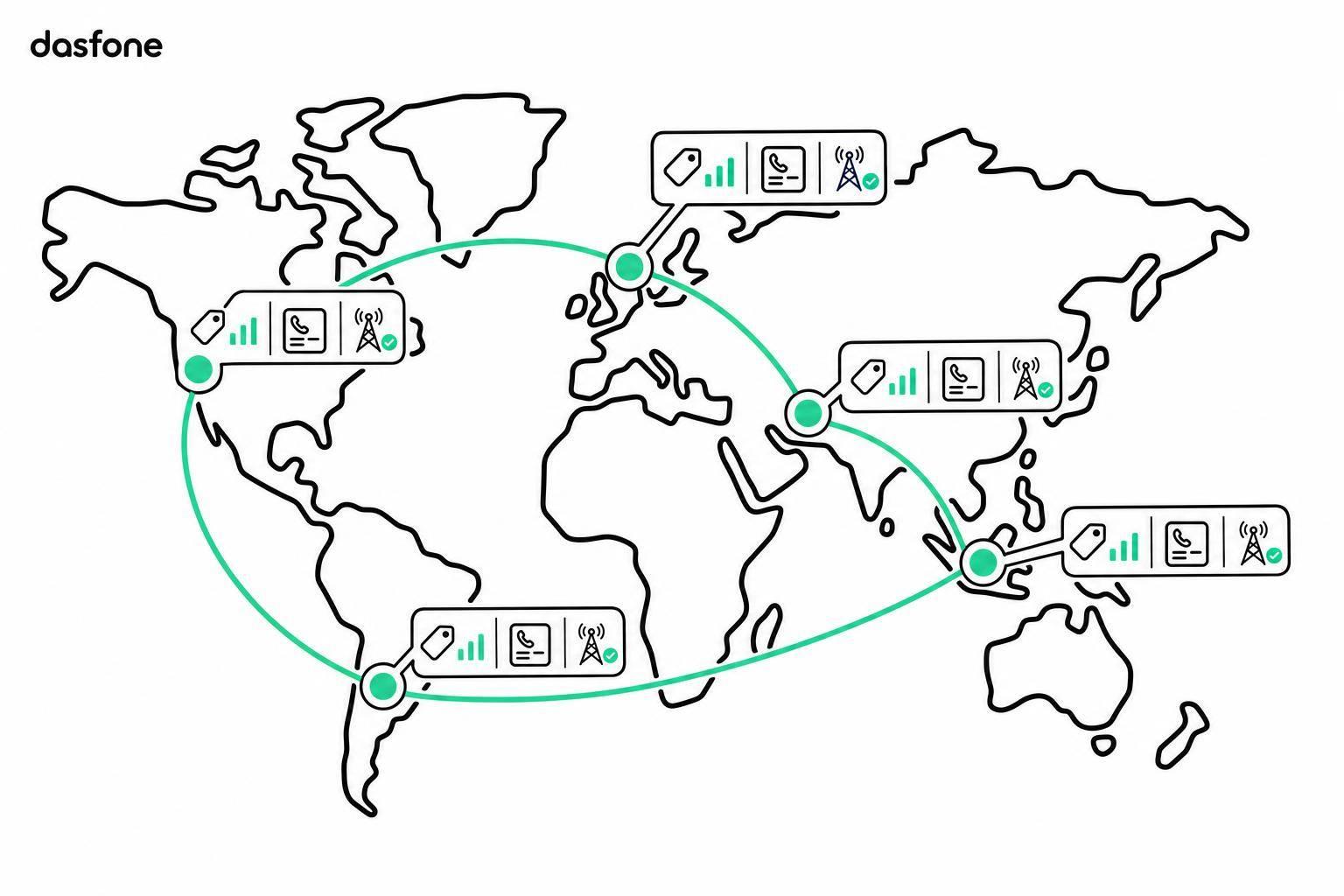
Browser Calling Coverage by Region: Comparison
If you want the short answer: North America and Western Europe are usually the easiest places for browser calling, while Africa and Latin America need more destination-by-destination checking. Prices can start at about $0.01/minute for some UK landlines, but mobile calls in parts of Asia can run $0.11 to $0.25/minute or more.
I’d boil the whole article down to this:
- Best overall coverage: North America and Western Europe
- Most mixed pricing: Asia, Latin America, and Africa
- Biggest quality risk: weak Wi-Fi, weak mobile data, and local VoIP limits
- Most common price split: mobile numbers often cost more than landlines
- Best way to avoid surprises: check the country, number type, local time zone, and caller ID status before you dial
This matters if you call banks, schools, hotels, government offices, suppliers, clients, or family abroad. In some regions, browser calling is smooth and low-cost. In others, the same call can cost more, sound worse, or fail because of local network limits.
Quick Comparison
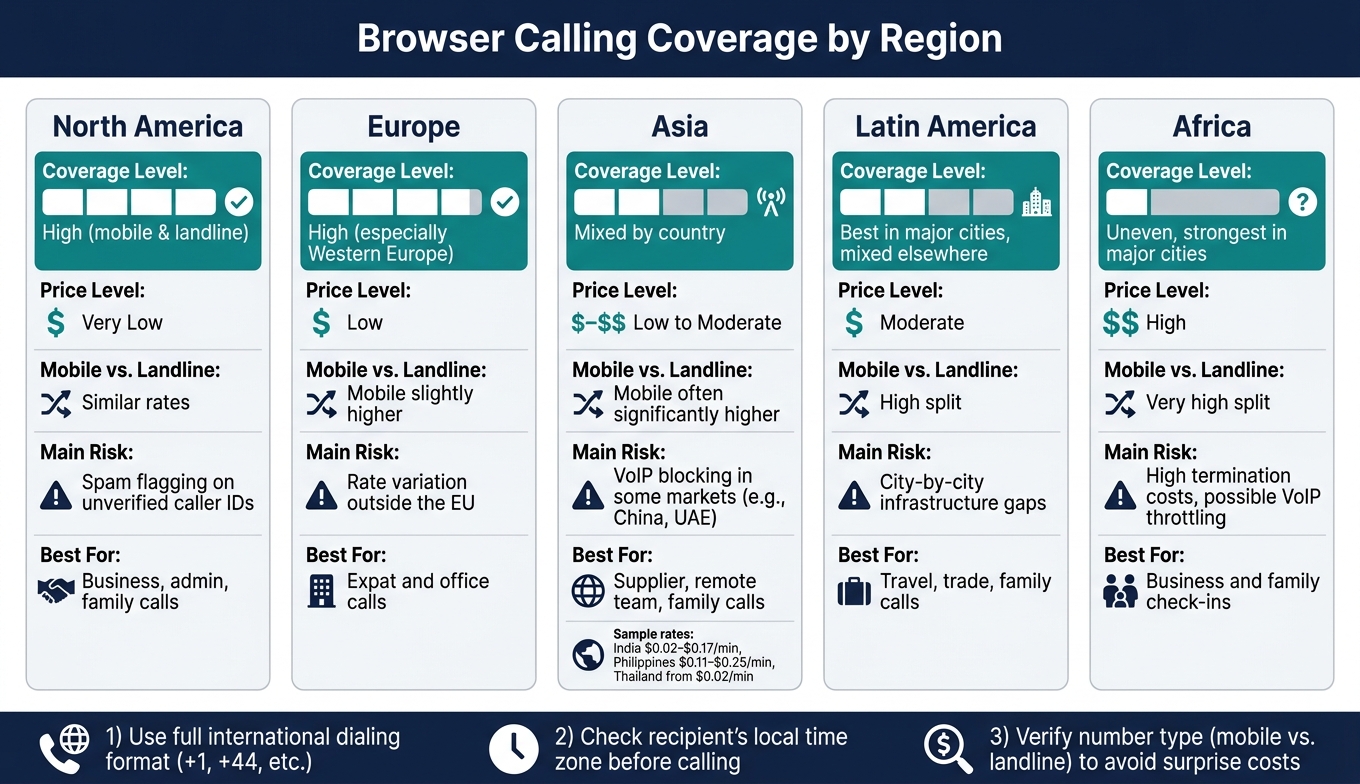
| Region | Coverage | Price Pattern | Main Risk | Common Use |
|---|---|---|---|---|
| North America | High | Usually low and clear | Spam labeling on unverified caller ID | Business, admin, family |
| Europe | High, especially West | Usually steady | More variation outside the EU | Expat and office calls |
| Asia | Mixed by country | Low to mid, but uneven | VoIP limits in some markets | Supplier, team, family |
| Latin America | Best in major cities | Mid-range, mixed by destination | City-by-city network gaps | Travel, trade, family |
| Africa | Uneven, strongest in major cities | Often higher | Network quality and higher termination rates | Business and family check-ins |
Bottom line: I’d use regional averages only as a starting point. For the call that matters, the live destination rate and the quality of your connection matter more than the region name.
1. Europe
Reach
Western Europe usually offers the best reach for both mobile and landline calls. Central and Eastern Europe are often supported too, but coverage can change from one country to another.
Pricing
Call rates vary based on the destination and on the type of number you're calling. A mobile number may cost more or less than a landline, depending on the country. Non-EU destinations often follow a different pricing model.
Connectivity
In most cases, a stable Wi-Fi or 4G/5G connection is enough for clear calls. If your internet is steady, call quality is usually smooth and easy to manage.
Use Cases
Europe works well for calls to banks, government offices, schools, hotels, and business lines. It's also a good fit for expats and importers/exporters who need to reach European numbers.
Dasfone supports these use cases with instant setup, mobile-browser access, HD audio, pay-as-you-go pricing, secure encryption, and optional caller ID.
Asia is more variable, with bigger differences in reach and pricing depending on the destination.
2. Asia
Reach
Asia is less uniform than Europe. Coverage can change a lot from one country to the next, which makes planning a bit harder. China and the UAE may restrict VoIP, so reach can be less predictable in those markets.
Pricing
Rates depend on where you're calling. India is often one of the lowest-cost markets, with pricing around $0.02 to $0.17 per minute. The Philippines tends to sit in the mid-to-high range at $0.11 to $0.25 per minute. Thailand can start as low as $0.02 per minute.
Connectivity
Call quality often comes down to the basics: data speed, Wi-Fi strength, filtering, and the state of local telecom infrastructure. If the network is slow, audio can get choppy fast.
Use Cases
Asia is a major region for staying in touch with businesses, suppliers, and family. It matters a lot for expats, students, importers/exporters, and sales teams making cross-border calls.
That’s where Dasfone makes sense. Browser access, mobile compatibility, and pay-as-you-go pricing make it a practical option for calls across the region.
Africa is even more uneven, with coverage tied more closely to local infrastructure.
3. Africa
Reach
Africa's browser-call coverage isn't even. Reach changes from one country to the next, and cities usually get better service than rural areas. That gap also shapes pricing, because places that are harder to reach often cost more to call.
Pricing
Pricing depends on the destination, and tougher-to-reach areas usually come with higher rates. Pay-as-you-go is a good fit when your call destinations change a lot, since you only pay for what you use.
Connectivity
Call quality depends mostly on mobile data speed and Wi-Fi stability. With a strong connection, audio can sound clear and smooth. With a weak one, quality can drop fast. In Africa, that makes day-to-day calling needs especially important, where steady service matters more than extra features.
Use Cases
People often use browser-based calling for suppliers, banks, schools, and family across borders. In many cases, a phone call is simply more practical than messaging. Dasfone works well here with instant setup, mobile access, and pay-as-you-go pricing.
That mix of reach, cost, and network quality leads to very different calling patterns in the next region.
4. North America
Reach
North America is much more even than Africa when it comes to coverage. Across the U.S., Canada, and Mexico, browser calling is broad and steady enough for day-to-day personal and business use.
Pricing
Pricing across North America is usually simple to follow. Per-minute rates for calls to the U.S., Canada, and Mexico are often listed clearly, which makes costs easier to track.
Pay-as-you-go works well for people who call once in a while. But if you're making a lot of calls, the total can climb fast.
Connectivity
That same consistency often shows up in call quality too, as long as the connection is stable. The U.S. and Canada have strong 4G and 5G networks, so browser-based calling usually sounds great on both Wi-Fi and mobile data.
Mexico's main cities are also well connected. Out in rural areas, though, coverage can be less steady.
Use Cases
Because the region is steady, it's a good fit for calls that can't wait. Expats, students, digital nomads, and businesses often need to contact banks, government offices, schools, healthcare providers, or other business contacts across borders.
Dasfone fits this kind of use well. It offers instant setup, mobile access, HD audio, and pay-as-you-go pricing.
5. Latin America
Reach
Browser calling across Latin America tends to work best in major cities. In secondary cities, service is more hit or miss. That gap affects both day-to-day call stability and what you may end up paying across the region.
| Destination Type | Reliability Level | Primary Connectivity Challenges |
|---|---|---|
| Major Cities | High | Peak-hour congestion |
| Secondary Cities | Moderate | Unstable public Wi-Fi |
In many secondary cities, stable mobile data is often a safer bet than public Wi-Fi.
Pricing
Pricing changes by destination, and the pay-as-you-go model helps keep costs easy to track.
Use Cases
Latin America is a common calling region for expats, students, digital nomads, importers and exporters, and sales teams running cold calling campaigns. It also fits office calls, banks, and day-to-day business contacts.
With browser access and no app installation, Dasfone works well for these situations.
The contrast across the region stands out more when you look at pricing, access, and calling scenarios side by side.
Pricing, Access, and Calling Scenarios by Region
The table below compares the five regions by coverage, pricing, and the kinds of calls people make most often.
| Region | Coverage | Relative Price Level | Mobile vs. landline pricing | Typical Calling Scenarios | Main Limitation or Risk |
|---|---|---|---|---|---|
| North America | High (mobile & landline) | Very low | Low - rates are often similar | Business outreach, family check-ins, bank and administrative calls | High spam-flagging risk for unverified caller IDs |
| Europe | High across Western Europe | Low | Moderate - mobile is usually a bit higher | Expat calls, hotel and bank coordination | Rates are less uniform outside the EU |
| Asia | High in major hubs | Low to moderate | High - mobile often costs more | Expat communication, supply chain contacts | VoIP blocking in specific regulatory zones |
| Latin America | Mixed - strong in major cities | Moderate | High | Local service booking, family calls, travel logistics | Infrastructure varies by city and local ISP stability |
| Africa | Variable; strongest in major cities | High | Very high | Business development, family calls, administrative contacts | High termination costs and possible VoIP throttling |
A few dialing details can change how well your calls go, no matter the region.
Country codes and dialing format. Use the full international format when you place a call: +1 for the U.S., +44 for the UK, and so on.
Time zones. Check the recipient’s local time before dialing. A cheap call isn’t much use if it lands at 3:00 a.m.
Caller ID. In North America, unverified numbers are more likely to get flagged. That can hurt answer rates, especially for business calls.
Pay-as-you-go and fees. Dasfone uses clear pay-as-you-go pricing, so you only pay for what you use and there’s no monthly subscription. Rates change by destination and call type. That setup keeps costs tied to usage, but higher-rate destinations can still push your total up fast.
These tradeoffs lead directly into the region-by-region pros and cons below.
Pros and Cons by Region
Use this quick summary to compare the biggest tradeoffs side by side.
| Region | Main Advantages | Main Drawbacks | Best For | Caution Before Calling |
|---|---|---|---|---|
| North America | Low rates | Unverified caller IDs can be flagged as spam | Business and family calls | Ensure a stable connection |
| Europe | Competitive rates | Mobile calls usually cost more than landlines | Expat and business outreach | Check whether the recipient is on a mobile or landline number |
| Asia | Good browser-call support in major markets | Rates vary sharply by country, and some markets restrict VoIP | Remote teams and cross-border contacts | Check local calling restrictions first |
| Africa | Broad reach across major cities | Higher per-minute rates and fewer low-cost plans | Essential business or family check-ins | Expect credit to deplete quickly on higher-rate destinations |
| Latin America | Affordable rates in key markets | Some destinations are much more expensive than others | Regional trade contacts, travel logistics, and family calls | Confirm destination rates before dialing |
Two things shape results in every region: number type and connection quality. Mobile numbers usually cost more than landlines, so that detail can change the total fast. A stable Wi-Fi or mobile data connection also matters if you want clear calls without dropouts.
Conclusion
The regional differences come down to three things: coverage, pricing consistency, and route reliability. North America and much of Europe are the easiest places for browser-based calling. Coverage is broad, pricing tends to stay steadier, and setup is usually more predictable. Asia is close behind, but pricing and operator support can still shift from one country to another, so it pays to check the destination first.
The story changes in places where infrastructure is less consistent. In Latin America and Africa, you need to do a bit more homework before placing a call. Rates can swing a lot by destination, and route quality can vary just as much. In those regions, a regional average only tells part of the story.
That’s why destination-level checks matter more than regional averages. Before you dial, check the live rate, destination network support, number type, toll-free or special-service coverage, and caller ID display.
For expats, students, digital nomads, importers, exporters, and outbound teams, Dasfone fits the browser-based use cases covered above. For app-free calls to banks, offices, and outbound campaigns, Dasfone offers browser-based international calling with pay-as-you-go pricing and optional dedicated caller ID.
Regional patterns help set expectations, but live destination checks and a stable connection matter most.
FAQs
How can I check the live rate before calling?
Use the rate calculator built into the dasfone platform to check the live per-minute rate for your destination before you place a call.
You’ll also see clear per-minute pricing before each call starts. And in your account dashboard, you can track your balance and call spend in real time.
Why do mobile numbers cost more than landlines?
Calls to mobile numbers often cost more because mobile termination fees can be 200% to 500% higher than the fees tied to fixed-line networks. In plain English, the carrier on the receiving end charges more to complete the call, and that extra cost usually lands on the caller's bill.
This is where many calling plans get slippery. A plan may promote low rates, but those prices may not apply to mobile numbers. Or the mobile rate may be much higher than the landline rate.
Dasfone keeps it simple by showing clear, destination-specific per-minute pricing for both mobile and landline calls before you place a call.
What should I verify before calling a new country?
Before calling a new country, check local rules first. Some places restrict or block VoIP traffic, which can stop your call from going through.
It also helps to review the per-minute rate for your destination. In many cases, mobile rates are much higher than landline rates, so a quick check can save you from an unpleasant surprise.
You should also make sure a few basics are in place:
- A stable internet connection
- The correct international dialing format, including the country code
- Browser microphone access enabled
Those small checks can make the difference between a smooth call and one that fails before it even starts.
Related Articles
Ready to Make International Calls?
Try dasfone today and make your first international call in seconds. No app download, no subscription—just instant, affordable calling from your browser.
Start Calling Now