Common Hidden Fees in International Calling
Common Hidden Fees in International Calling
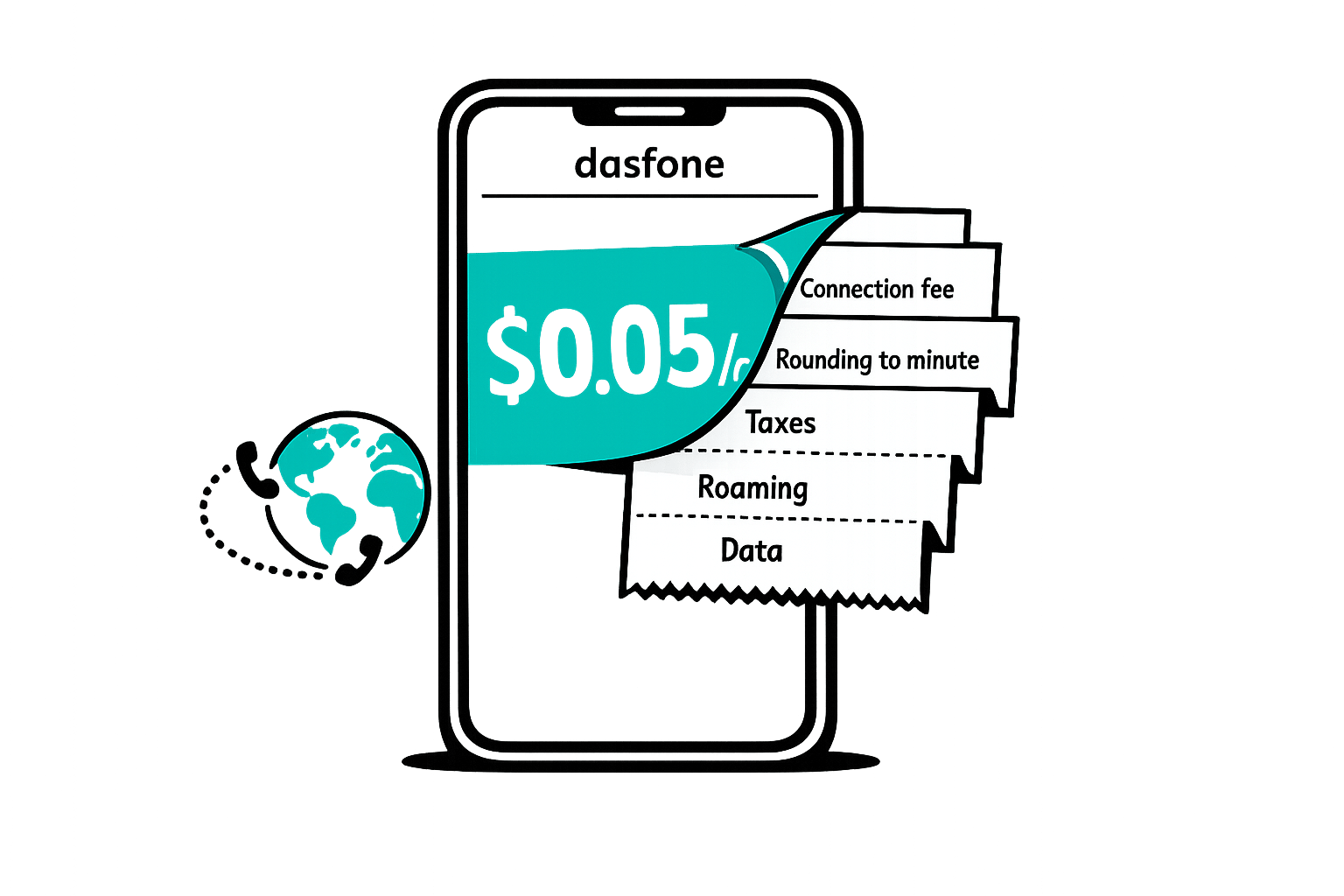
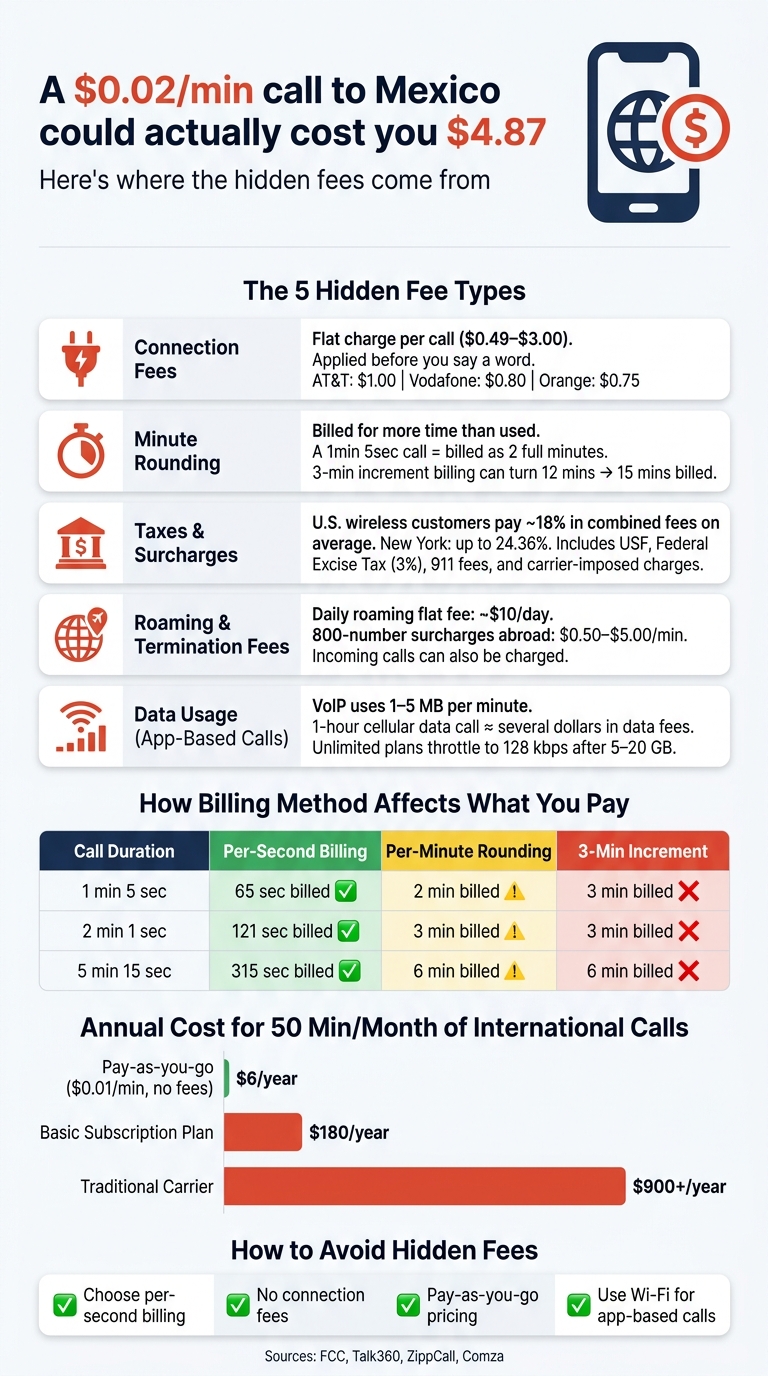
International calling can get expensive fast if you’re not aware of hidden fees. These charges - like connection fees, minute rounding, surcharges, and roaming costs - often aren’t included in the advertised rates. For example, a 12-minute call to Mexico advertised at $0.02 per minute could cost $4.87 due to added fees. Here’s what you need to know:
- Connection Fees: Flat charges applied at the start of every call, often buried in terms like "access fee."
- Minute Rounding: Providers round up call durations to the next minute or more, inflating costs.
- Taxes & Surcharges: Extra charges like Universal Service Fund (USF) fees or mobile termination surcharges.
- Roaming & Termination Fees: Additional costs when using foreign networks or calling international mobile numbers.
- Data Usage for App-Based Calls: Internet calls can rack up data charges, especially without Wi-Fi.
To avoid these, choose the cheapest way to make international calls with transparent pricing, no connection fees, and per-second billing. Options like browser-based platforms (e.g., Dasfone) offer straightforward costs, saving you from surprises.
Connection Fees: The Cost of Starting a Call
What Are Connection Fees?
A connection fee is a flat charge applied as soon as you place a call - even before you’ve said a word. [3] Whether your call lasts 30 seconds or 30 minutes, this fee is applied every time.
This is how a "cheap" rate can quickly become expensive. For example, a provider might promote a $0.02 per minute rate for international calls. But if there’s a $1.00 connection fee, a quick 2-minute call actually costs $1.04 - not $0.04. For people who make frequent short calls, these fees can add up alarmingly fast.
"While some apps boast cheap per-minute rates, they often offset them with steep connection fees." - Talk360 [5]
Connection fees vary significantly between providers. For instance, AT&T charges $1.00 per call, Vodafone charges $0.80, and Orange charges $0.75. [3] Budget VoIP services can range from $0.49 to $3.00 per call. [1] Unfortunately, these fees are often buried in the fine print and not highlighted during sign-up, making it essential to carefully review fee disclosures on a provider’s website.
Next, let’s explore how to identify these fees before they take a toll on your wallet.
How to Spot Connection Fees
Knowing what connection fees are is just the beginning; the next challenge is figuring out where they’re hiding on your bill.
These fees are rarely included in the advertised rates. Instead, they’re tucked away in the terms of service under names like "connection charge", "access fee", "setup fee," or "regulatory cost recovery." [3] If you don’t actively search for them, you might not notice until they appear on your bill.
One practical way to uncover them: before committing funds to a calling service, make a short test call and check how much is deducted. If the amount exceeds what the per-minute rate suggests, a connection fee is likely being applied. [3] For U.S. carriers, FCC regulations require international rates to be disclosed on their websites. Taking a few extra minutes to visit the carrier’s support or international services page can save you from surprises. [4]
"I wasted so much on connection fees before switching to an app that clearly shows costs per minute. It's saved me hundreds." - Daniel, User, Talk360 [5]
Minute Rounding: Paying for More Time Than You Use
How Rounding Policies Work
Minute rounding is one of those sneaky practices that can quietly inflate your international calling bills. Instead of charging you for the exact seconds you’re on the line, many providers round up to the next full minute. For instance, if your call lasts 1 minute and 5 seconds, you’re billed for 2 full minutes. That’s an extra 55 seconds of charges you didn’t actually use[8]. Make ten such calls a day, and you could be looking at over 300 unnecessary billed minutes every month[8].
Some services take it even further. Traditional calling cards often bill in 3-minute increments. That means a 12-minute call could be charged as 15 minutes[6]. To make matters worse, some providers tack on a minimum charge per call, billing each one as at least 3 to 5 minutes, no matter how short it is[1][9].
"Most providers bill per minute, and some round up to the next minute or even increment (like every 30 seconds). That means a 2:01 call could be billed as a full 3 minutes!" - Josh Mead, Founder, ZippCall[3]
Here’s a quick look at how different billing methods can impact your charges:
| Call Duration | Per-Second Billing | Per-Minute Rounding | 3-Minute Increment |
|---|---|---|---|
| 1 min 5 sec | 65 seconds billed | 2 minutes billed | 3 minutes billed |
| 2 min 1 sec | 121 seconds billed | 3 minutes billed | 3 minutes billed |
| 5 min 15 sec | 315 seconds billed | 6 minutes billed | 6 minutes billed |
These small increments can really add up, making it crucial to understand how your provider calculates call time.
How to Cut Costs from Rounding
The best way to avoid overpaying due to rounding is to opt for services that bill by the second. This ensures you’re only charged for the exact time you’re on the call[8].
Before signing up with a provider, take a close look at the fine print. Look out for terms like "billing increment", "rounding policy", or "minimum call duration"[8][9]. As consumers push for fairer practices, more providers are starting to offer transparent per-second or per-minute pricing options[3].
If you’re stuck with a per-minute billing service, try to make the most of each billing minute. For example, if you’ve already crossed into a new minute, use the remaining time since you’re paying for it anyway[3]. Small adjustments like this can help you minimize unnecessary charges.
Taxes, Surcharges, and Regulatory Fees
Taxes, surcharges, and regulatory fees can significantly increase your international calling costs beyond the advertised rates. On average, U.S. wireless customers pay nearly 18% in combined federal, state, and local fees in addition to their base rate. In states like New York, this figure can soar to 24.36% [10]. Let’s take a closer look at these fees and why they often remain hidden.
Common Taxes and Fees on Calling Bills
Your bill might include several types of charges, not all of which are actual government taxes. Here’s a breakdown of the most common ones:
| Fee Name | What It Is | Government-Mandated? |
|---|---|---|
| Universal Service Fund (USF) | Supports telecom access for rural and low-income areas | No - carriers choose to pass it on [13] |
| Regulatory Recovery Fee | Covers the carrier’s compliance costs | No - carrier-imposed [9] |
| Federal Excise Tax | A 3% tax on local telephone service | Yes [13] |
| 911/E911 Fee | Funds local emergency services | Yes (varies by location) [13] |
| Mobile Termination Surcharge | Cost of connecting to overseas mobile phones | No - carrier-imposed [11] |
| State & Local Taxes | Includes gross receipts surcharges and city-specific taxes | Varies [10] |
One fee to keep an eye on is the mobile termination surcharge. In many countries, the cost of connecting to a wireless phone falls on the caller, and U.S. carriers often pass this expense directly to you [11]. If you frequently call international mobile numbers, these charges can add up quickly.
Why These Fees Are Not Always Disclosed Upfront
Much like connection and rounding fees, many of these charges are buried in the fine print. For example, providers are allowed - but not required - to recover USF contributions from customers [13]. This gives them the ability to advertise a straightforward per-minute rate while tacking on additional costs later.
"The advertised rate is just the beginning. Connection fees, service charges, 'regulatory fees,' and other hidden costs can multiply your bill by 10x or more." - Comza [9]
Taxes and fees imposed by other countries also add to the confusion. For instance, India applies an 18% GST on international calls [12], while EU countries include VAT. Because these taxes vary by destination, providers often exclude them from the advertised price. When evaluating calling plans, look out for terms like "regulatory cost recovery", "maintenance fee", or "service charge", as these are typically carrier-imposed [3][9].
Roaming and Termination Fees
Roaming and termination fees can quickly drive up the cost of international calls, often catching people off guard just like other hidden charges tied to global communication, which is why many users compare browser-based calling apps to find more transparent alternatives.
Roaming Fees While Traveling
Roaming kicks in as soon as your phone connects to a foreign carrier's network instead of your home provider's. That connection alone can result in immediate charges. For many U.S. carriers, this means a flat daily fee of about $10 to enable roaming for a 24-hour period, even if your phone usage is minimal [1][7].
A common surprise for travelers is that incoming calls - whether answered or missed - can also rack up charges [7]. Adding to the confusion, foreign networks often delay processing billing data, so you might not see these charges until your next billing cycle [14].
If you're near a border, accidental roaming can happen when your phone automatically connects to a foreign network. To avoid this, manually select your home carrier in your phone's network settings [15]. On top of roaming, termination fees can also pile up when calls are routed through foreign networks.
Termination Fees on Foreign Networks
Termination fees are the costs foreign carriers charge to complete a call on their network. Your U.S. provider pays these fees and then passes them along to you [11]. These fees vary depending on the destination and whether you're calling a mobile phone or a landline, operating under a "calling party pays" system:
"Many foreign countries use a 'calling party pays' framework under which wireless phone subscribers pay only for the outgoing calls they place to others. The calling party must pay for calls placed to wireless phones." - FCC [11]
To avoid unexpected charges, check whether you're dialing a mobile or landline number. Be especially careful when calling 800 numbers or short codes abroad, as these can come with steep surcharges ranging from $0.50 to $5.00 per minute [1].
Data Usage Costs for Internet and App-Based Calling
After looking into roaming and termination fees, it's also worth considering the potential extra costs tied to data usage when making internet-based calls.
When Data Usage Becomes a Hidden Cost
App-based calling depends on a reliable data connection. While switching to internet calling can bypass carrier fees, using cellular data instead of Wi‑Fi can lead to unexpected expenses. For example, a one-hour call over cellular data might cost several dollars in data usage fees [8]. VoIP calls typically consume between 1–5 MB per minute [16], which can quickly add up if you're on a limited data plan.
Even with unlimited data plans, there’s a catch. Many of these plans reduce speeds to 128 kbps after you hit 5–20 GB of high-speed data [1]. At these slower speeds, call quality drops significantly, and calls may disconnect, all while still using data.
To avoid these pitfalls, consider these tips: always connect to Wi‑Fi before making international calls, keep an eye on your monthly data usage, and turn off data roaming when traveling abroad to prevent extra charges.
These hidden data costs highlight the importance of exploring more efficient options, such as comparing browser-based calling apps to find the right fit.
How Browser-Based Calling Reduces Data Costs
One of the key advantages of browser-based calling is its efficiency. Unlike apps that use background data for updates and syncing, browser-based calls only use data during the actual call. This approach aligns with efforts to reduce hidden fees in international calling.
| Feature | App-Based Calling | Browser-Based Calling |
|---|---|---|
| Background Data Use | Yes (updates, syncing) | No |
| Setup Required | Download and install | Open a URL, start calling |
| Storage Impact | Uses device storage | None |
| Call Reach | Recipient must have the app | Calls any landline or mobile number |
Platforms like Dasfone demonstrate this efficient method. There’s no need for downloads, background processes, or subscriptions. Simply open the browser, load a pay-as-you-go balance, and make your call - using data only while you're talking. This straightforward system is especially helpful for expats, digital nomads, or anyone making frequent international calls, as it minimizes the risk of surprise data charges.
How to Avoid Hidden Fees by Choosing Transparent Services
Now that we've explored how hidden fees can inflate your bills, let’s focus on how to avoid them by selecting a service that prioritizes transparency.
What to Look for in a Transparent Calling Service
First, ensure the service doesn’t tack on connection fees. Some providers charge $0.49–$3.00 per call, which can add up quickly [9][1]. A reliable service won’t bill you simply for making a call.
Look for pay-as-you-go pricing. This model allows you to pay only for the minutes you use, making it a great choice for light users. For instance, if you make about 50 minutes of international calls per month, a rate of $0.01 per minute would cost you just $6.00 per year. Compare that to $180.00 for a basic subscription or over $900.00 with a traditional carrier [3].
Be wary of "free trial" offers that require a credit card upfront. These often lead to automatic subscriptions that are hard to cancel [9][1]. Instead, consider starting with a small deposit, like a $5 top-up. This lets you test the service’s call quality and billing practices without a significant financial commitment.
Choosing a service with these features ensures you won’t face unexpected charges and sets you up for a better international calling experience.
Why dasfone Stands Out
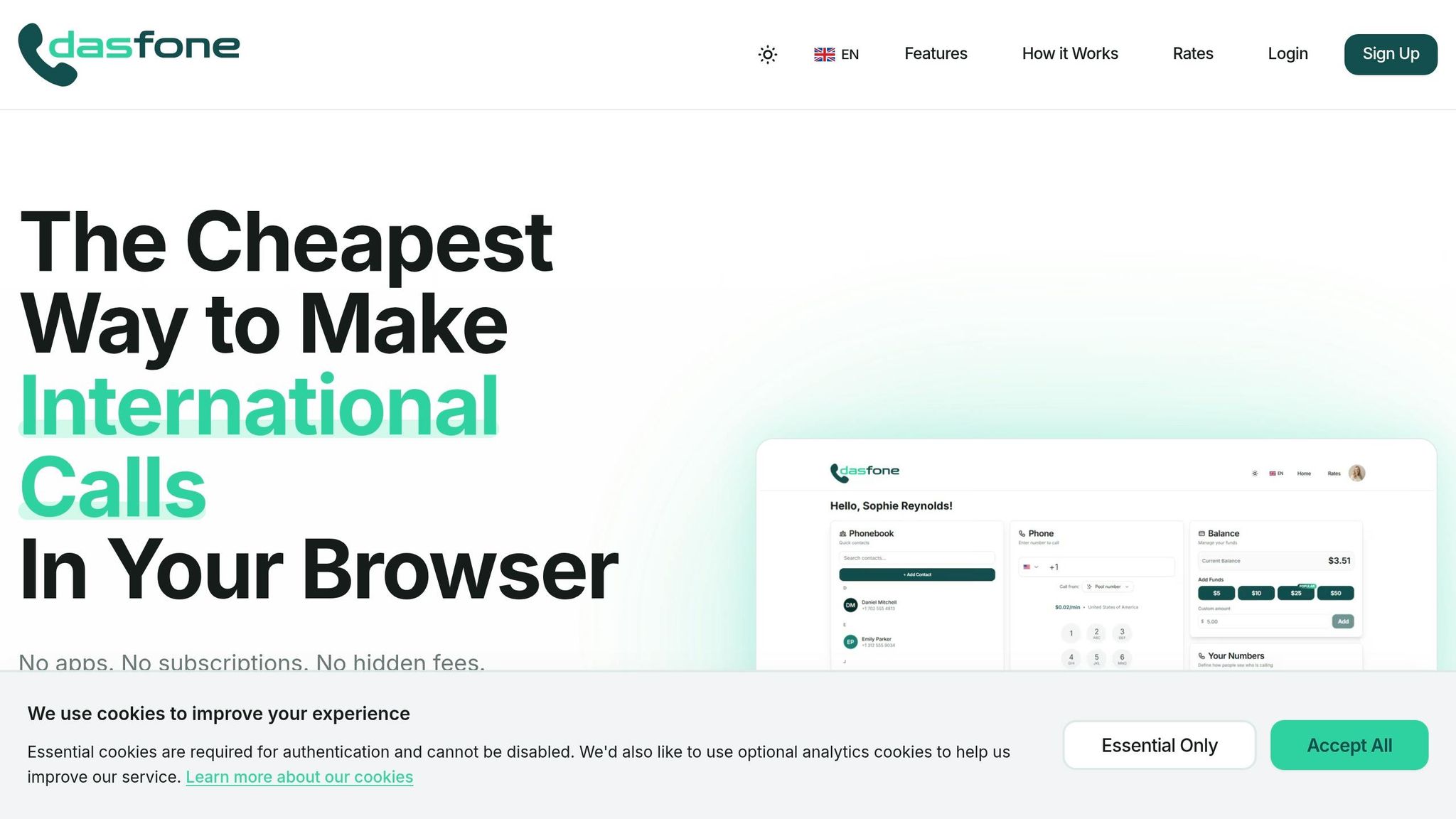
Dasfone is a browser-based international calling platform designed with simplicity and fairness in mind. It offers pay-as-you-go pricing with no subscriptions, connection fees, or monthly obligations. Rates are clearly listed: for example, calls to the U.S. and Canada cost $0.02/min, while calls to Mexico start at $0.03/min [17]. You only pay for the minutes you use by loading a balance.
Dasfone is perfect for expats, students, digital nomads, and businesses that need to make international calls - especially when app-based options aren’t viable. There’s no software to download, setup is instant, and new users get a $2 sign-up bonus (up to 100 free minutes). Plus, you can enjoy a 25% discount on your first top-up with the code DF25.
With regulatory changes in 2026 pushing for clearer billing practices [3], Dasfone is already ahead of the curve, offering a straightforward and transparent model. By choosing a pay-as-you-go service like Dasfone, you can avoid hidden fees and take control of your international calling costs.
Conclusion: The True Cost of International Calling
Hidden fees are often baked into the pricing models of traditional carriers. Charges like connection fees, minute rounding, maintenance costs, roaming fees, and vague surcharges can quickly inflate a seemingly low $0.02/min rate into something much higher.
"International calling has been a profit machine for telecoms since the 1970s. The technology got cheaper. The prices didn't." - GlobCall [6]
The real cost of a call includes all these extra fees. These hidden charges, outlined above, highlight why advertised rates can be misleading.
To truly understand your expenses, it’s essential to identify these charges. A more transparent alternative like Dasfone can simplify things with straightforward per-minute rates, no connection fees, and no subscriptions. This approach has helped expats, students, digital nomads, and businesses save hundreds of dollars each year compared to traditional carrier plans [2].
The takeaway: a low advertised rate often isn’t the most affordable option. Knowing where hidden costs come from is the first step toward avoiding them.
FAQs
How can I tell if a low international rate includes a connection fee?
When choosing a provider, it’s important to review the fine print for additional charges like setup fees, access costs, or per-call surcharges. These are usually flat rates applied to every call, often falling between $0.50 and $1.00. Services such as dasfone offer a more straightforward approach, clearly listing per-minute rates upfront and only billing for the time you actually spend talking. This way, you can steer clear of unexpected connection fees.
What billing increment does my provider use (per-second, per-minute, or 3-minute)?
When reviewing your phone plan or calling service, take a close look at the billing increments outlined in the terms of service or plan details. Many older calling cards and traditional carriers still rely on 3-minute increments or round up to the nearest minute. This practice can make short calls unnecessarily expensive.
On the other hand, services like dasfone stand out by charging only for the exact time you spend on the call. This means you’re billed fairly, without hidden markups. For the most accurate and cost-effective billing, look for providers that use per-second increments. It’s worth confirming this detail to avoid paying more than you should.
How can I avoid roaming and data charges when calling internationally?
To keep roaming and data charges in check, make the most of Wi-Fi whenever you can and turn off cellular data roaming before you head out on your trip. Another smart option is using an eSIM for data instead of relying on your carrier's roaming plans.
For making calls, browser-based VoIP services like Dasfone are a great choice. They let you make secure, high-quality international calls straight from your browser - no apps or subscriptions needed. Plus, with their transparent, pay-as-you-go pricing, you can avoid hidden fees altogether.
Related Articles
Ready to Make International Calls?
Try dasfone today and make your first international call in seconds. No app download, no subscription—just instant, affordable calling from your browser.
Start Calling Now