Custom Caller ID for Cold Calling Campaigns
Custom Caller ID for Cold Calling Campaigns
Cold calling is tough - most people don't answer unknown numbers. But using custom caller ID can change that. By displaying a local area code or your verified business name, you can significantly improve answer rates and build trust with prospects. Here’s what you need to know:
- Why Calls Go Unanswered: Only 15% of adults answer unfamiliar area codes, and flagged numbers (“Spam Likely”) are ignored 75% of the time.
- How Custom Caller ID Helps: Local area codes boost answer rates from 5%–8% to as high as 40%. Adding your verified business name increases trust and reduces spam flags.
- Key Features to Look For: Automatic local number matching, real-time analytics, and multi-region support ensure better performance and scalability.
With tools like Dasfone, setting up custom caller ID is easy and can lead to higher connection rates, more conversations, and ultimately, more closed deals.
Problems with Cold Calling Without Custom Caller ID
Low Answer Rates
When people see an unfamiliar number pop up, they usually ignore it. The stats back this up: calls from local area codes have an answer rate of about 27.5%, but toll-free numbers only manage 7% [6]. However, using a local area code that matches the recipient’s can push answer rates up to 40% [6].
Why does this happen? A local number feels familiar - it might be a neighbor, a school, or even a doctor’s office [6][7]. On the other hand, out-of-state or toll-free numbers scream "sales call" or "robocall" to most people. The reality is that only 11% of people answer unknown numbers, and it takes an average of 18 calls to connect with just one prospect [7][4]. These low answer rates create a domino effect of issues for call delivery.
Spam Filters and Call Blocking
Even if someone wants to answer, your call might not make it to their phone. Carriers assign reputation scores to every number based on its call history, and generic caller IDs often get flagged as "Spam Likely" or "Scam Likely" [8]. Once flagged, 75% of consumers won’t pick up [7].
Here’s the technical side: calls without proper STIR/SHAKEN verification are much more likely to be marked as robocalls - five times more likely, in fact [9]. By late 2025, only 30.1% of calls had the highest A-level attestation, leaving most calls vulnerable to being flagged [9]. For sales teams, the impact is immediate: connect rates can plummet from 8% to 3% overnight if a number gets flagged [9]. And it’s not just about numbers - 81% of sales professionals say spam flags directly hurt their company’s revenue [8]. Beyond the technical hurdles, an unrecognized number undermines trust with potential leads.
Trust Issues with Unknown Numbers
When a number shows up as unfamiliar or from an out-of-area location, trust evaporates. Prospects don’t recognize your business, and 7% of them actively block or report the number [7]. Even among those who do answer, nearly 6% hang up right away [7].
These repeated blocks and reports hurt your number’s trust score with carriers, eventually making it unusable [7]. Without a local presence or a verified business name on the caller ID, you’re at a disadvantage before the call even begins. This is why having a customized caller ID is so critical for cold calling success.
Smart Caller ID for Business: Verified Business Caller ID Explained
How Custom Caller ID Fixes Cold Calling Problems
Local Number Matching
browser-based calling apps can automatically display a local area code, taking advantage of something called familiarity bias. This approach can significantly boost answer rates, increasing them from 25% to 40% by matching the prospect's location within about 50 miles [5][6][10]. When your number appears local, you're nearly four times more likely to get an answer compared to using out-of-state or toll-free prefixes [6][2][5].
"A familiar local area code feels like a neighbor calling, not a stranger."
– Daniyal Dehleh, Email Deliverability Expert [5]
In addition to local number matching, including clear caller identification - such as your company's name - helps further build trust with potential customers.
Displaying Company Information
With custom caller ID, you can register your company name through CNAM, ensuring that prospects see something like "ABC Roofing" or "Sales Team" instead of the dreaded "Unknown" [1][5]. Adding verified STIR/SHAKEN Level A attestation can also prevent your calls from being flagged as spam, improving connect rates by as much as 31% [5][6][10]. This verified caller display not only separates your call from spam but also directly addresses trust concerns that often deter people from answering.
Measurable Results from Custom Caller ID
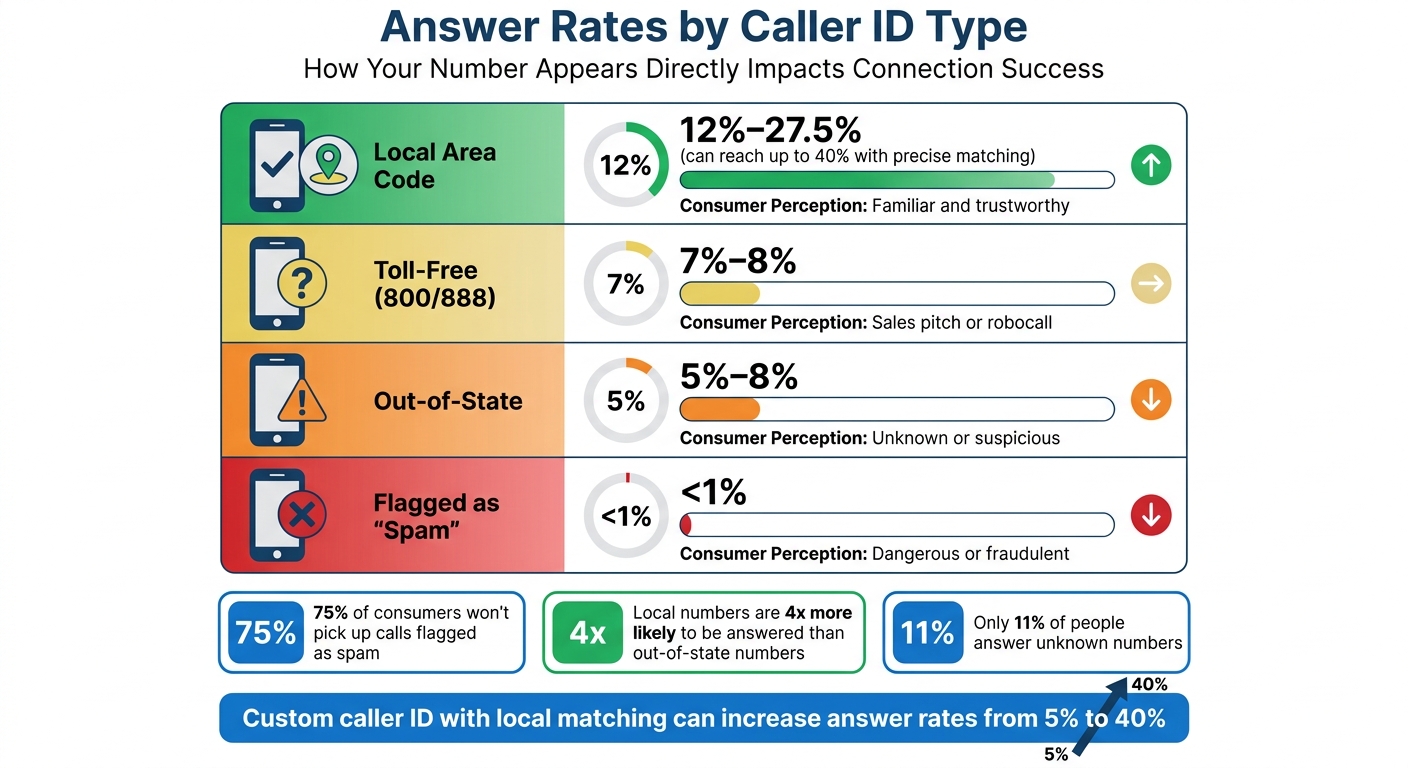
The benefits of custom caller ID aren’t just theoretical - they’re backed by measurable results. Traditional cold calling typically results in a 5.5% answer rate after 18 attempts [4]. But with custom caller ID, those rates can climb to anywhere between 12% and 27.5% [6][10].
| Caller ID Type | Typical Answer Rate | Consumer Perception |
|---|---|---|
| Local Area Code | 12%–27.5% | Familiar and trustworthy [6][10] |
| Toll-Free (800/888) | 7%–8% | Sales pitch or robocall [6][10] |
| Out-of-State | 5%–8% | Unknown or suspicious [10] |
| Flagged as "Spam" | < 1% | Dangerous or fraudulent [7] |
The effectiveness of custom caller ID can also vary by industry. Sectors like home services, real estate, and recruiting see particularly strong results because geographic relevance plays a big role in their interactions [5][10]. On the other hand, B2B software sales teams may see smaller improvements, as their buyers are often accustomed to receiving calls from out-of-state contacts [5]. Overall, presenting a legitimate local presence helps eliminate the immediate suspicion that often comes with unknown or flagged calls [10].
What to Look for in a Custom Caller ID Solution
Automatic Number Matching
Automatic number matching ensures the right local number is assigned based on your prospect's location - completely eliminating manual effort [6][12]. This feature selects a matching local number in real time, and if an exact match isn’t available, it chooses the next-best option, typically from the same geographic region [14].
This automation also helps protect your numbers from being flagged as spam. Sophisticated systems rotate through a pool of 10–15 numbers per area code to keep them "fresh", reducing the likelihood of carrier blocks. This rotation not only improves answer rates but also builds trust with your prospects.
"Projecting a local presence through your Caller ID to your call recipients helps a lot here as they are more inclined to take local calls and calls from their own region."
– DoorVaani [14]
Multi-Region Support and Scaling
For campaigns that extend beyond local areas, flexibility is key. If your outreach spans multiple states or countries, look for a solution that offers global number coverage. Platforms with access to local numbers in over 100 countries and support for international formats (like E.164 for the UK) ensure your calls connect seamlessly and comply with telecom regulations [12][13][3]. This is essential for maintaining trust across diverse markets.
Additionally, unified carrier management simplifies scaling. A centralized dashboard allows you to deploy and monitor numbers across all networks in one place [11]. This is particularly useful for high-volume campaigns, where you need to track performance and quickly identify flagged numbers without juggling multiple systems.
Performance Tracking and Analytics
Effective performance tracking is just as crucial as seamless number matching. Real-time dashboards should provide insights into key metrics like answer rates, spam flags, and call outcomes for every number [15][3]. This data helps you pinpoint high-performing area codes and identify numbers that need to be rotated out, ensuring your campaigns remain effective.
| Metric to Track | Why It Matters |
|---|---|
| Answer Rate | Indicates how effective each caller ID is at encouraging prospects to pick up [3][4] |
| Reputation Score | Alerts you when carriers label your numbers as "Spam Likely" [4] |
Real-time monitoring allows you to act quickly if a number’s performance drops or it’s flagged as spam. Replacing problematic numbers immediately prevents them from harming your campaign’s overall success [4]. Integration with your CRM can further streamline this process by automatically logging which caller ID was used for each call, making follow-ups more efficient [3][6].
"Regularly review call analytics to measure caller ID performance and optimize strategies."
– Calilio [3]
Setting Up Custom Caller ID: Step-by-Step
If you’re ready to leverage custom caller ID, here’s a guide to setting up your local numbers effectively.
Acquiring and Configuring Local Numbers
To start, purchase virtual phone numbers with area codes matching your prospects' locations. For instance, if you’re targeting businesses in New York, look for a 212 number; for Chicago, go with a 312. Most VoIP providers allow you to search by city or area code, making it straightforward to find numbers for your target regions [17].
After selecting your numbers, verify ownership by entering the six-digit code you’ll receive through a verification call [3]. You may also need to complete additional steps like ID or address verification and number porting, which can take up to seven business days [17].
Once verified, set up your Caller ID Name (CNAM) by submitting your business name to national databases. Keep the name under 15 characters and ensure it matches your registered business name to avoid rejection [16]. Approval usually takes 48 hours, with another two to three days for the information to update across carriers [16]. To reduce the chance of your numbers being flagged as spam, register them with the Free Call Registry and major carrier analytics services [16][17].
Creating Area Code Matching Rules
Set up automatic rules to display a local caller ID that matches your prospect’s area code. Use a dedicated pool of numbers, rotating through them to limit each to 50–75 calls daily. This keeps the numbers fresh and helps avoid carrier blocks [4][17]. Ensure you have enough numbers for each region so your dialer always has a matching ID available [4][17].
You can configure these rules at the campaign or department level, ensuring your team consistently displays the correct local identity [3][17]. Label numbers clearly (e.g., "NYC Sales 212") so they’re easy to identify by region [17].
Testing and Adjusting Settings
Before launching your campaign, test each number by calling and sending SMS messages to confirm they display and route correctly [17]. Review analytics monthly to track the performance of different area codes [17]. If a number’s answer rate drops, check if it’s been flagged as spam and adjust your calling patterns to avoid triggering flags, such as avoiding rapid or repeated calls [17]. Regularly audit your system to remove outdated caller IDs from completed campaigns [3].
"A local business phone number uses the area code for your target city - for example, 415 for San Francisco - and gives customers a reason to pick up."
– Sandeep Gaur, US Sales Lead, JustCall [17]
Use these insights and analytics to fine-tune your setup and optimize your campaign results.
Why Dasfone Works Well for Cold Calling Campaigns
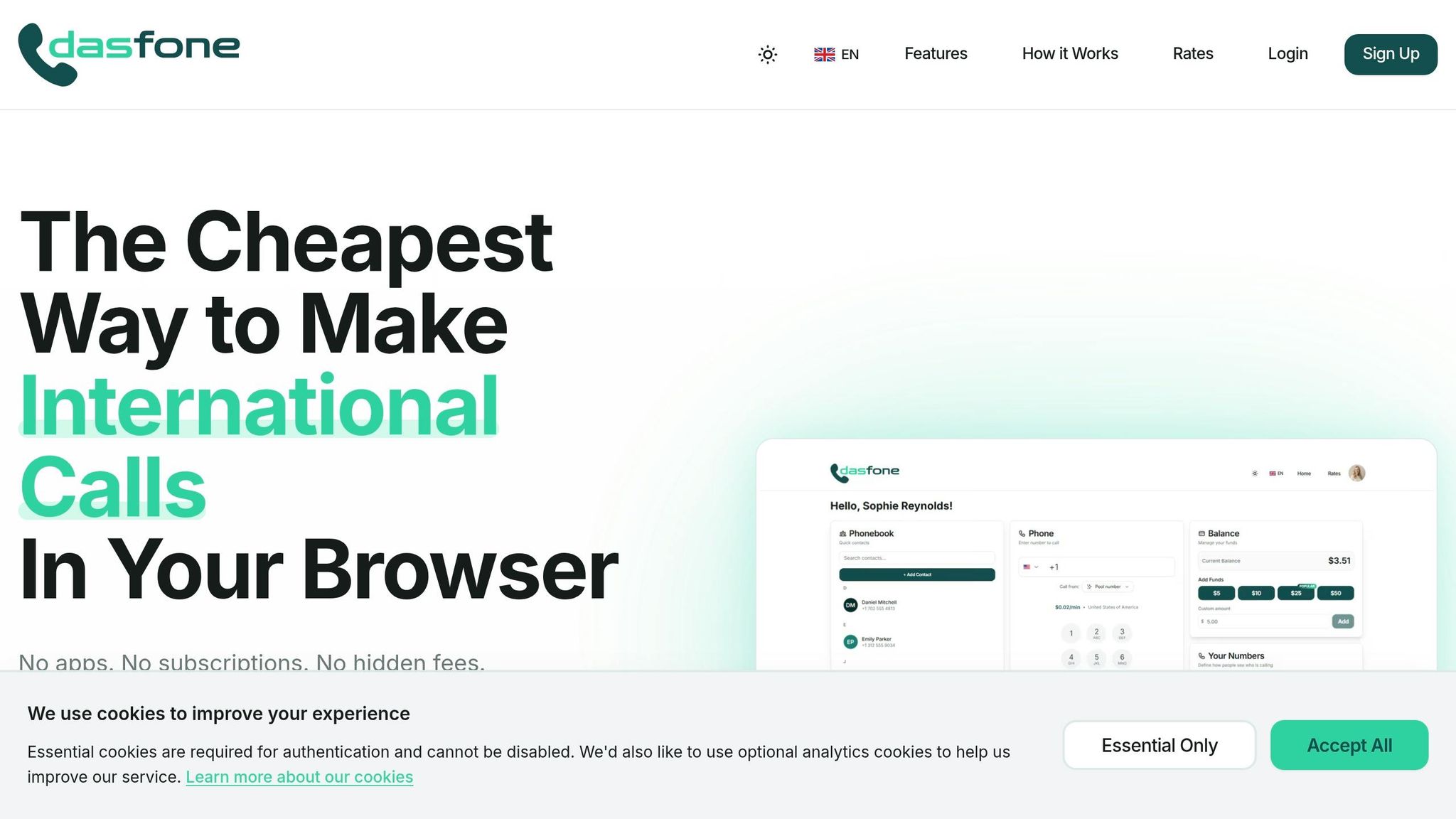
Dasfone tackles cold calling challenges head-on with its browser-based platform and adaptable pricing. Forget about complicated software installs or lengthy commitments - Dasfone’s simplicity and flexibility make it a great choice for executing cold calling campaigns quickly and effectively.
No Apps or Downloads Required
Dasfone operates entirely in your web browser, making it incredibly easy to use. Your sales team can start calling in under a minute: just sign up with an email, add credits, and you’re ready to go. This setup is perfect for remote or international teams, eliminating the hassle of installing dialer software on multiple devices. Plus, it works smoothly across desktops, tablets, and mobile devices, offering a single dashboard for managing contacts and active calls.
Pay-As-You-Go Pricing
Dasfone’s pricing model is straightforward and budget-friendly. You only pay for what you use - no subscriptions, no monthly fees, and no hidden costs. With a minimum top-up of just $5, you can test out caller ID strategies without worrying about overspending. Need to scale up? Adjust your spending based on your campaign’s performance. And to sweeten the deal, you get a 25% discount on your first top-up, giving you an extra boost as you get started.
Custom Caller ID Features
Dasfone’s "Own Caller ID" feature lets you either purchase dedicated local numbers or use your existing business numbers for outbound calls. Showing a local area code can increase connection rates by up to 400% [18]. With international calling available in over 200 countries and high-definition voice quality secured by enterprise-grade encryption, Dasfone ensures your calls are professional and reliable. Considering that 75% of Americans ignore calls from unknown numbers [18], having a custom caller ID is a game-changer for cold calling success.
Conclusion
Tackling the challenges of trust and low answer rates in cold calling requires a well-thought-out strategy - and custom caller ID is a game-changer. When 75% of Americans ignore calls from unknown numbers, showing a local area code or a verified business name isn’t just helpful - it’s critical [19]. The numbers speak for themselves: businesses that use local presence dialing report answer rates increasing by 20% to 40% [4]. This not only boosts connection rates but also helps establish stronger customer trust.
Dasfone simplifies your cold calling efforts, letting you concentrate on building local credibility and achieving results. With industry-wide connection rates hovering around just 2% to 3% [20], even modest gains in answer rates can lead to more conversations - and more closed deals.
FAQs
Is local caller ID the same as spoofing?
Local caller ID and spoofing are not the same thing. Local caller ID uses legitimate, leased phone numbers with area codes that match the recipient's location. This approach is designed to increase answer rates and establish trust. Spoofing, however, involves falsifying numbers to mislead the recipient. Unlike local caller ID, spoofed numbers are often non-functional and cannot be called back.
How many local numbers do I need per area code?
The amount of local numbers you’ll need for each area code depends on how many calls you plan to make and the size of your campaign. In most cases, having several local numbers for each area code can improve answer rates and help establish trust - particularly when you’re contacting numerous prospects in the same area.
Will a verified caller ID stop 'Spam Likely' labels?
A verified caller ID can help build trust and increase the chances of your calls being answered. However, it doesn't automatically eliminate those pesky 'Spam Likely' labels. These tags are assigned by carrier spam detection systems. To minimize the risk of being flagged, focus on improving your caller ID reputation and ensure your number is properly registered with carrier analytics systems.
Related Articles
Ready to Make International Calls?
Try dasfone today and make your first international call in seconds. No app download, no subscription—just instant, affordable calling from your browser.
Start Calling Now