7 Ways to Cut Your International Calling Costs
7 Ways to Cut Your International Calling Costs
Making international calls can cost up to $5 per minute with standard plans, but you don't have to overpay. By using modern tools and smarter pricing options, you can save over 90% on your calls. Here's how:
Browser-Based Calling Platforms: Services like dasfone let you call directly from your browser at rates as low as $0.01 per minute.
VoIP Services: Convert your voice into digital data for rates starting at $0.01 per minute.
Pay-As-You-Go: Only pay for what you use, avoiding monthly fees.
Least Cost Routing: Automatically picks the cheapest route for your call.
Flat-Rate Plans: Ideal for frequent callers, offering predictable monthly costs.
Cloud Solutions: Skip expensive hardware and use your existing devices.
Review Your Patterns: Analyze your bill to avoid high "basic rate" charges.
Switching to these methods can save you hundreds of dollars annually. For example, a 26-minute call to the UK could drop from $87.81 to just $0.26 with a browser-based service. Whether you're connecting with family or managing business calls, these strategies make staying in touch affordable.
1. Use Browser-Based Calling Platforms Like dasfone
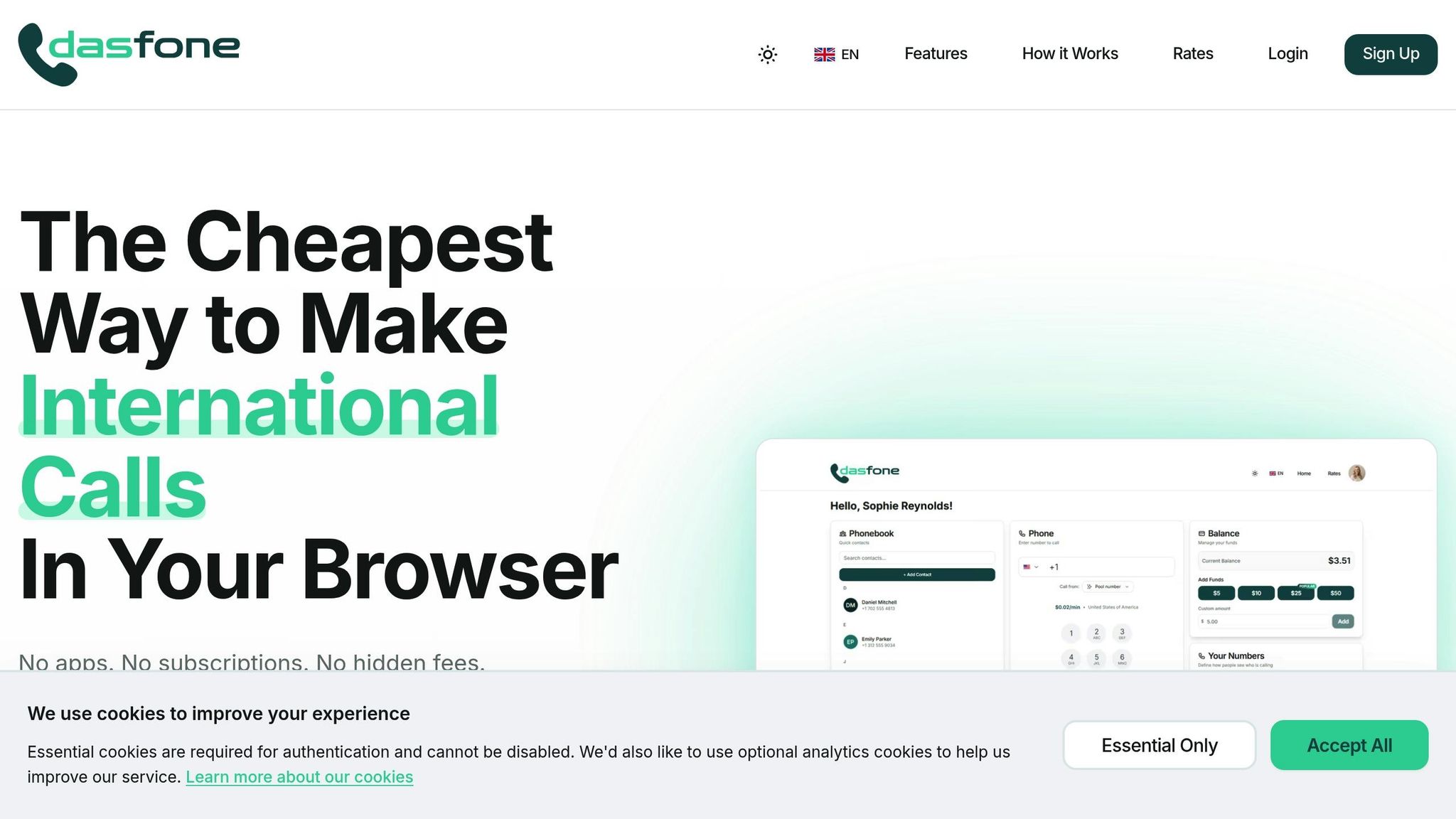
Browser-based calling platforms make international calls easy and affordable by letting you connect directly through your web browser - no extra apps or hardware needed. These services rely on WebRTC (Web Real-Time Communication) and VoIP (Voice over Internet Protocol) technology, which routes calls over the internet instead of traditional phone networks. By skipping traditional carriers, you can avoid hefty international fees.
Getting started is straightforward. All you need is a device with a modern browser (like Chrome, Firefox, Edge, or Safari) and a reliable internet connection. There's no need for SIM cards, physical calling cards, or special equipment[6]. Whether you’re using a laptop, desktop, or smartphone, you can set up and make calls within minutes. For the best experience, ensure your internet connection is stable - testing with a quick call can help confirm clarity before longer conversations. This simple setup means you can start saving money almost immediately.
Here’s an example that highlights the savings: In March 2025, AARP technology writer Edward C. Baig shared that a 26-minute call to the United Kingdom on a standard carrier plan cost $87.81, including taxes. Using a browser-based service, the same call would cost just $0.01 per minute - or $0.26 total - saving over 99% on the call[5]. Typically, these services charge between $0.01 and $0.02 per minute for major international destinations, compared to traditional carriers' rates of $3.50 to $5.00 per minute[1][5].
Another advantage? These platforms are incredibly data-efficient, using only 0.2 to 0.5 MB of data per minute. You can call both landlines and mobile numbers directly - just add a small amount of credit, dial the number, and connect. It’s that simple.
2. Switch to VoIP Services for Lower Per-Minute Rates
If you're looking to cut costs on international calls, switching to VoIP (Voice over Internet Protocol) services is a smart move. This technology works by converting your voice into digital data packets and sending them over the internet, bypassing the need for costly physical infrastructure. The result? A significant reduction in overall expenses[8]. For context, traditional carriers often charge between $3.00 and $5.00 per minute for international calls, while VoIP services can bring that number down to as little as $0.01 to $0.02 per minute[8].
The savings can add up quickly. For example, in March 2025, Edward C. Baig, a technology columnist for AARP, highlighted the stark difference in costs for a 5-minute call from the U.S. to Australia. On a traditional network, the call cost $16.89 ($3.38 per minute). In contrast, the same call using VoIP was just $0.05, at $0.01 per minute[5].
VoIP services also offer another cost-saving perk: virtual phone numbers. Let’s say you frequently call family in the United Kingdom. With a VoIP provider, you can purchase a British virtual number. This means calls to that number are treated as local calls, not international ones, saving you even more money[8].
"The biggest advantages of making international calls using VoIP is that you can choose to purchase a phone number in another country... that way, every time you call your relatives... it's charged as a local call, not an international call" - Dave Roos, HowStuffWorks[8]
Beyond the low per-minute rates, many VoIP providers offer free in-network calls. Plus, if you're traveling and connected to Wi-Fi, you can avoid hefty international roaming fees. Even calls to landlines and mobile numbers remain far more affordable with VoIP than with traditional carriers.
3. Choose Pay-As-You-Go Pricing Models
Pay-as-you-go pricing is straightforward: you’re charged only for the minutes you use, without any monthly fees or long-term commitments. This model is ideal for those who make international calls occasionally rather than regularly. The Federal Communications Commission highlights that basic rate calling can be a cost-efficient choice for people who don’t need a dedicated calling plan [1].
The key advantage here is avoiding wasted payments for unused minutes. Monthly international plans typically cost between $5.00 and $15.00 and include a set number of minutes - often 300 or more [1]. If you’re someone who only uses a small fraction of those minutes, you could end up paying for time you’ll never use. For instance, if you need just 20 minutes of international call time, spending $10.00 for 300 minutes doesn’t make much sense.
This is where pay-as-you-go shines. It’s a practical choice, especially for lighter users, and platforms like dasfone have embraced this model, offering browser-based services with transparent pricing and no monthly fees.
When comparing traditional rates to VoIP (Voice over Internet Protocol) options, the cost difference is staggering. For example, AT&T charges up to $5.00 per minute for basic rate calls to China and India [1]. Meanwhile, VoIP services charge as little as $0.01 to $0.02 per minute for the same destinations - saving you over 99% on international calls.
To put it into perspective, a monthly plan only makes sense if you use enough minutes to justify the cost. At a $6.00 plan rate, with calls dropping from $1.55 to $0.05 per minute, you’d need to use at least four minutes per month for the plan to break even [1]. For those who make fewer calls, pay-as-you-go is the clear winner.
Browser-based platforms like dasfone further simplify things. You can top up your account with as little as $5.00 and pay only for the minutes you actually use. This approach is part of a broader shift toward cost-effective and flexible communication solutions.
Here’s a quick comparison of rates across different services:
| Destination | Traditional Basic Rate (No Plan) | Monthly Plan Rate (with $5–$10 fee) | VoIP Pay-As-You-Go (No fee) |
|---|---|---|---|
| Canada | $1.55/min | $0.05/min | $0.023/min |
| China | $5.00/min | $0.11–$0.15/min | $0.020/min |
| India | $5.00/min | $0.28/min | $0.015/min |
| UK | $3.50/min | $0.08/min | $0.023/min |
Source: FCC [1]
4. Use Least Cost Routing Technologies
Least cost routing (LCR) is a smart technology that helps cut down the cost of international calls by automatically picking the most affordable route. It works by analyzing the destination of your call and then selecting the least expensive carrier path available [4]. When paired with browser-based platforms and VoIP, LCR can further shrink international calling expenses. It’s an automated solution that fits seamlessly with the VoIP and browser-based tools mentioned earlier.
Here’s the deal: Traditional international calls often pass through a series of intermediary networks. These intermediaries handle the call transfer between countries, and each one charges a termination fee for using its infrastructure [9]. These fees can pile up fast, which is why standard rates from traditional carriers can range anywhere from $3.00 to $5.00 per minute [4][5]. LCR, often built into VoIP and cloud-based systems, can drastically lower these per-minute rates [5].
One of the best parts about LCR is that it works quietly in the background. Some apps will even notify you when LCR activates to secure a cheaper rate [11]. Once the system is set up, there’s no need for you to manually intervene - the platform takes care of everything [11].
For businesses, using virtual local numbers (Direct Inward Dialing) is another way to save. These numbers allow incoming calls to be routed locally, reducing costs [4]. However, keep in mind that calls to mobile phones are generally more expensive than those to landlines. It’s always a good idea to review your provider’s specific mobile termination rates to avoid surprises [1][4].
5. Consider Flat-Rate or Unlimited International Plans
If you make international calls often, flat-rate plans can save you money by offering a steady, predictable cost instead of high per-minute charges. The challenge is figuring out when paying for a monthly subscription makes sense compared to sticking with standard rates.
Without a plan, international calls can cost anywhere from $3.50 to $5.00 per minute to countries like China, India, or the United Kingdom [1]. However, a monthly discount plan - like AT&T's Worldwide Value Calling for $5.99 per month - can drop those rates to about $0.08 per minute [1]. That means the plan pays for itself in just a couple of minutes of talk time.
Even if you don’t call internationally very often, a flat-rate plan can still save you money. For example, a 5-minute call to Australia on a standard plan might cost around $16.89 [5]. In contrast, Verizon's World Plan 300, which costs $10 per month, offers 300 minutes of international calling [1]. If your per-minute costs add up to more than the plan’s monthly fee, it’s worth signing up. Just make sure the plan covers the countries you call most frequently.
Keep in mind that not all flat-rate or "unlimited" plans are the same. For instance, T-Mobile’s $15 per month Stateside International plan includes unlimited calls to landlines in over 70 countries and mobile numbers in about 30 countries. However, calls to places outside this coverage area are still billed per minute [5]. Also, calling mobile numbers internationally usually costs more than calling landlines [1].
For businesses or individuals who make a lot of international calls, unlimited plans can simplify budgeting by providing a fixed monthly expense. Just double-check that your most-called destinations are included in the plan to avoid surprise charges.
6. Eliminate Hardware and Setup Costs with Cloud Solutions
Gone are the days of bulky PBX hardware, specialized desk phones, and tangled professional wiring. With cloud-based calling, all you need are the devices you already own - whether that's a smartphone, laptop, tablet, or desktop. This shift eliminates equipment expenses, technician visits, and ongoing maintenance fees. It’s a straightforward way to simplify setup and daily operations.
"Unlike the old-school bulky phone setup, business VOIP is a perfect phone solution for small businesses. You can cut down traditional phone costs while getting a more powerful business phone system." - WPBeginner Editorial Staff [13]
Setting up a professional phone system has never been easier. With web-based platforms, you can configure everything digitally in just minutes - no on-site installation required. For example, tools like dasfone operate directly in your browser, so there’s no need to download extra software. Adding lines or extensions is as simple as updating your dashboard, making it a breeze to scale as your business grows.
By switching to cloud-based calling, you not only save on upfront hardware costs but also avoid the hassle of repairs, upgrades, or updates - those are all handled by your provider. The financial benefits are significant: businesses that adopt VoIP can slash monthly phone bills by more than 50% [13]. Plus, about 65% of long-distance calls in the U.S. now rely on VoIP or internet-based services.
Before making the switch, take a moment to review your team’s current devices. Most modern laptops and smartphones are fully compatible with softphone apps, meaning you can make the transition without purchasing additional hardware. This ensures you maximize savings while upgrading to a more efficient system.
7. Review Your Calling Patterns to Find Savings
Your phone bill can be a goldmine of information when it comes to finding out where you're overspending. A quick look at your call records might uncover "basic rate" charges - those steep, non-discounted fees that apply if you're not signed up for a specific plan. These basic rates can soar as high as $5.00 per minute, while a monthly plan could drop that cost to around $0.11 per minute[1]. Spotting these charges in your call history is the first step toward cutting down on unnecessary expenses.
Start by pinpointing the countries you call the most and whether you're dialing landlines or mobile phones. Keep in mind that calls to mobile numbers often come with higher surcharges. If you notice even a few calls billed at basic rates, switching to a monthly plan costing $5–$15 could slash your per-minute costs by more than 90%[1][5].
"The difference between basic rates and rates for other international calling options may be substantial." - Federal Communications Commission [1]
Also, make sure your calls are routed through the service you’ve chosen. For instance, if you’re using an app like Google Voice, you should hear a cost-per-minute announcement at the beginning of each call. If you don’t, your call might be going through your mobile carrier instead, which could lead to significantly higher charges[11]. Watch out for international roaming fees as well - they may not show up on your bill until the next billing cycle[3].
To stay ahead, take advantage of your carrier’s real-time tracking tools to monitor your usage during the billing cycle. Keeping an eye on your activity helps ensure you stay within your plan’s limits and avoid any surprise overage charges.
Cost Comparison Table
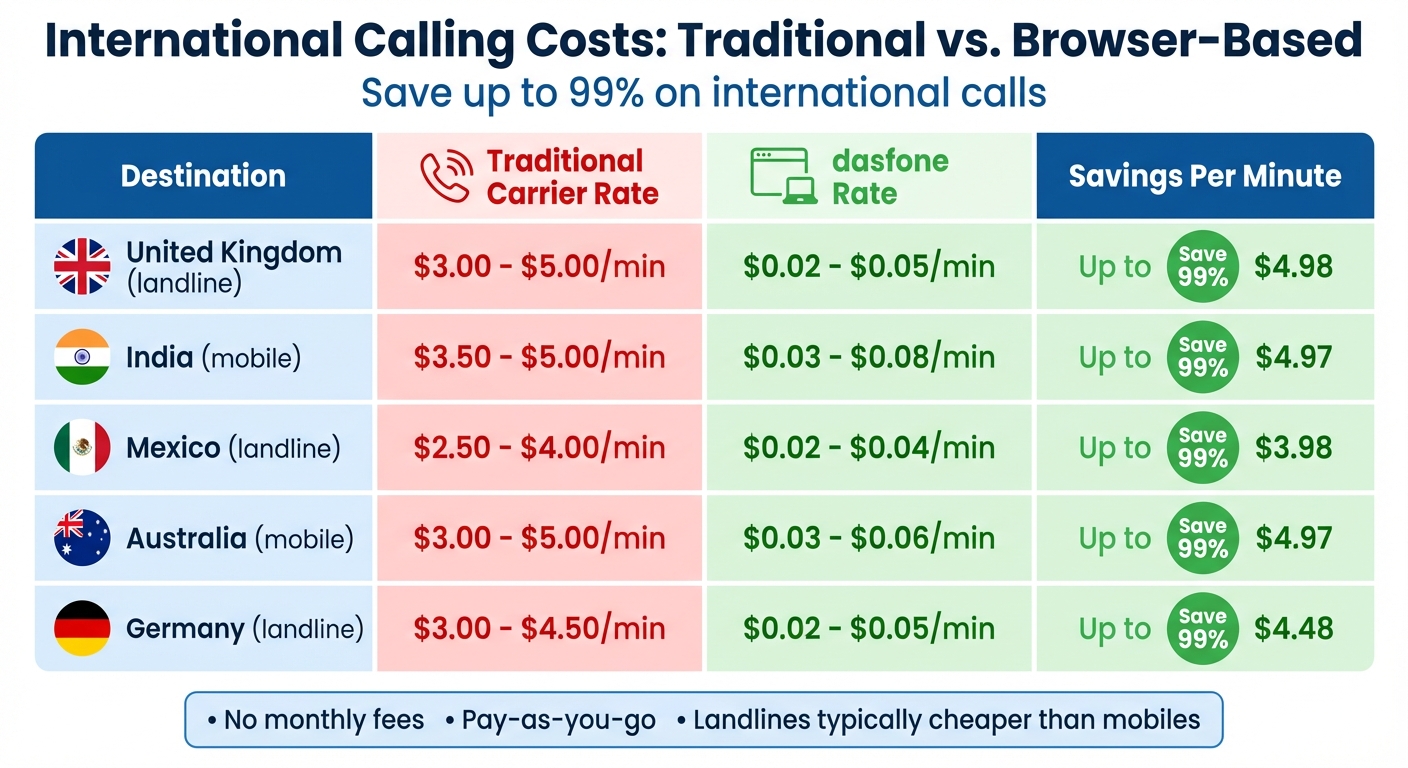
Traditional carriers often charge over $3.00 per minute for international calls. In contrast, dasfone's browser-based platform uses internet routing to bypass intermediary fees, slashing rates by up to 75× [14]. Here's a breakdown of the cost differences for popular international destinations:
| Destination | Traditional Carrier Rate | dasfone Rate | Savings Per Minute |
|---|---|---|---|
| United Kingdom (landline) | $3.00 - $5.00 | $0.02 - $0.05 | Up to $4.98 |
| India (mobile) | $3.50 - $5.00 | $0.03 - $0.08 | Up to $4.97 |
| Mexico (landline) | $2.50 - $4.00 | $0.02 - $0.04 | Up to $3.98 |
| Australia (mobile) | $3.00 - $5.00 | $0.03 - $0.06 | Up to $4.97 |
| Germany (landline) | $3.00 - $4.50 | $0.02 - $0.05 | Up to $4.48 |
This table highlights the substantial savings you can achieve with dasfone. For example, calling a landline in the United Kingdom could cost as little as $0.02 per minute compared to up to $5.00 with a traditional carrier. Plus, with dasfone's pay-as-you-go model, there are no monthly fees or hidden charges - just straightforward pricing for every call [1][4][9][14].
Note: Calling landlines is typically cheaper than calling mobile numbers.
Conclusion
Staying connected across borders doesn’t have to break the bank. The seven strategies covered here show how shifting away from traditional networks can slash costs - from a steep $5.00 per minute to as little as 2 cents per minute [1]. This kind of savings is a win for both individuals and businesses.
For businesses, VoIP systems and virtual numbers offer a polished, professional touch, while individuals can enjoy the predictability of pay-as-you-go or flat-rate plans. As the Federal Communications Commission points out, "the difference between basic rates and rates for other international calling options may be substantial" [1].
Taking a closer look at your calling habits helps identify where you might be overspending, making it easier to pick the right plan - whether that’s using dasfone’s browser-based platform for low per-minute costs, opting for an unlimited monthly plan, or combining a few strategies to fit your needs.
With over 6.2 billion international calls made from the U.S. each year [2], affordable global communication isn’t just a luxury - it’s a necessity. These approaches put you in control of your expenses while ensuring clear, reliable connections worldwide. By incorporating these methods, you can make international calling a seamless and cost-effective part of your routine.
FAQs
How does browser-based calling save money compared to traditional phone carriers?
Browser-based calling, powered by VoIP technology, offers a much cheaper alternative to traditional phone carriers, especially for international calls. While traditional carriers often charge steep per-minute rates or require pricey monthly plans - sometimes costing upwards of $1.50 per minute - browser-based services take advantage of internet connectivity to significantly cut costs. In many cases, calls can be made for just a few cents per minute.
Some services even go a step further by offering free calls to specific regions or landlines, particularly within the U.S. and Canada. By using the internet to sidestep traditional carrier fees, these platforms make staying connected across the globe more affordable.
What are the advantages of using VoIP for international calls?
VoIP services stand out for their ability to slash costs on international calls compared to traditional landlines or mobile services. By routing calls over the Internet instead of conventional phone networks, VoIP providers can offer rates that are often just a few cents per minute, depending on where you're calling.
Another advantage is how adaptable it is. With VoIP, you can make calls using a variety of devices - whether it’s a smartphone, computer, or even a standard phone hooked up to a VoIP adapter. This means you can stay connected no matter where you are, whether at home, in the office, or traveling. Plus, many VoIP providers let you select a local or international number, which helps you avoid steep roaming and long-distance charges.
For anyone aiming to keep communication costs low, VoIP offers an affordable and flexible way to stay connected across the globe.
When does it make sense to choose a flat-rate plan instead of pay-as-you-go pricing for international calls?
A flat-rate plan might be the way to go if you make frequent international calls, especially to the same countries. These plans often offer unlimited or deeply discounted minutes to specific destinations, which can help you save a lot compared to paying per minute.
For those who regularly keep in touch with friends, family, or business contacts overseas, a flat-rate plan makes it easier to manage your budget while steering clear of surprise charges. However, if your international calls are occasional or short, a pay-as-you-go option could end up being the more economical choice.
Related Articles
Ready to Make International Calls?
Try dasfone today and make your first international call in seconds. No app download, no subscription—just instant, affordable calling from your browser.
Start Calling Now