Bulk VoIP Credits vs. Pay-As-You-Go
Bulk VoIP Credits vs. Pay-As-You-Go
Looking to save on international calls? Here's the deal: Bulk VoIP credits and Pay-As-You-Go (PAYG) are two popular ways to cut costs, but they work best for different needs.
- Bulk VoIP Credits: Prepaid bundles offering lower per-minute rates. Great for businesses or high-call volumes but come with risks like unused credits expiring.
- PAYG VoIP Plans: Flexible, no contracts, and you pay only for what you use. Perfect for individuals, small teams, or unpredictable call patterns.
Quick takeaway: If you make over 200 minutes of calls monthly, bulk credits can save money. For fewer calls or irregular usage, PAYG is the smarter choice.
Quick Comparison
| Feature | Bulk VoIP Credits | Pay-As-You-Go (PAYG) |
|---|---|---|
| Upfront Cost | High (prepaid bundles) | Low (small top-ups) |
| Per-Minute Cost | Lower with high usage | Fixed, varies by destination |
| Unused Credit Risk | Credits may expire | Minimal (longer validity) |
| Flexibility | Fixed allowance | Pay only for usage |
| Best For | High-volume callers | Lower or unpredictable usage |
Choose based on your call volume and destination costs. PAYG suits most individuals, while bulk plans shine for businesses with consistent, heavy usage.
Pay-as-you-go vs Prepaid VoIP: Which Fits Your Business Best?
How Bulk VoIP Credits Work
Bulk VoIP credits operate like a prepaid balance, deducting minutes or seconds as calls are made. Each call reduces the balance based on the provider’s rate - whether billed per minute or per second. Many platforms include real-time tracking, allowing users to monitor call durations, destinations, and costs in detail. This transparency makes it easier to manage expenses and usage.
Key Features of Bulk VoIP Credit Plans
One standout feature is auto-recharge, which automatically adds more credits when your balance drops below a set amount (e.g., $5). This ensures uninterrupted service during peak call times [4]. Another useful option is the ability to share credits across a team from one central pool. Instead of assigning individual allowances, this shared approach adapts to varying call needs among team members, avoiding wasted resources.
Billing increments also play a big role. Providers differ in how they bill: some round up to the nearest minute, others charge by the second, and some even include a connection fee of $0.05–$0.15 per call [1]. These small details highlight how bulk credits can help businesses cut down on international call costs compared to pay-as-you-go (PAYG) plans.
Benefits of Buying Bulk VoIP Credits
The biggest draw of bulk VoIP credits is their cost efficiency. These plans offer access to wholesale per-minute rates that were once reserved for large corporations. For example, rates for high-volume destinations like the US and UK can go as low as $0.008 per minute [5]. Another advantage is avoiding the flat fees of per-seat licensing, where you pay for every employee regardless of their call activity.
"You don't pay for utilities like water and electricity per user, so why would you with your phone service?" - Telzio [3]
This pay-per-use model is especially beneficial for call centers or sales teams using auto-dialers. With high call volumes, even small per-minute savings can lead to significant cost reductions.
Downsides of Bulk VoIP Credits
One major drawback is the risk of unused credits. If your call volume decreases unexpectedly, you might end up with unused credits that many providers expire after 90–180 days [1]. This can tie up funds in a balance you may not fully use. Additionally, bulk plans are only cost-effective if your team consistently makes over 200 minutes of international calls per month [1]. For lower call volumes, PAYG plans are typically a better option. To avoid overspending, it’s important to calculate your average monthly usage and compare it to PAYG rates to ensure the bulk discount provides real savings.
How Pay-As-You-Go VoIP Works
Pay-As-You-Go (PAYG) VoIP operates on a simple concept: you load a balance and pay only for the minutes you use. There's no monthly fee, no contract, and no penalties for inactivity. Think of it like your electricity bill - you’re charged based on what you consume, rather than paying a flat rate regardless of usage [3].
Key Features of Pay-As-You-Go VoIP Plans
The billing structure of PAYG VoIP is straightforward and usage-based. Calls are charged per minute, with rates varying by destination. Some providers even bill in 6-second increments, avoiding the cost of rounding up to a full minute, which is especially helpful for short calls [2]. Additionally, many plans skip hidden connection fees and allow for flexible top-ups.
With browser-based PAYG services, there’s no need to download apps or use a SIM card. All you need is a Wi-Fi connection, and you can start making calls from virtually any device [1].
One thing to watch out for is credit expiration. Depending on the provider, your balance might expire 6 to 12 months after purchase, so it’s wise to check validity before topping up [2]. To test the waters, new users should consider starting with a small balance to evaluate call quality, especially since most providers don’t refund unused credits [2]. These features make PAYG VoIP an excellent option for those looking to control their communication costs.
Benefits of Pay-As-You-Go VoIP
One of the biggest advantages of PAYG VoIP is cost control. For instance, international VoIP rates can drop as low as $0.02 per minute for calls to the US or Canada - that’s up to 15 times cheaper than traditional carrier rates [1]. Picture this: if you call the UK twice a week for 10 minutes each time, at $0.03 per minute, your monthly cost would be around $2.40. Compare that to a typical $20/month international calling plan, and the savings are clear [1].
Another perk? There’s no "fair use" cap. With PAYG, you’re only charged for what you use, and there’s no risk of having your service suspended for exceeding any hidden limits [3].
"PAYG VoIP earns its keep when your calling volume is irregular. If you call internationally a few times a week... a subscription at $15–$25/month almost never makes financial sense." - GlobCall Team [1]
For users with unpredictable calling habits, PAYG VoIP is a smart choice.
Who Should Use Pay-As-You-Go Plans
Thanks to its flexibility and cost-saving potential, PAYG VoIP suits a variety of users. It’s perfect for students who call home occasionally, digital nomads who need to stay connected internationally without racking up roaming fees, and small businesses with fluctuating communication needs. Even within companies, departments like accounting or development - where phone use might be minimal - can share a PAYG balance instead of paying for a flat-rate plan for each employee [3]. This shared approach ensures teams only pay for the minutes they actually use [1].
| User Type | Why PAYG Works |
|---|---|
| Students & expats | No subscription required; pay only for calls home |
| Digital nomads | Browser-based calling avoids roaming charges completely |
| Small businesses | Shared balance eliminates costs for unused seats |
| Low-volume staff (e.g., developers) | Avoids wasting money on unused monthly minutes |
Bulk VoIP Credits vs. Pay-As-You-Go: A Direct Comparison
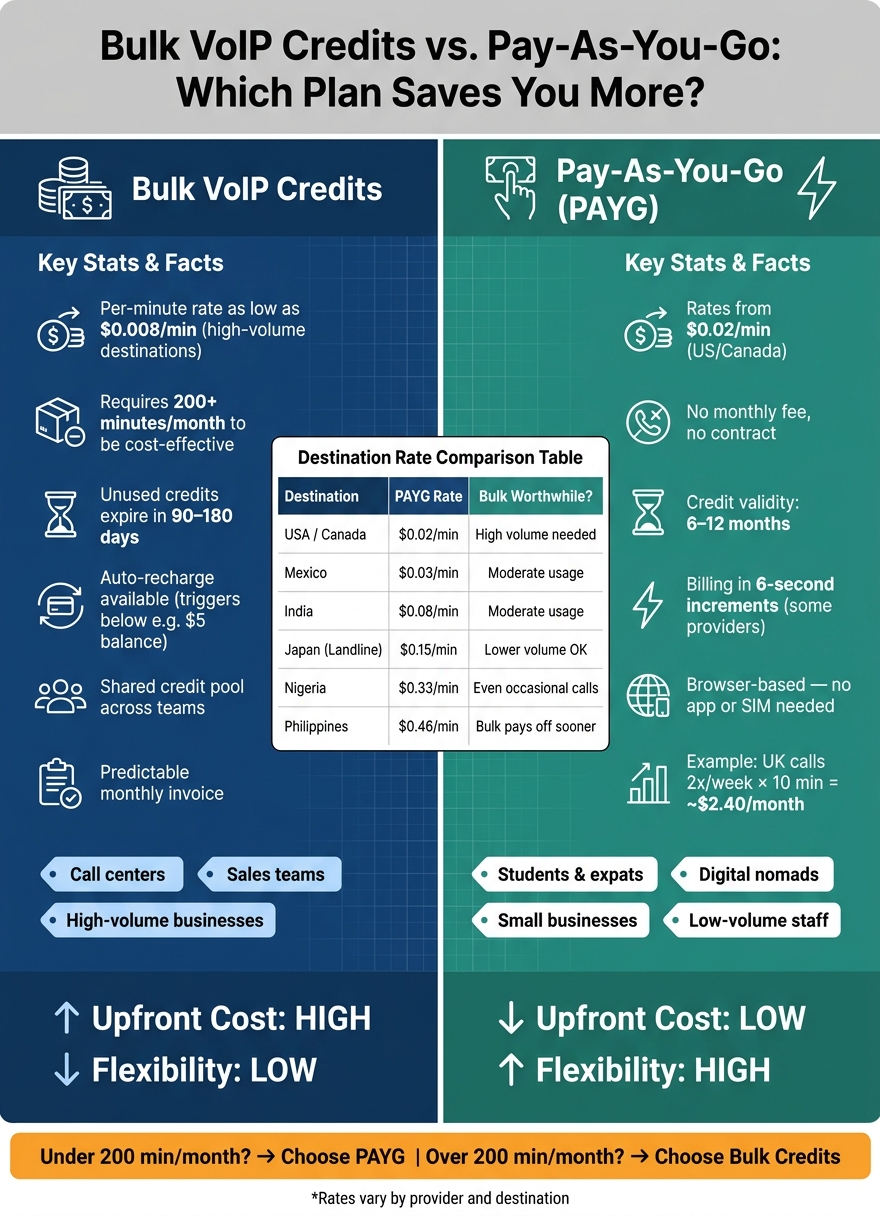
Pricing and Cost per Minute
The main distinction between these two payment models lies in how and when you pay. Pay-As-You-Go (PAYG) allows you to add a small balance and pay per minute, with rates varying by destination. For example, some routes start as low as $0.02 per minute [1]. On the other hand, bulk plans become more economical if your usage exceeds 200 minutes per month [1]. For users below that threshold, PAYG typically offers better value.
| Destination | PAYG Rate | Bulk Plan Consideration |
|---|---|---|
| USA / Canada | $0.02/min | High volume needed to justify a flat fee |
| Mexico | $0.03/min | Moderate usage needed |
| India | $0.08/min | Moderate usage needed |
| Japan (Landline) | $0.15/min | Lower volume can justify bulk |
| Nigeria | $0.33/min | Even infrequent calls can become costly |
| Philippines | $0.46/min | Bulk plan may pay off sooner |
For destinations with higher rates, like Nigeria or the Philippines, even occasional calls can make a bulk plan worthwhile since the per-minute costs add up quickly [1]. Now, let’s consider how these models handle changing call demands.
Flexibility and Ease of Use
When it comes to adaptability, PAYG is the clear winner. It allows you to:
- Call various countries as needed.
- Adjust spending based on actual usage.
- Pay only for the minutes you use.
In contrast, bulk plans lock you into a fixed allowance, meaning unused minutes go to waste if you don’t meet your quota [6].
"The worst decision is the default one - accepting whatever plan your provider initially quoted without analyzing your usage." - Connection Technologies [6]
While bulk plans offer the convenience of a predictable monthly invoice, they lack the transparency of PAYG, which lets you track usage and share a unified balance across teams. PAYG also works seamlessly with browser-based services, eliminating the need for apps or SIM cards. However, for those who value simplicity over flexibility, bulk plans may still appeal [1][6].
Side-by-Side Comparison Table
| Factor | Pay-As-You-Go | Bulk / Inclusive Plans |
|---|---|---|
| Upfront Cost | Low (small top-ups) | Higher (fixed monthly fee) |
| Cost per Minute | Fixed (varies) | Decreases with high volume |
| Unused Credit Risk | Possible expiration | Wasted minutes if unused |
| Cash Flow Impact | Flexible; pay as needed | Fixed monthly cost |
| Administrative Simplicity | Shared balance; no per-seat fees | Predictable invoice; often seat-based |
| Ideal Call Volume | Under 200 min/month | Over 200 min/month |
Which Model Fits Each Use Case?
Choosing the right model depends entirely on your usage patterns. Here’s a breakdown of what works best for different types of users:
| User Type | Recommended Model | Rationale |
|---|---|---|
| Expats & Casual Callers | Pay-As-You-Go | Infrequent calls don’t justify monthly fees. |
| International Students | Pay-As-You-Go | Flexible, no contracts; perfect for occasional use. |
| Digital Nomads & Travelers | Pay-As-You-Go | Browser-based calling avoids roaming charges. |
| High-Volume Call Centers | Bulk / Inclusive | Significant call volumes reduce per-minute costs. |
| Sales Teams | Bulk / Inclusive | Predictable daily use benefits budget planning. |
| Mixed Business Teams | Hybrid Approach | Combines bulk for heavy users and PAYG for others. |
For teams with mixed calling needs, a hybrid strategy works well. Assign bulk plans to heavy users while keeping a shared PAYG balance for occasional callers. This way, you avoid wasting unused minutes while keeping costs manageable.
How to Choose the Right Model
Key Factors to Consider
When deciding on a plan, think about your call volume, the predictability of your usage, and the costs of your call destinations. If you use fewer than 200 minutes per month, pay-as-you-go is typically the smarter choice. Subscriptions only start to make sense financially if your usage consistently exceeds that threshold [1].
The cost of your call destinations is just as important as your call volume. For example, occasional calls to low-cost destinations won't add up to much. But if you're frequently calling high-cost destinations like the Philippines (at $0.46 per minute), even a few calls each week could make a bulk plan more economical.
One thing to keep in mind: unused bulk credits might expire, so always check your provider's policy before committing [1].
Recommendations by User Type
Your choice should align with your specific needs and usage patterns. Here's a breakdown:
Individuals and small teams (like expats, students, or digital nomads): Pay-as-you-go is ideal because it avoids contracts, monthly fees, and the risk of unused minutes.
Businesses: The best option depends on your team's roles. For example, sales reps might rack up over 1,000 minutes each month, while developers or finance staff might barely hit 100 [3]. Instead of paying per-user "seat" fees, a shared pay-as-you-go balance allows the whole team to draw from one pool, so you only pay for actual usage. As Telzio explains:
"Unlimited calling may sound appealing, but it almost always comes with important caveats... there's no such thing as 'unlimited' usage because of what's called a 'fair use policy'." [3]
- High-volume call centers: If your traffic is both high and predictable, bulk plans are often the most cost-effective. The per-minute savings become significant when you're dealing with thousands of minutes each month.
These examples highlight why flexibility is key when choosing a plan.
How Dasfone Makes International Calling Simpler
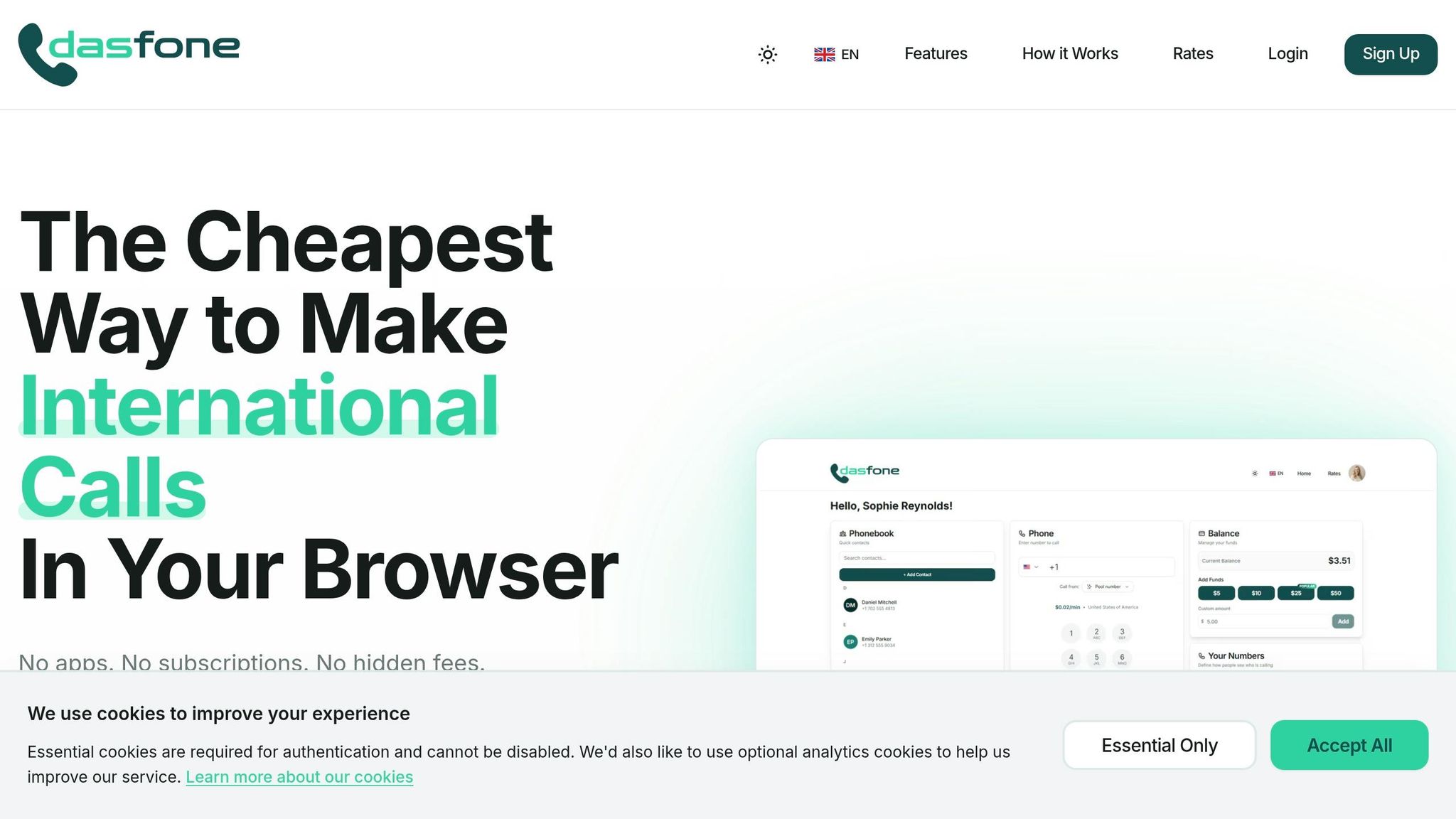
Dasfone offers a straightforward, browser-based platform to make international calling easier, whether you prefer pay-as-you-go or need a solution for varying call volumes. With Dasfone, you can make HD-quality calls from any device as long as you have a stable internet connection - whether you're working from a desk in Chicago or using Wi-Fi at a hotel overseas.
Their pricing is transparent, starting at $0.02 per minute for calls to the US and Canada. To get started, there's a $5 minimum top-up, and new users receive a $2 sign-up bonus - enough for up to 100 minutes of calls to low-cost destinations. Plus, first-time users can enjoy a 25% discount on their first top-up with the code DF25. For businesses, Dasfone's shared balance feature allows you to add team members without extra per-seat fees, making it a practical option for teams that want flexibility without the commitment of a bulk plan.
Conclusion: Which Option Is Right for You?
Choosing the best option depends on how consistently you make international calls.
For those who make occasional or unpredictable calls abroad, pay-as-you-go (PAYG) is a solid choice. With rates starting as low as $0.02 per minute for calls to the US and Canada - and no monthly fees or expiring credits - it’s hard to beat for flexibility. As the GlobCall team explains:
"PAYG VoIP earns its keep when your calling volume is irregular. If you call internationally a few times a week... a subscription at $15–$25/month almost never makes financial sense." [1]
If you’re regularly clocking over 200 minutes a month, especially to pricier destinations, bulk credits can help lower your per-minute costs and simplify billing. This approach is particularly appealing for call centers or sales teams handling high call volumes - it’s a numbers game that works in their favor.
For most individuals, expats, students, and small teams, PAYG stands out for its flexibility and cost-effectiveness. On the other hand, larger businesses might benefit more from a shared pool of minutes rather than opting for per-seat "unlimited" plans, which often come with fair use limits that restrict actual usage [3]. Reviewing your call history can help pinpoint the most economical choice for your needs.
FAQs
How do I calculate my break-even point for bulk credits vs. pay-as-you-go?
To figure out your break-even point, start by comparing the per-minute costs of bulk credits versus pay-as-you-go rates. Here's how:
- Calculate the per-minute rate for the bulk package by dividing its total cost by the number of minutes included.
- Use this formula to find the break-even point: Break-even minutes = Bulk package cost / Pay-as-you-go rate.
If your usage exceeds the break-even minutes, bulk credits will save you money. On the other hand, if you use fewer minutes, sticking with the pay-as-you-go option is the better deal.
Do VoIP credits expire, and how can I avoid losing unused balance?
VoIP credits usually remain active as long as they're being used. However, some providers might deactivate your balance if there's no activity for a certain period, like six months. To keep your credits safe, make sure to use them regularly. If your balance does become inactive, reaching out to customer support can often help reactivate it. Always review your provider’s terms to understand their rules on credit expiration and activity requirements.
What hidden fees should I check for (billing increments, connection fees, fair use)?
When deciding between bulk VoIP credits and pay-as-you-go plans, it’s crucial to keep an eye out for potential hidden fees. These can include billing increments, connection fees, and fair use policies.
- Billing increments: Some providers round up call durations, meaning you might pay for time you didn’t actually use.
- Connection fees: These are per-call charges that can add up quickly, especially with high call volumes.
- Fair use policies: These could impose limits on your usage or tack on extra costs if you exceed certain thresholds.
If you’re opting for bulk credits, make sure to check for expiration dates or minimum purchase requirements. Carefully reviewing these details can help you avoid surprise charges and get the most value for your money.
Related Articles
Ready to Make International Calls?
Try dasfone today and make your first international call in seconds. No app download, no subscription—just instant, affordable calling from your browser.
Start Calling Now