Top 7 Cultural Factors to Consider in Cold Calling
Top 7 Cultural Factors to Consider in Cold Calling
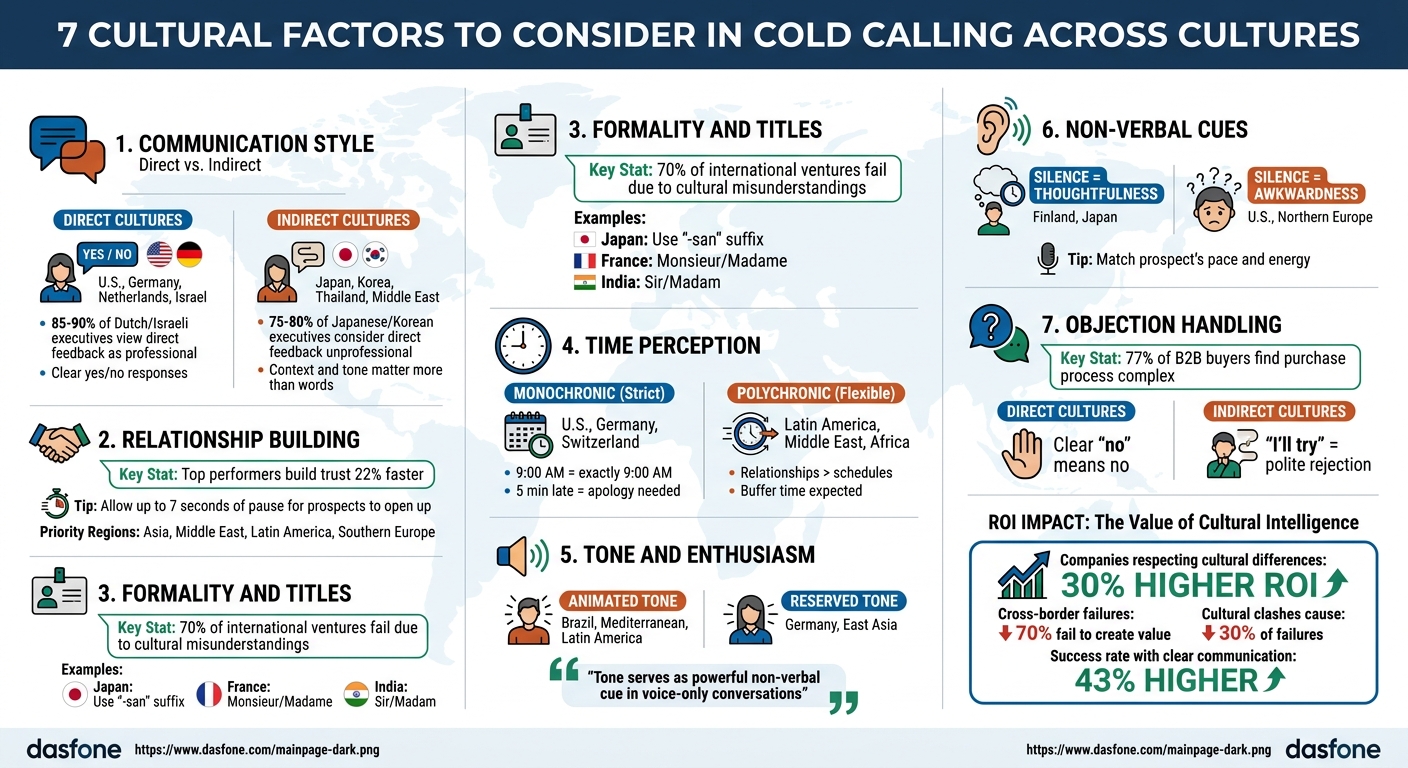
Cold calling across different regions isn't one-size-fits-all. Success hinges on understanding how cultural norms shape communication, relationships, and business etiquette. A pitch that works in one country might fail - or even offend - in another. Here’s what you need to know:
- Communication Style: Direct cultures (e.g., U.S., Germany) value clarity, while indirect ones (e.g., Japan, Middle East) rely on subtle cues.
- Relationship Building: In some regions, trust must be built before discussing business.
- Formality and Titles: Using correct names, titles, and avoiding slang shows respect.
- Time Perception: Punctuality matters in some places; flexibility in others.
- Tone and Enthusiasm: Adjust your tone to match local preferences - animated in Brazil, reserved in Germany.
- Non-Verbal Cues: Silence can mean thoughtfulness in Japan but awkwardness in the U.S.
- Objection Handling: Direct refusals differ from polite rejections. Listen closely to interpret intent.
Quick Tip: Use local caller IDs to increase answer rates and avoid missteps by researching norms before calling. Small adjustments can lead to better connections and higher success rates.
1. Communication Style
Communication styles can differ widely depending on the region. In countries like the U.S., Germany, The Netherlands, and Israel, people often favor a direct approach. A "yes" typically means agreement, while a "no" is a clear refusal. This approach prioritizes efficiency and straightforwardness, respecting the other person’s time by eliminating ambiguity.
On the other hand, many Eastern and Middle Eastern cultures rely more on tone, context, and subtle cues to convey meaning. In places like Japan, Korea, Thailand, and much of the Middle East, a "yes" might simply indicate acknowledgment rather than commitment. Similarly, phrases such as "I will try my best" can sometimes act as polite refusals without directly saying "no."
Research highlights these differences clearly: about 85–90% of Dutch and Israeli executives view direct negative feedback as professional, while 75–80% of Japanese and Korean executives consider it unprofessional [2]. Interestingly, indirect communicators often recall the emotional impact of blunt feedback but may struggle to remember its content. In contrast, those from direct cultures tend to focus on the words themselves while missing any emotional undertones [2].
"The most important thing in communication is hearing what isn't said." – Peter Drucker [2]
For those accustomed to indirect communication, pay attention to signs of hesitation or less definitive language. If you're dealing with direct communicators, ensure clarity by stating your points plainly and following up with a brief written summary to confirm understanding.
2. Relationship Building
Establishing trust is the cornerstone of successful cold calling, especially in cultures where business relationships are built on personal connections. In regions like Asia, the Middle East, Latin America, and parts of Southern Europe, trust isn't just a bonus - it's a prerequisite. Jumping straight into a sales pitch without laying the groundwork can come off as impersonal or even disrespectful. These cultural nuances call for a thoughtful and strategic approach.
The data supports this: top-performing salespeople build trust and credibility 22% faster than their peers. They do this by asking thoughtful questions and maintaining a calm, confident tone [6]. This ability to quickly establish rapport is crucial in relationship-driven cultures, where small talk often sets the stage for deeper conversations.
"Rapport is the invisible bridge between two people who trust each other enough to have an honest conversation. It's that moment when a prospect stops seeing you as a salesperson and starts seeing you as a partner." – Diego Mangabeira, HubSpot [6]
So, how can you build this bridge? Start with research. Look into your prospect's company - recent news, new hires, or regional projects. Mentioning these details shows you're prepared and genuinely interested, which is far more compelling than a cookie-cutter pitch. Approach the conversation with curiosity rather than immediately diving into product features. Ask about their challenges, and when you pose a question, give them time to respond. A pause of up to 7 seconds can encourage them to open up about concerns they might not have shared otherwise [6].
Taking the time to build rapport isn't just a courtesy - it’s a safeguard. Understanding cultural norms and prioritizing trust can help you avoid costly missteps or misunderstandings. In cultures that rely on indirect communication, having a relationship in place also makes it easier to pick up on subtle cues or hesitations that might otherwise slip by unnoticed [3]. Investing in these relationships pays off in more ways than one.
3. Formality and Titles
Getting someone's name and title correct is more than just good manners - it’s a smart move that can influence the success of your cold call. In fact, a study highlights that 70% of international business ventures fail because of cultural misunderstandings [7].
The expectations for addressing someone can differ greatly depending on the region. For instance, in Japan, adding “-san” after a name (like “Tanaka-san”) is a standard practice in business settings. In France, using “Monsieur” or “Madame” is customary until you’re invited to use first names. In India, calling someone “Sir” or “Madam” is seen as a sign of respect. Similarly, in many parts of Asia, the Middle East, and Europe, addressing people by their surname along with their professional title is the norm [5].
When you’re unsure, it’s always safer to start formal. Use “Mr./Ms. [Surname]” or the full first name (e.g., “Thomas” instead of “Tom”) unless the other person suggests otherwise. Asking something like, “Do you prefer Thomas, or do you go by Tom?” shows that you’re considerate of their preferences [5]. For international calls, taking the time to note phonetic pronunciations in your CRM can make a big difference. Using a tool to make international calls directly from your browser can streamline this process. Mispronouncing someone’s name, especially in cultures where formality and hierarchy are emphasized, can come across as careless.
Also, steer clear of American business slang like “win-win situation” or casual expressions like “dude” when speaking with international prospects. Such terms can confuse or even offend in more formal settings [5]. Instead, keep your language straightforward, professional, and free of unnecessary jargon. Showing this level of cultural understanding not only earns respect but also gives you a head start in building trust before you even begin your pitch [3].
4. Time Perception
How people perceive time can play a big role in the success of a cold call. In some cultures, time is treated like money - strict, valuable, and not to be wasted. In others, time is seen as more flexible, where building relationships takes priority over rigid schedules.
Monochronic cultures, such as those in the U.S., Germany, and Switzerland, operate with strict adherence to schedules. A 9:00 AM call in these cultures means starting exactly at 9:00 AM. For instance, in Germany, being five minutes late warrants an apology, and in Japan, even a one-minute delay calls for a formal acknowledgment [8]. When reaching out to prospects in these regions, it’s crucial to respect their time. Be efficient, get straight to the point, and minimize small talk.
On the other hand, polychronic cultures - common in Latin America, the Middle East, and Africa - have a more relaxed approach to time. A 9:00 AM call might not actually begin until 9:15 AM or later. In Brazil, arriving over an hour late to a two-hour event is generally no big deal [8]. Anthropologist Edward Hall captured this difference well:
"Time can sometimes convey content more clearly than words" [8].
When working with these cultures, it’s wise to build in buffer time and allow the conversation to flow naturally without rushing to a conclusion [8].
Understanding these cultural nuances can save you from making awkward or costly mistakes. For example, in India, waiting isn’t just tolerated - it can be a subtle signal of power. As Richard Brislin and Eugene Kim point out:
"The more power and influence you have, the longer you can make people wait for you" [8].
Adapting to these differences in time perception can help you build trust and rapport. Up next, we’ll explore how personal space and tone influence cross-cultural interactions.
5. Personal Space and Tone
On a call, your tone and enthusiasm take the place of physical personal space. What feels professional and engaging in one culture might come off as pushy, distant, or even rude in another.
Tone serves as a powerful non-verbal cue in voice-only conversations. As Meegle explains, "Cultural considerations go beyond translation. Non-verbal cues, tone, and context play significant roles" [3]. For instance, in Brazil, an expressive and animated tone helps build rapport and shows genuine interest. But that same level of energy might feel overly casual or even inappropriate to German executives, who often value a more reserved and professional tone [4].
In the U.S., directness often signals efficiency and clarity, but in regions like the Middle East or India, skipping small talk can be a misstep. In these cultures, engaging in friendly, personal conversation is an essential part of doing business. As Crystal highlights, "What's considered a formal, professional demeanor in one country might be seen as cold and unfriendly in another" [4].
Confidence is universally important, but how it's expressed varies widely. Luster notes, "When you begin a cold call sounding uncertain or nervous, your prospect is likely to pick up on it and may question the legitimacy of your offer or pitch" [1]. The trick is to adjust your tone to align with cultural expectations. In China, for example, a warmer, conversational tone fosters trust before diving into business discussions. In contrast, German professionals may prefer a more formal and detail-focused approach, allowing ample time for thorough analysis [3].
Ultimately, your tone and pacing should respect the psychological comfort zone of the person you're speaking with. This cultural sensitivity isn't just polite - it’s a strategic tool for building stronger connections across borders [3]. Understanding these nuances in tone sets the stage for interpreting other non-verbal cues, which we’ll explore next.
6. Non-Verbal Cues Over Phone
When you're on a voice-only call, the way you pause, pace your speech, and use vocal inflection can reveal a lot about your level of respect and engagement. These subtle vocal cues carry different meanings depending on the cultural context, and misunderstanding them can derail an otherwise productive conversation.
Take silence, for example. In Finnish and Japanese business settings, pauses often indicate thoughtful consideration or strategic thinking. But professionals in the U.S. or Northern Europe might perceive these quiet moments as awkward or as a sign that the conversation has stalled. If you jump to fill the silence during a call with a Japanese client, it could come across as pushy or even disrespectful. Instead, recognize that these pauses often signal careful decision-making. Paying attention to these nuances is as crucial as understanding communication styles.
Tone, pacing, and inflection also play a major role in how non-verbal cues are interpreted. In Mediterranean and Latin American cultures, animated vocal expressions are common and show enthusiasm and engagement. In contrast, East Asian cultures tend to value tonal restraint, where too much enthusiasm might come across as unprofessional. As Crystal wisely points out:
"Pay attention to cultural norms around body language, personal space, and other non-verbal cues. These can make or break your sales interactions" [4].
On a call, vocal cues like volume, rhythm, and inflection serve as stand-ins for body language. This is especially important in cultures like Japan, where non-verbal communication is closely observed. Even a small shift in your tone or something as subtle as an impatient sigh could be interpreted as disrespectful, regardless of how polite your words are. Crystal underscores this point:
"Not recognizing and adapting to these cultural differences can lead to a cascade of miscommunication, misunderstandings, and missed business opportunities" [4].
The best approach? Match your prospect’s pace and energy. By mirroring their vocal style, you demonstrate attentiveness and respect, which helps you navigate cultural nuances more effectively. These non-verbal signals complement your tone strategies, setting the stage for smoother objection handling and stronger commitment from your prospects.
7. Objection Handling and Commitment
How prospects voice objections or show commitment can differ widely across cultures, and misunderstanding these cues could cost you the deal. In more direct cultures like Germany, Israel, or the Netherlands, a "no" is typically clear and straightforward. On the other hand, in indirect cultures such as Japan, Thailand, or the Middle East, objections are often wrapped in polite phrases like "I will try my best" or "It is difficult", which are more likely polite rejections than promises to act.
Understanding these subtleties is crucial - 77% of B2B buyers describe the purchase process as complex, which can amplify hesitations [9]. For instance, in high-consideration cultures like Finland or Japan, silence after your pitch isn't indifference; it's a sign they're carefully weighing your proposal. If you rush to break that silence, you might come across as pushy or disrespectful. Recognizing these dynamics is key to handling objections effectively.
Instead of arguing against objections, acknowledge them. As Armand Farrokh notes:
"When you agree with the objection, it feels really dumb to keep fighting someone who isn't fighting you. That gets them listening instead of reacting" [10].
This tactic works well across cultures because it shifts the conversation from confrontation to collaboration. For example, if a prospect in China or Korea raises a concern, agreeing first and then asking an open-ended question gives them space to share their reservations without risking embarrassment.
Commitment signals also vary by culture. In relationship-driven environments like China, genuine commitment is rarely given during an initial cold call - trust-building takes time [3]. By contrast, in places like the U.S. or Australia, prospects might offer a quick "yes" if your pitch resonates. To ensure clarity, especially in indirect cultures, follow up with a written summary of agreed action items. This step helps confirm alignment and avoids miscommunication stemming from differing interpretations of verbal agreements [2].
Objections, when handled well, can also be a goldmine of information. As Ryan Reisert puts it:
"A sales rejection isn't really rejection - it's information" [9].
Whether the objection is "no budget", "bad timing", or silence, you're gaining insight into their needs, limitations, and decision-making process. By tailoring your response to their cultural communication style, you can turn objections into meaningful opportunities for dialogue and progress.
Using Tools for Cross-Border Calling
While understanding cultural nuances lays the groundwork for successful international cold calls, having the right technical tools ensures you can overcome geographical and trust barriers. For instance, using local caller IDs can significantly improve your chances of getting through to potential customers. Research shows that calls with matching local area codes can have answer rates up to four times higher. Essentially, a local caller ID acts as a virtual handshake, creating an immediate sense of familiarity and trust. In fact, 92% of individuals value geographic proximity, often defining "local" as being within about 50 miles [11].
Dasfone makes it easy to adopt this localization strategy. Their browser-based international calling service allows you to purchase a local number for your target region or use your existing caller ID. The platform is designed for convenience, offering quick setup, HD audio quality, and a transparent pay-as-you-go pricing model starting at just $5. Plus, it doesn’t require any app downloads. This makes it an excellent option for businesses managing cold calling campaigns across multiple countries, especially when traditional apps like WhatsApp aren’t a viable option for contacting offices, banks, or other businesses [3].
Maintaining a local identity also means ensuring secure and trustworthy caller authentication. A strong caller ID reputation is critical, as carriers increasingly rely on STIR/SHAKEN protocols to verify caller identities and combat spoofing. Make sure all dedicated numbers are registered with these standards to guarantee your identity is cryptographically validated. If a number gets flagged as "Spam Likely", even the most culturally attuned approach won’t help - the call may not even go through. To avoid this, rotate numbers if a dedicated ID’s reputation falters, and never use a local ID in a region where you can’t deliver services. This kind of mismatch can quickly erode trust [11].
Conclusion
Recognizing and respecting cultural differences in cross-border cold calling isn't just courteous - it’s a game-changer. Companies that embrace these differences can see up to 30% higher ROI compared to those that overlook them[12]. Aligning with local norms not only builds trust but also lays the foundation for lasting partnerships.
The stakes are high: nearly 70% of cross-border business transactions fail to create value, with cultural clashes being a major factor in 30% of those failures[12]. Despite this, only 29% of executives actively evaluate cultural compatibility during due diligence, even though 75% acknowledge its importance for success[12].
"Cultural awareness in cross-border business is more than a soft skill; it's a strategic advantage." – Meegle[3]
The seven factors discussed earlier provide a solid framework for overcoming these challenges. But knowledge alone isn’t enough - it must be paired with in-depth research, local expertise, and flexible strategies that adapt to real-time feedback[5,20]. Companies that prioritize clear and open communication in global dealings enjoy a 43% higher success rate[12].
When cultural awareness is combined with the right tools, the results can be transformative. For example, browser-based platforms like dasfone ensure your culturally tailored messages are delivered effectively and without barriers. By investing in cultural understanding, businesses can strengthen relationships, increase conversions, and pave the way for sustainable global expansion.
FAQs
How can I quickly tell if a prospect is from a direct or indirect culture?
You can tell if a prospect comes from a direct or indirect culture by paying attention to how they communicate. Notice things like how straightforward they are, how they handle taking turns in a conversation, and whether they interrupt or not. These behaviors often reflect the cultural norms that influence their communication style.
What should I say first when relationship-building matters more than the pitch?
When building relationships is your main focus, begin by establishing rapport and showing authentic interest in the other person. Take the time to understand their needs and priorities, creating a meaningful connection before moving into any sales conversation.
How do I avoid my number showing up as “Spam Likely” in other countries?
To lower the chances of your number being marked as "Spam Likely", steer clear of spam-like activities. This includes avoiding excessive short calls or rapid dialing patterns. Regularly rotating your phone numbers, linking your number to your business for added trust, and choosing providers that implement STIR/SHAKEN protocols can also help. Additionally, tools like dasfone can assist in maintaining secure and reliable international calls, reducing the likelihood of being flagged.
Related Articles
Ready to Make International Calls?
Try dasfone today and make your first international call in seconds. No app download, no subscription—just instant, affordable calling from your browser.
Start Calling Now