VoIP vs. Traditional Calling: Cost Breakdown
VoIP vs. Traditional Calling: Cost Breakdown
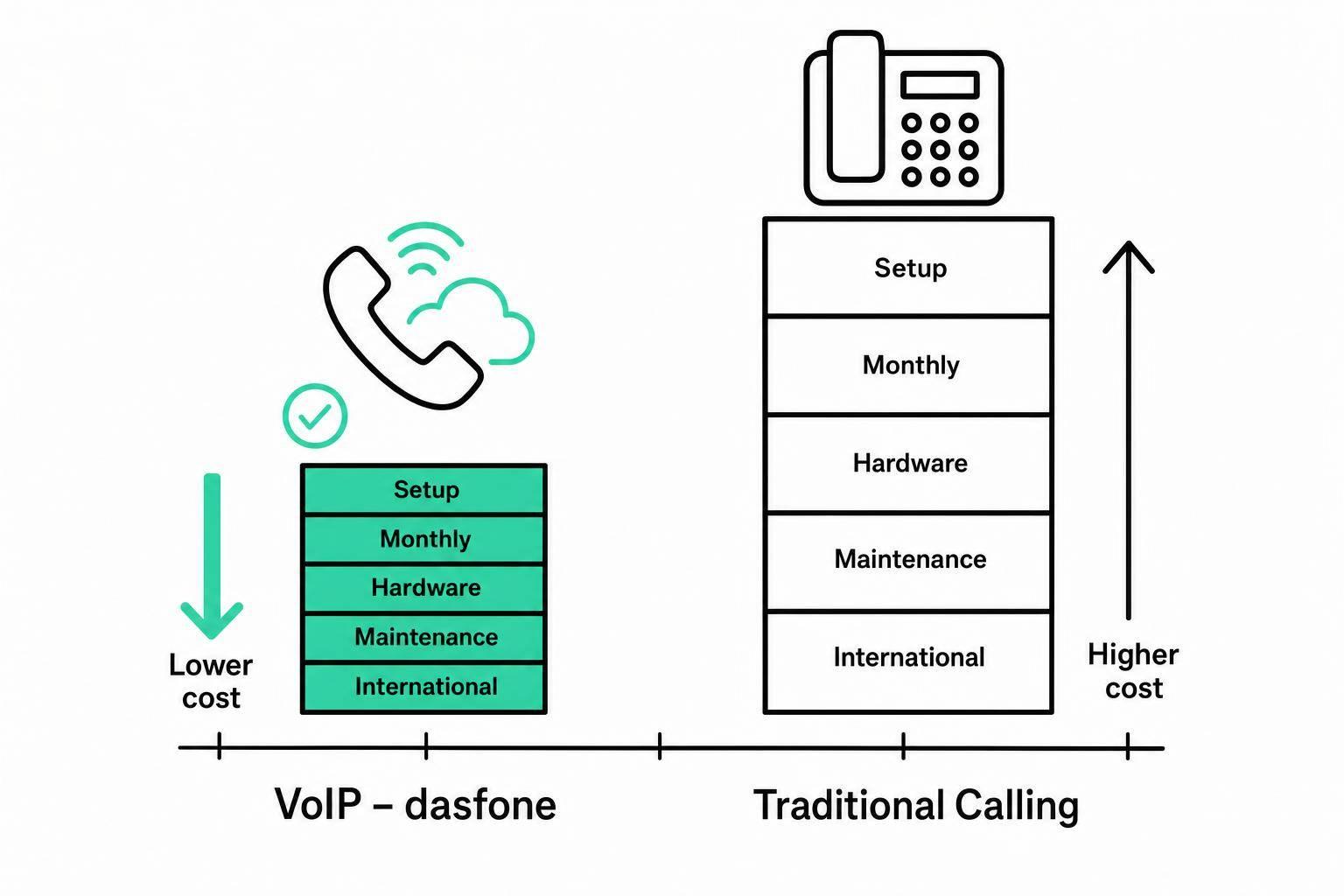
VoIP is usually the lower-cost choice. In the article, I found lower monthly fees, little to no setup cost, lower hardware spend, fewer service charges, easier growth, and much cheaper international rates.
If you want the short answer, here it is:
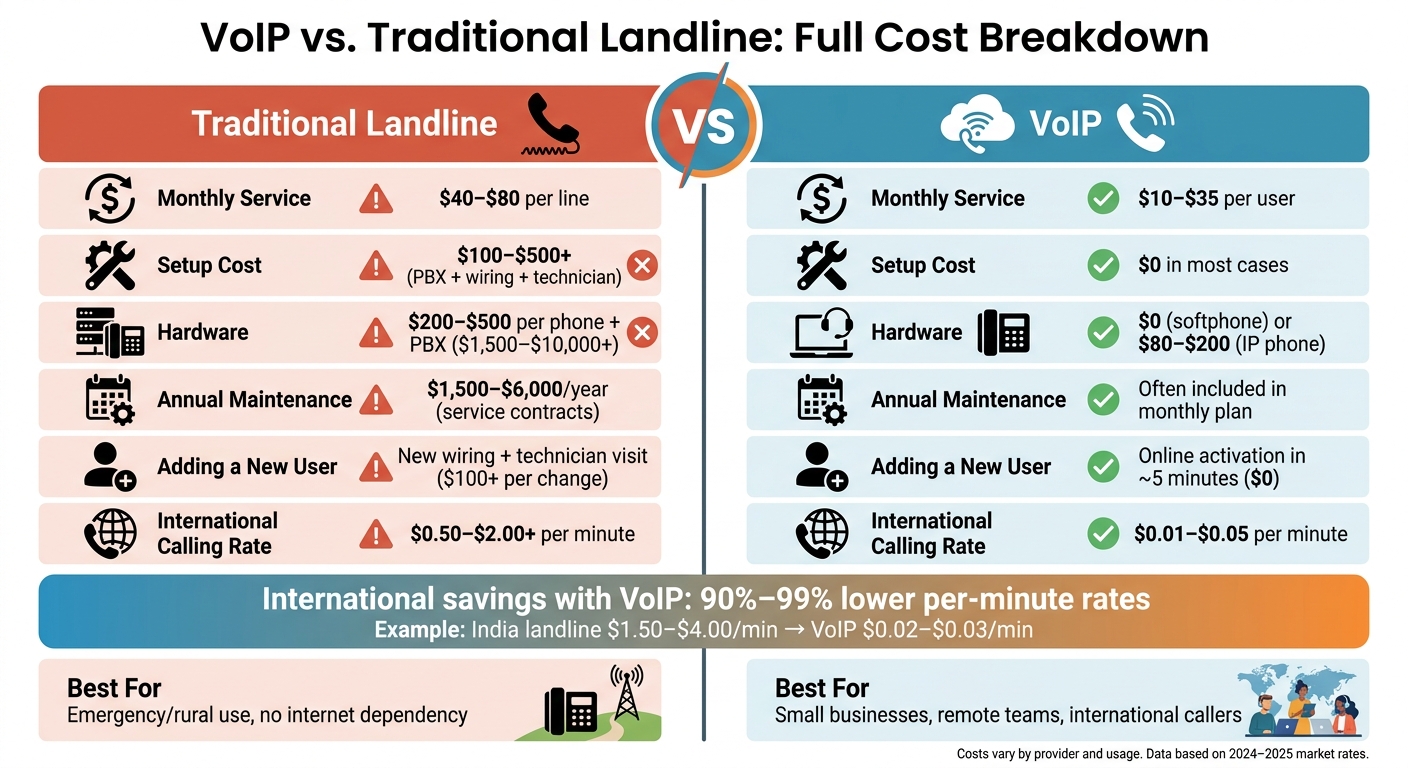
- Monthly service: VoIP often runs $10 to $35 per user, while landlines often cost $40 to $80 per line
- Setup: VoIP can start at $0, while landline installs can cost $100 to $500 or much more with PBX and wiring
- Hardware: VoIP can work with a softphone at $0 or an IP phone up to $150; landline systems often need pricier desk phones and PBX gear
- Maintenance: VoIP updates are often part of the monthly plan; PBX service contracts can run $1,500 to $6,000 per year
- Scaling: VoIP users can often be added online in minutes; landline systems may need new wiring, hardware, and technician visits
- International calling: VoIP often costs $0.01 to $0.05 per minute, versus $0.50 to $2.00+ per minute for landline carriers
That means the gap can get big fast. For people and small teams that call abroad often, rates may be 90% to 99% lower with VoIP. A five-person team can also cut both startup spend and monthly bills by moving away from a PBX-based phone setup.
VoIP vs Landline (& The Key Differences)
Quick Comparison
| Cost Area | Landline / PSTN | VoIP |
|---|---|---|
| Monthly service | $40–$80 per line | $10–$35 per user |
| Setup | $100–$500+ | $0 in many cases |
| Hardware | $200–$500 per phone + PBX | $0 to $150 |
| Yearly maintenance | $1,500–$6,000 | Often included |
| Adding users | New wiring / service visit | Online activation |
| International rates | $0.50–$2.00+ per minute | $0.01–$0.05 per minute |
My takeaway: if your main goal is to cut phone costs, especially for a small business or for overseas calls, VoIP usually wins. The main reason to keep a landline is if you need phone service that does not depend on internet access, such as in some rural or emergency-use cases.
Below, I break down where the money goes and how the total bill changes over time.
Monthly Service and Setup Costs
Monthly Plans, Per-Line Charges, and Included Features
VoIP and traditional phone service don't bill the same way. And once you start adding people, features, and call volume, the price gap usually gets much bigger.
Traditional carriers often charge $35–$70 per line per month just for the line. Then the extras start piling on: voicemail licenses can cost $300–$1,500 per year, and auto-attendants often add $200–$1,000 per year. Long-distance calling is also often billed separately.[4]
VoIP pricing is usually simpler. Most providers charge $15–$40 per user per month and include common business phone features in that monthly rate.[4][8]
For a five-person team, that comes to about $75–$200 per month with VoIP, compared with $175–$350 per month for traditional phone lines before add-ons and long-distance fees.[4][8]
There can still be a few small extra charges. Some cloud VoIP providers add a one-time $19 registration fee plus $1.50–$3.00 per month in messaging fees.[8]
Monthly pricing is only one part of the story. The bigger sticker shock often shows up during setup.
Hardware, Wiring, and Installation Costs
This is where the gap often becomes hard to ignore.
Traditional phone systems usually need on-site PBX hardware, copper wiring, and a technician to install everything. For a small office, labor and wiring alone can cost $500–$2,000, while PBX hardware can run $1,500–$10,000+, depending on the setup.[6][9]
VoIP is much lighter on upfront spending. If your team uses softphones or browser-based calling, startup cost can be $0. If you want physical phones, IP phones usually cost $80–$200 each.[6][9]
| Cost Category | Traditional (PSTN/PBX) | Cloud VoIP |
|---|---|---|
| PBX Hardware | $1,500–$10,000+ | $0 |
| Installation & Wiring | $500–$2,000 (technician required) | $0 (self-setup) |
| Desk Phones | $150+ per phone | $0 (softphone) or $80–$200 (IP phone) |
| Adding a New User | $100+ setup fee + technician visit | $0 (instant digital activation) |
A 2025 example from a seven-person law office in White Plains, New York, shows how fast those setup savings can snowball. The firm spent $400 on optional new desk phones, dropped its monthly bill from $680 to $175, and saved $6,060 in the first year. Its payback period was less than one month.[6]
Ongoing Costs: Maintenance, Scaling, and Call Charges
Upfront savings matter, but monthly costs often decide which system ends up cheaper over time.
Maintenance and Adding New Users or Lines
Setup costs hit once. Maintenance and scaling show up month after month, and that’s where old-school phone systems can get expensive in a hurry.
With a traditional PBX, maintenance isn’t optional. Annual contracts often run $1,500–$6,000 per year, and that’s before technician visits for repairs, moves, adds, or changes. Bring on one new employee, and you may need physical wiring, new hardware, and a service visit. That can mean $100 or more in setup fees for just one change. In a 20-user office, ongoing IT and repair costs can top $1,400 per month.[4]
VoIP is a different story. Updates happen automatically behind the scenes through the provider, with no added charge. Features like AI transcription or CRM integration are added through software, so there’s no need to swap hardware or pay upgrade fees. Adding a new user usually takes about five minutes in an admin portal.[4] If your team grows and shrinks through the year, or if people work from different places, that kind of flexibility can save both time and money.
There’s another pressure point here: legacy networks are being phased out, which makes old phone systems harder and more expensive to keep running.[5][6]
That same cost gap shows up in calling rates, especially for calls outside the U.S.
Domestic and International Calling Rates
Monthly service fees are one thing. Call charges are where the difference can get dramatic, especially for international traffic.
Traditional carriers often pile on per-minute rates, connection fees, surcharges, and monthly minimums.[1][2] VoIP sends calls over the internet, which cuts out much of that markup. Rates often land around $0.01–$0.05 per minute for the same destinations.[1]
Destination-by-destination pricing makes the gap easy to see.[2]
| Destination | Traditional Carrier | VoIP |
|---|---|---|
| United Kingdom | $1.00–$2.70/min | $0.01–$0.02/min |
| India | $1.50–$4.00/min | $0.02–$0.03/min |
| Mexico | $0.99–$3.65/min | $0.01–$0.04/min |
| Philippines | $1.79–$3.50/min | $0.04–$0.09/min |
| Nigeria | $2.45–$3.45/min | $0.04–$0.10/min |
Browser-based VoIP can also work well for people who want international calling without installing apps or paying for a separate subscription.[1][2]
International mobile calls usually cost more than landline calls because destination networks charge higher termination fees.[7] If rate control matters, using a landline number can help.
Total Cost Over Time: Which Option Costs Less
Once you add up setup, monthly service, hardware, maintenance, and call charges, the price difference between VoIP and traditional calling gets pretty hard to miss. That’s especially true over 6 to 12 months, when small monthly gaps start to pile up. The clearest way to see it is through a few common usage scenarios.
Sample Cost Scenarios for Different Calling Needs
| Scenario | Usage Pattern | Traditional Cost (6–12 Mo.) | VoIP Cost (6–12 Mo.) |
|---|---|---|---|
| International Caller | 30 min/week to India | $1,950–$3,120 | $15.50–$78 |
| 5-Person Small Biz | 100 min/person/mo. (UK/India) | $2,550–$5,100 | $90–$180 |
| Frequent Overseas Team | 10 lines, mobile-heavy calling | $6,600–$13,200 | $600–$1,500 |
Traditional pricing includes base service plus international add-ons, while VoIP uses usage-based rates. [10]
Put simply, if you need the cheapest way to make international calls, traditional phone bills can climb fast. VoIP, on the other hand, tends to keep costs far lower in the same situations.
The next table boils those figures down into a simple buyer’s guide.
Summary Table: Best Fit by Budget and Usage
| User Type | Best Fit | Why |
|---|---|---|
| Frequent International Caller | VoIP | 90–99% lower per-minute rates [3][1] |
| Growing Small Business | VoIP | No per-seat fees; usage-based balance scales with the team [10] |
| Emergency or Rural User | Traditional | Works without internet; reliable 911 access [2][1] |
Conclusion: Key Cost Differences to Keep in Mind
Main Takeaways
The tables above point to the same outcome in each cost area: VoIP usually costs less overall. Setup is lower, upkeep is lower, international calling is far cheaper, and adding new lines is much simpler.
Traditional landlines come with extra costs that add up fast, like technician visits, PBX hardware, and maintenance fees. International calls can run $1.50 to $4.00 per minute, compared with $0.01 to $0.09 per minute for VoIP. For a business with 20 lines, that can work out to about $8,600 in yearly savings [5][2][1].
That gap gets even bigger as call volume grows or when teams make more calls across borders. If 911 access is a top concern, it may make sense to keep a landline or mobile backup. Aside from that, VoIP is usually the lower-cost pick for international calling, remote teams, and companies that are growing fast.
The big thing is to compare the total bill, not just the advertised plan price. Connection fees, minute rounding, and regulatory surcharges can push the real cost up by 5% to 15% [2].
FAQs
When is a landline still worth the cost?
A landline can still make sense if your internet is unreliable, especially if speeds drop below 1 Mbps or outages happen often.
It can also be the right fit for certain setups that still need a physical copper line, like analog elevator phones, some older alarm and fire-monitoring panels, or certain point-of-sale terminals.
And if all you need is a basic single-line phone setup, with no remote work and no extra calling features, that may be all you need.
What hidden fees should I watch for with VoIP?
Check how calls are billed: per second or rounded up to the nearest minute. That detail matters more than it looks, because rounding can make short calls cost more than you'd expect.
You should also review:
- Connection fees
- Whether account credits expire
- Whether rates are different for mobile and landline numbers
Those small pricing details can change the total cost in a hurry, especially if you're making lots of brief calls.
How much internet speed does VoIP need?
VoIP doesn't need much bandwidth. In most cases, it uses about 100 Kbps per call.
That means even a modest internet connection can handle calls well. For basic call quality, you should have at least 1 Mbps upload speed. If you want high-definition audio, 3 Mbps of stable bandwidth is a better target.
Bandwidth isn't the whole story, though. Connection stability matters just as much. For clear, steady calls, keep latency below 150 milliseconds and packet loss as low as possible. And when you have a choice, reliable Wi-Fi is usually a better option than cellular data.
Related Articles
Ready to Make International Calls?
Try dasfone today and make your first international call in seconds. No app download, no subscription—just instant, affordable calling from your browser.
Start Calling Now