Best Time To Cold Call In 2026

Best Time To Cold Call In 2026
If you want the short answer: call in the contact’s local time, aim for Tuesday through Thursday, and focus on 10:00 a.m.–11:00 a.m. or 4:00 p.m.–6:00 p.m..
I’d use that as the default plan because the data in this piece points the same way across millions of calls. The best results show up in the late morning and late afternoon, while lunch hours, Monday mornings, and Friday afternoons tend to drag. One data point stands out: Thursday morning connect rates reached 14.2%, while Friday afternoon dropped to 4.3%.
Here’s the article in plain English:
- Best hours: 10:00 a.m.–11:00 a.m. and 4:00 p.m.–6:00 p.m. local time
- Best days: Tuesday, Wednesday, and Thursday
- Hours to avoid: 12:00 p.m.–2:00 p.m. in many markets
- Best day overall: Wednesday
- For senior buyers: try before 8:30 a.m. or after 5:30 p.m.
- For global teams: batch lists by time zone before dialing
A few regional patterns matter too. In North America, earlier morning and late afternoon often work well. In Europe, start times and lunch breaks change by country. In APAC, 10:00 a.m.–12:00 p.m. is often the safest first block. And if you don’t convert each call window into the contact’s local time, you can miss the best slot entirely.
That’s the core takeaway: I’d treat these time blocks as the starting point, then check my own connect rate, conversation rate, meetings booked, and voicemail rate to fine-tune the schedule.
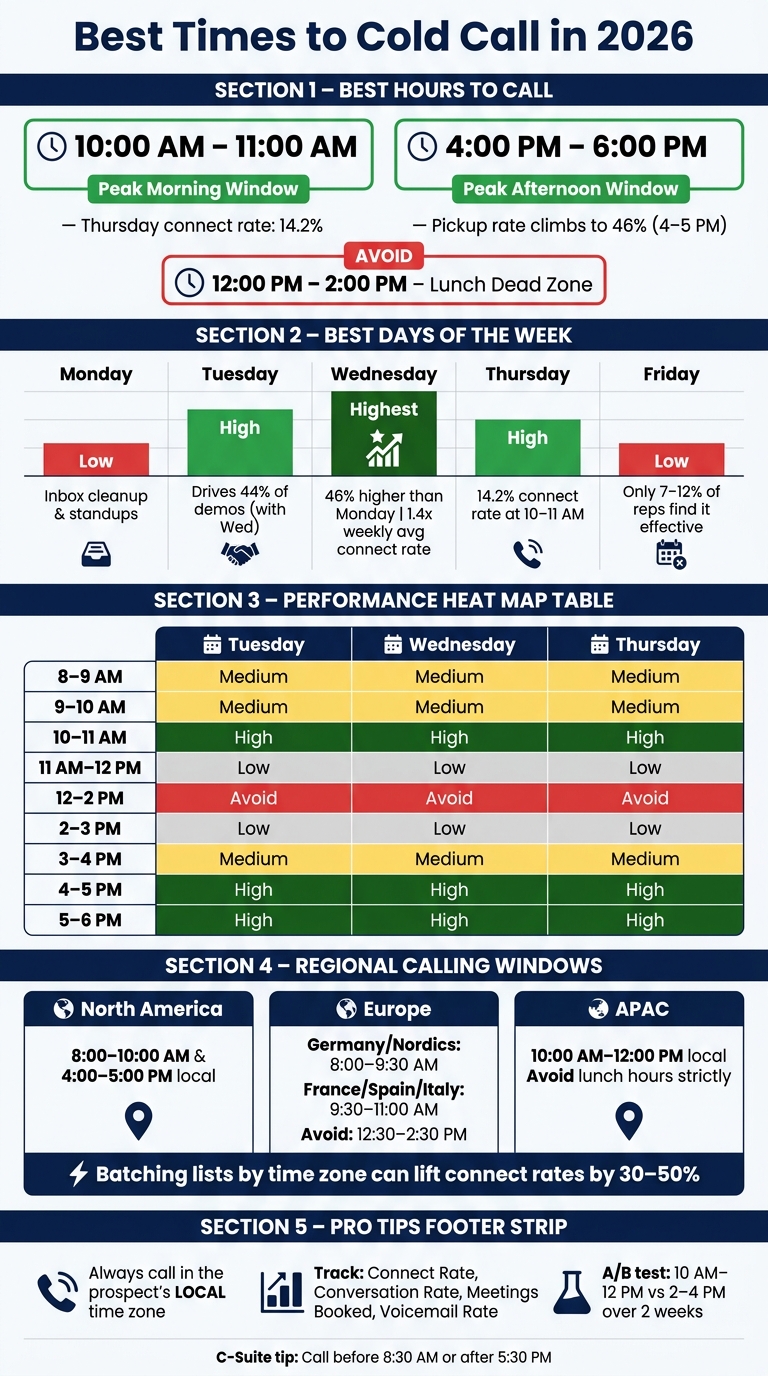
The BEST Time to Cold Call Prospects ⏰
Best Days And Hours To Cold Call In 2026
These local-time windows are your starting point. Then you tweak based on region.
Strongest Calling Windows: 10:00 a.m.–11:00 a.m. And 4:00 p.m.–6:00 p.m. Local Time
The top calling windows are 10:00 a.m.–11:00 a.m. and 4:00 p.m.–6:00 p.m. in the prospect's local time.
The 10:00 a.m.–11:00 a.m. slot stands out as the best single hour for B2B cold calling. Connect rates hit 14.2% on Thursday mornings, compared with only 4.3% on Friday afternoons [5].
The 4:00 p.m.–6:00 p.m. block is the best part of the late day. Pickup rates climb from 27% in mid-morning to 46% from 4:00 p.m. to 5:00 p.m. [8]. At that point, many prospects are wrapping up meetings and moving into lighter admin work, so they’re easier to reach.
By contrast, 12:00 p.m. to 1:00 p.m. is usually a poor window for cold calls. In parts of Europe, that slowdown can stretch closer to 2:00 p.m. [2][5]. That hour is better spent on list prep, research, or CRM cleanup. If you are calling from a desktop, you can also use a browser-based calling tool to streamline your workflow.
Best Weekdays: Tuesday Through Thursday
Tuesday through Thursday beat the rest of the week.
Tuesday and Wednesday drive 44% of all demos booked from cold calls, and Wednesday performs 46% higher than Monday [6][8]. Connect rates on Wednesday run about 1.4x the weekly average [2]. Thursday also performs well, especially in the 10:00 a.m.–11:00 a.m. window.
Monday and Friday tend to drag. Monday mornings often disappear into inbox cleanup and standups. Friday afternoons see engagement fall off fast, and only 7% to 12% of sales professionals say Friday is an effective day for cold outreach [7].
Performance Table By Time Of Day And Weekday
The table below turns the data into a quick dialing guide.
| Time Block (Local) | Tuesday | Wednesday | Thursday | Relative Strength |
|---|---|---|---|---|
| 8:00 a.m. – 9:00 a.m. | Medium | Medium | Medium | Medium |
| 9:00 a.m. – 10:00 a.m. | Low | Low | Low | Low |
| 10:00 a.m. – 11:00 a.m. | High | High | High | High |
| 11:00 a.m. – 12:00 p.m. | Medium | High | Medium | Medium/High |
| 12:00 p.m. – 2:00 p.m. | Avoid | Avoid | Avoid | Very Low |
| 2:00 p.m. – 3:00 p.m. | Medium | Medium | Medium | Medium |
| 3:00 p.m. – 4:00 p.m. | Medium | Medium | Medium | Medium |
| 4:00 p.m. – 5:00 p.m. | High | High | High | High |
| 5:00 p.m. – 6:00 p.m. | High | High | High | High |
High-level contacts usually follow a different schedule. C-suite prospects are often easiest to reach before 8:30 a.m. or after 5:30 p.m., outside their meeting-heavy core hours. So if your list leans toward VPs and above, shift your dial blocks to match [5][8].
How Cold Calling Windows Differ By Region
Cold-calling windows change by region, so you need to call in the prospect's local time. That sounds obvious, but it's where a lot of teams slip. A good window in New York can be a dead zone in Berlin or Singapore. The table below helps turn those local patterns into dialing blocks you can actually use.
Calling Windows For North America, Europe, And APAC
In North America, the best windows are 8:00 a.m.–10:00 a.m. and 4:00 p.m.–5:00 p.m. local time [2].
Western and Central Europe runs on a different schedule. German and Nordic offices tend to start earlier, which makes 8:00 a.m.–9:30 a.m. a strong slot [2]. French, Spanish, and Italian prospects usually start later, so 9:30 a.m.–11:00 a.m. tends to beat the earlier window [2].
Lunch also matters more across much of Europe. 12:30 p.m.–2:30 p.m. is often a weak block because lunch breaks run longer [2][5]. In Germany and the Nordics, the break is shorter - about 12:00 p.m.–1:00 p.m. - but connect rates still drop during that time [2].
APAC needs a tighter plan. The most dependable entry point across markets like Singapore, Japan, and South Korea is 10:00 a.m.–12:00 p.m. local time, and in some markets a late-afternoon window can also work [5][9]. Japan and Korea, in particular, have strict lunch-hour norms, so it's smart to stay away from that period [5].
One simple move can make a big difference: batch prospects by time zone before dialing. That can lift connect rates by 30% to 50% [2].
Convert Prospect Time Zones Before Building A Dialing Schedule
Once you know the right local window, the next step is turning it into your team's workday. For U.S.-based teams, that means converting each region's calling block into your own schedule.
Here's a plain example: a San Francisco-based SDR calling New York prospects has to start at 6:00 a.m. PT to catch the 9:00 a.m. ET window [1]. That's not a small shift. It's the kind of detail that can shape hiring, coverage, and daily call blocks.
European calls are even tougher for U.S. teams because those windows often land outside normal business hours. In practice, that usually means setting up a separate session or using a team that's closer to those time zones.
Use this table to map out daily dialing blocks by market.
Regional Schedule Table For International Campaigns
| Target Region | Recommended Local Window | U.S. Eastern Time Equivalent |
|---|---|---|
| North America (East) | 8:00 a.m. – 10:00 a.m. | 8:00 a.m. – 10:00 a.m. |
| North America (West) | 9:00 a.m. – 11:00 a.m. | 12:00 p.m. – 2:00 p.m. |
| UK & Ireland | 8:30 a.m. – 10:00 a.m. | 3:30 a.m. – 5:00 a.m. |
| Germany & Nordics | 8:00 a.m. – 9:30 a.m. | 2:00 a.m. – 3:30 a.m. |
| France, Spain, Italy | 9:30 a.m. – 11:00 a.m. | 3:30 a.m. – 5:00 a.m. |
| APAC (General) | 10:00 a.m. – 12:00 p.m. | 9:00 p.m. – 11:00 p.m. (previous day) |
| APAC (Late Window) | 4:00 p.m. – 5:00 p.m. | 3:00 a.m. – 4:00 a.m. |
For multi-region campaigns, timezone-stacked sessions usually make the most sense. Start with East Coast prospects early in the day, then move through Central, Mountain, and Pacific as each local window opens [1][3]. Europe and APAC usually need either an early-morning Eastern Time block or a team working closer to those markets.
How To Turn These Findings Into A Working Calling Schedule
Group Calls Into Focused High-Probability Blocks
Take the regional windows above and turn them into fixed call blocks each day. Keep 10:00 a.m.–11:00 a.m. and 4:00 p.m.–5:00 p.m. in the prospect’s local time for live calling only. Push admin tasks, list cleanup, and CRM updates outside those windows.
If your team calls across more than one region, stagger those blocks by time zone. That way, each market gets called during its own peak hours instead of being forced into your team’s clock.
Also, stay out of the dead zones: Monday mornings, Friday afternoons after 3:00 p.m., and local lunch hours. That matters even more in France, Spain, and Italy, where 12:30 p.m.–2:30 p.m. is often a poor time to call [2][5].
Once your blocks are in place, don’t just stick with them on faith. Track which ones turn into actual conversations and meetings.
Track Your Own Data To Refine The Baseline
Benchmarks give you a starting point. They don’t tell the whole story.
Your audience may pick up at different times, so track your own numbers by local hour, region, and weekday. Focus on:
- Connect rate
- Conversation rate
- Meetings booked
- Voicemail rate
If voicemail rate jumps during a certain window, that’s usually a sign you’ve drifted into a low-yield stretch.
A simple way to test this: run a two-week A/B test. For one block, call only during 10:00 a.m.–12:00 p.m. local time. For the next two weeks, switch to 2:00 p.m.–4:00 p.m. local time. Then compare conversation rate and meetings booked, not just raw connect rate. That difference shows whether the timing lines up with how your audience actually responds.
Practical Setup For International Cold Calling
Why Browser-Based Calling Works Well For Global Outreach
Browser-based calling makes global outreach a lot easier. When your team moves from one region to another, you don't have to jump between tools or patch together a messy workflow.
It also helps when prospects only pick up on direct business lines. Dasfone cuts that friction by letting teams move between time-zone calling blocks in one place, which keeps the day moving instead of slowing reps down with setup issues.
Using dasfone To Run Time-Zone-Based Calling Blocks
For global campaigns, a few features matter most.
- HD audio helps keep calls clear
- Secure encryption helps protect business conversations
- Dedicated caller ID lets you show a local number, which can help pickup rates
This matters even more when your team runs several regional calling blocks in the same day. With Dasfone, it's easier to stay lined up with each prospect's local time instead of forcing one rigid schedule across every market.
Conclusion: The Best Cold Call Times To Focus On In 2026
The rule is simple: call in the prospect's local time, not yours.
As a starting point, call during 10:00 a.m.–11:00 a.m. and 4:00 p.m.–6:00 p.m. local time and put most of your volume on Tuesday through Thursday [4][5][6]. Avoid local lunch hours [2].
Convert every calling window to the prospect's local time. Build your calling blocks around their schedule, test against your own data, and adjust based on what your connect and conversation rates show.
FAQs
How many times should I call the same prospect?
In 2026, reps need an average of 1.55 call attempts to reach a prospect.
Most give up at around 2.1 attempts. That’s the gap.
The data points to a better target: 6 to 9 attempts. That range accounts for 90% of eventual connections.
Push past 12 attempts, though, and the odds fall off a cliff. At that point, success rates drop below 0.5%.
What should I track besides connect rate?
Connect rate is useful, but it only tells you if you got the right person on the phone.
To judge cold-calling performance, you also need to track a few deeper metrics:
- Conversation rates
- Demo volume
- Cold call-to-demo conversion rate
- Positive call sentiment
Look at these next to your timing data. That way, you're not just chasing more connections. You're dialing in for outcomes that lead to revenue.
How do I schedule calls across multiple time zones?
Base your calling schedule on the prospect’s local time, not yours.
That means you shouldn’t rely on one fixed call block for everyone. Instead, split your day into sessions by time zone. For example, you might start with Eastern, then shift to Central, Mountain, and Pacific as the morning moves along.
For international campaigns, group queues by country so your team calls during local work hours and avoids lunch breaks. Many dialers and CRM systems can also spot a prospect’s time zone using area code or location data.
Related Articles
Ready to Make International Calls?
Try dasfone today and make your first international call in seconds. No app download, no subscription—just instant, affordable calling from your browser.
Start Calling Now