5 Benefits of Caller ID Localization
5 Benefits of Caller ID Localization
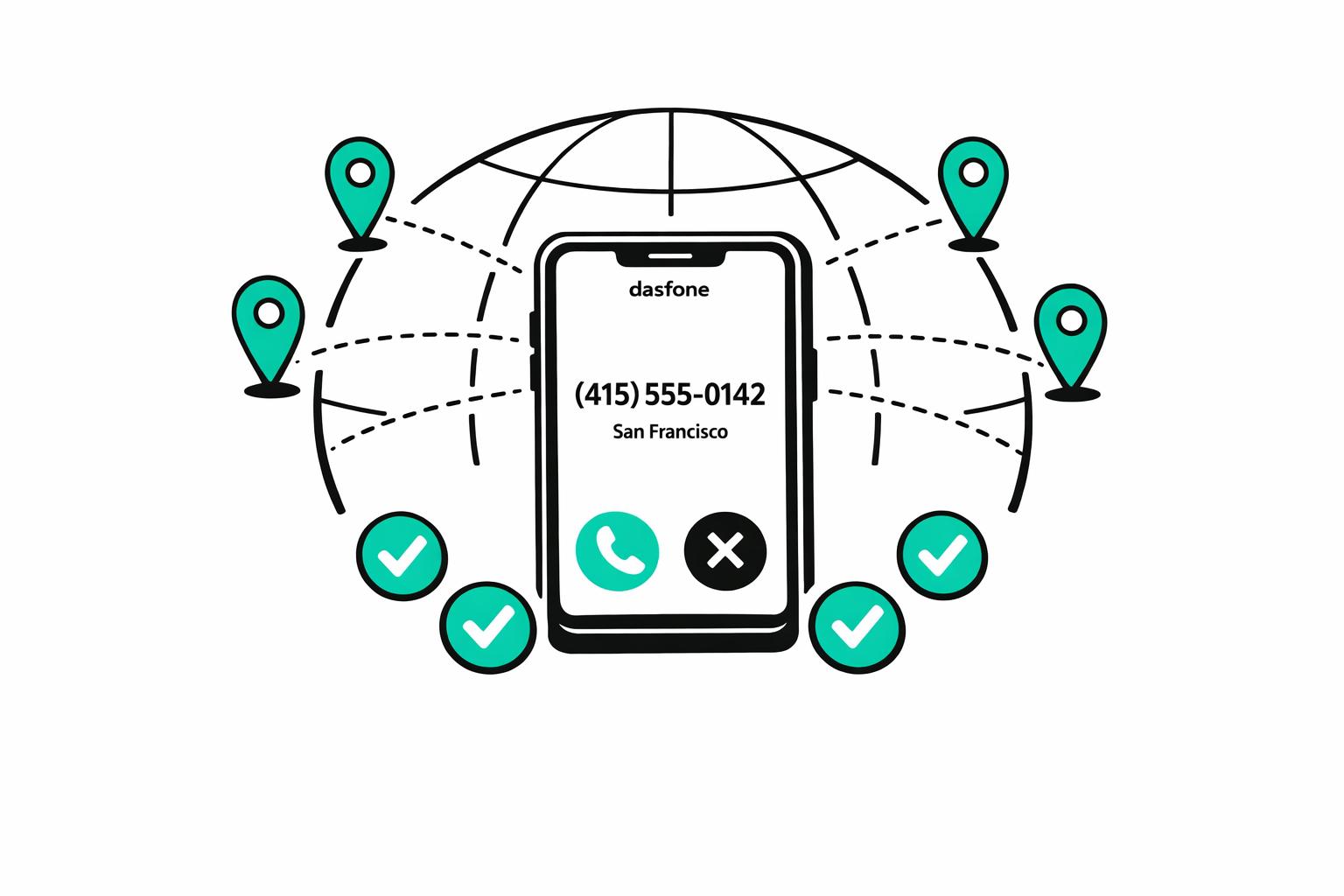
Want more people to answer your calls? Caller ID localization makes it happen by displaying a local phone number instead of your real one. This simple change can increase answer rates, build trust, and make communication smoother - especially for international calls.
Here’s why it works:
- Higher Answer Rates: People are up to 4x more likely to answer calls from local numbers.
- Builds Trust: A familiar area code feels safer and more reliable.
- Avoids Call Blocking: Local numbers bypass spam filters that flag international calls.
- Encourages Callbacks: Recipients can return calls at local rates, removing cost concerns.
- Supports Global Reach: Establish a local presence anywhere without physical offices.
Platforms like Dasfone make it easy to adopt local caller IDs through a browser-based setup, with no subscriptions or complex systems. Whether you’re a business or an individual, this approach ensures your calls are recognized, answered, and returned.
What is Local Presence Dialing and How to Set it Up?
1. Higher Answer Rates
Most Americans tend to avoid picking up calls from numbers they don’t recognize. In fact, around 80% of Americans ignore such calls [1], and over 80% are "extremely unlikely" to answer when the caller ID displays “unknown number” [5]. This hesitation grows even stronger when the number appears international or toll-free, as these formats often spark immediate distrust.
Switching to a local caller ID can completely change this dynamic. Studies show that displaying a local phone number can boost call pickup rates by up to 400% [6]. For instance, while only 7% of people would answer an unknown toll-free number, 27.5% would answer an unknown local area code [7]. That’s nearly four times the response rate, all because the number feels more familiar and trustworthy.
Why does this happen? It’s all about cognitive fluency. Local numbers are easier for people to process - they feel familiar, approachable, and legitimate. A local area code suggests the caller might actually have a presence nearby, making the call seem relevant rather than intrusive. On the other hand, toll-free or international numbers often get lumped into the same category as robocalls or spam, leading to immediate skepticism.
There’s plenty of real-world evidence to back this up:
"I had a client in Phoenix who was struggling with cold calls using their 800 number. Pickup rates were terrible. We switched them to local Phoenix numbers for their campaigns, and within two weeks, their answer rates doubled." – Matt Bowman, Founder, Thrive Local [8]
This shift doesn’t just increase answer rates - it transforms how people perceive the call. A survey found that 72% of U.S. consumers are more likely to answer local numbers compared to toll-free ones [8]. Additionally, 90% of respondents felt local numbers seemed more "personal" or "human" [8]. These higher engagement levels create opportunities for stronger customer relationships and better communication outcomes.
For businesses making international calls, this strategy becomes even more critical. A solution like dasfone makes it simple to localize caller IDs, helping you connect with your audience more effectively while building trust.
2. Builds Trust and Credibility
Caller ID localization does more than just improve answer rates - it plays a key role in building trust and reinforcing credibility.
Trust is essential when making calls. Seeing a local area code on the screen feels familiar and safe, tapping into a natural preference for something recognizable [9]. On the flip side, international or toll-free numbers often carry the stigma of spam or unwanted solicitation [4].
A local number also provides reassurance by removing worries about long-distance charges [4]. This small detail can make recipients more comfortable answering the call.
The effect on business credibility is hard to ignore. For example, in January 2024, Ryan T. Murphy highlighted how switching from toll-free to local numbers boosted engagement rates by 71% [8]. Similarly, Bernadette King observed a threefold increase in callbacks when using local numbers in 2025 [8].
Platforms like dasfone make it easy to align your caller ID with your recipient’s location, helping you establish a stronger connection and enhance your credibility.
3. Reduces Call Blocking and Screening
International numbers often run into trouble with modern spam filters and call screening systems, but local caller IDs can help sidestep these issues.
Mobile networks and automated spam filters are designed to flag unfamiliar international formats as potential threats. A local number, however, blends in as standard domestic traffic, avoiding detection by these automated systems [4]. This advantage is further reinforced by telecom regulations that continue to evolve.
In countries like Singapore, Germany, Australia, and China, regulatory authorities have introduced strict measures to block or "mutate" international calls that attempt to display local caller IDs through traditional VoIP routes [10]. As Global Call Forwarding explains:
"Telecom authorities stopped allowing calls from international networks to display an in-country caller ID... Their calls were being blocked if they tried to use a local in-country caller ID or the caller ID was altered or mutated" [10].
To navigate these regulatory challenges and avoid detection by spam filters, businesses can turn to targeted solutions. Using local termination systems that rely on in-country carrier routes allows companies to comply with global telecom standards while ensuring their calls are recognized as legitimate. This approach minimizes the chances of calls being flagged or blocked.
For businesses making a high volume of calls, rotating through a pool of local numbers is another practical strategy. This prevents any single number from raising suspicion and being labeled as "Scam Likely" or "Potential Spam", which can severely impact answer rates [7]. Services like Dasfone provide options to use or purchase dedicated local caller IDs, helping ensure your calls bypass spam filters and successfully reach their recipients.
4. Enables Cost-Effective Return Calls
Localized caller IDs don’t just improve answer rates and build trust - they also help reduce costs. When recipients see a local number, they can return calls at domestic rates. It’s as simple as dialing a neighbor. This removes a significant financial barrier that often discourages customers from calling back.
Think about it: returning a call to an international number can rack up hefty per-minute charges, depending on the carrier and the destination. But a local area code signals to customers that the call will be treated as a domestic one. As United World Telecom explains:
"Customers are far more likely to return a call to a local number since they know they will be charged a local rate, or call for free if it is a toll-free number" [1].
Here’s how cloud telephony systems make this even better: while customers dial a local number and pay only local rates, the system seamlessly routes the call internationally to your office or team - at no extra cost to the caller. For businesses, this means you can stay connected without passing international call fees onto your customers. It’s a win-win, encouraging callbacks and fostering a smoother customer experience.
With solutions like dasfone, businesses gain a dedicated local caller ID, ensuring affordable two-way communication. Whether it’s a missed call, voicemail follow-up, or support inquiry, customers can reach out without worrying about surprise charges - keeping their phone bills predictable and their experience positive.
5. Supports Global Expansion and Remote Teams
Caller ID localization enables businesses to establish a presence in over 160 countries without needing physical offices or local registrations [11][2]. By aligning the caller ID with the recipient's country, a single team operating from one central location can effectively serve multiple global markets. This setup not only slashes costs but also builds trust and credibility by creating the impression of a local presence. The result? Higher call success rates and a stronger foothold in international markets.
Beyond improving answer rates and trust, caller ID localization enhances the professionalism of remote teams. Using softphone apps, remote employees can display a local caller ID, ensuring a unified, professional identity across borders. For example, a sales representative working from home in Texas can call prospects in Germany using a German number, while a support agent in the Philippines can handle callbacks from Brazil with a Brazilian caller ID [1][2].
The productivity boost is clear. Businesses using local caller IDs often experience 2–3x higher response rates compared to those using international numbers. Additionally, agents can connect with 4 to 10 times more prospects [2][3]. When combined with time-zone-based routing - where calls are automatically handed off to regional teams as business hours shift - companies can provide 24/7 coverage without opening offices in every market [12].
This approach creates a seamless, round-the-clock operation. As Global Call Forwarding explains:
"By tailoring outbound caller IDs to each region, your sales and support teams can expand reach, improve callback rates, and create a more trustworthy global presence - all without the need for physical offices" [2].
This flexibility is especially beneficial for businesses running cold calling campaigns or managing customer service teams spread across continents. Platforms like dasfone make it simple for remote teams to maintain a professional, local identity. With dasfone, businesses can secure dedicated caller IDs and make international calls directly from a browser, ensuring a consistent and professional appearance no matter where their teams are located.
Comparison Table
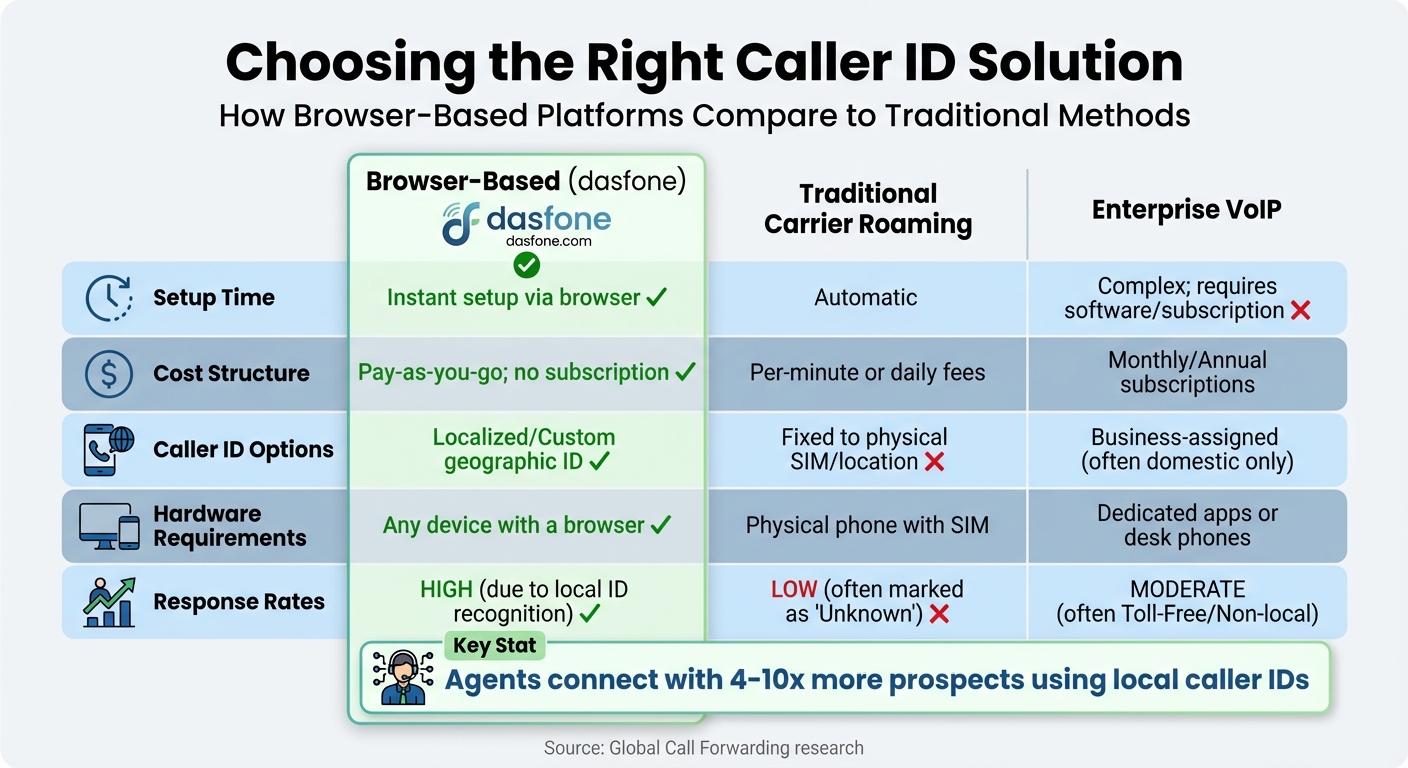
When it comes to making international calls with a local caller ID, the contrasts between different systems are striking. Traditional carrier roaming is convenient since it works automatically, but it often comes with steep per-minute fees or daily charges. Enterprise VoIP systems, while functional, require subscriptions and can involve complicated setups. On the other hand, browser-based platforms like dasfone provide a simpler, more transparent alternative: instant setup, no subscriptions, and pay-as-you-go pricing.
Traditional carriers lock you into a fixed SIM-based number, while browser-based platforms offer localized caller IDs. Enterprise VoIP systems tend to assign business numbers, often limited to domestic or toll-free options, which don't resonate as "local" for international prospects. With dasfone, you can display a caller ID that matches the region you're calling - for instance, showing a London +44 number while making a call from Texas. Here's how these differences stack up:
| Feature | dasfone (Browser-Based) | Traditional Carrier Roaming | Enterprise VoIP |
|---|---|---|---|
| Setup Time | Instant setup via browser | Automatic | Complex; requires software/subscription |
| Cost Structure | Pay-as-you-go; no subscription | Per-minute or daily fees | Monthly/Annual subscriptions |
| Caller ID Options | Localized/Custom geographic ID | Fixed to physical SIM/location | Business-assigned (often domestic only) |
| Hardware | Any device with a browser | Physical phone with SIM | Dedicated apps or desk phones |
| Response Rates | High (due to local ID recognition) | Low (often marked as "Unknown") | Moderate (often Toll-Free/Non-local) |
This table highlights how browser-based platforms outperform other solutions, especially in terms of setup, cost, and response rates. The benefits of localized caller IDs are particularly clear. According to Global Call Forwarding:
"With local presence dialing, agents can connect with between 4-10x more prospects by showing a local number as their caller ID" [3].
Such improvements are hard to achieve with international numbers flagged as "Unknown" or toll-free numbers that lack a geographic connection. For businesses engaged in cold calling or managing remote teams across different regions, the ability to quickly set up calls, avoid monthly fees, and use customizable local caller IDs can greatly enhance both cost efficiency and call success rates.
Conclusion
Caller ID localization is transforming international communication by displaying a local number instead of an unfamiliar international one. This builds trust instantly, helps bypass call screening, and makes callbacks more affordable - all while significantly increasing answer rates. Consider this: around 80% of Americans ignore calls from unknown numbers [1], but recipients are 4 times more likely to pick up when the caller ID shows a familiar local number [13].
This approach offers a practical solution for remote teams, cold calling efforts, or anyone entering new markets. It allows businesses and individuals to establish a local presence without needing physical offices or complicated VoIP setups. With Dasfone, the process is simple and quick. Their platform lets you display a local caller ID - whether it’s a London +44 number while calling from Texas or a New York number while abroad - all through an easy, browser-based setup.
Dasfone’s pay-as-you-go pricing ensures cost transparency, while features like high-definition audio and secure encryption guarantee professional-quality calls. Plus, you can test the service risk-free with $2 in free credits (up to 100 minutes) and access coverage in over 200 countries.
Whether you’re an expat maintaining business relationships, a digital nomad connecting with clients, or a company driving international sales, caller ID localization can make all the difference. A trusted local number can turn missed opportunities into meaningful conversations, ensuring your calls get answered when it matters most.
FAQs
Is caller ID localization legal?
Caller ID localization is typically allowed when used responsibly, but the rules differ depending on the region. For example, Europe enforces stricter regulations to prevent caller ID spoofing and impersonation, which are considered illegal in many cases. It's crucial to check and follow local laws to ensure proper use of this feature.
Will a local caller ID hurt my deliverability?
Using a local caller ID doesn’t negatively impact deliverability. In fact, it often boosts response rates and helps establish trust with your audience. This strategy encourages stronger engagement, making it simpler to connect with recipients and build more effective communication.
Can I use different local numbers per country?
Yes, you can assign different local numbers for each country to show a recognizable local caller ID when making international calls. This approach helps increase answer rates and establishes trust with recipients by making your calls feel more familiar and relevant to them.
Related Articles
Ready to Make International Calls?
Try dasfone today and make your first international call in seconds. No app download, no subscription—just instant, affordable calling from your browser.
Start Calling Now