Cheap Browser Calls with Right Caller ID
Cheap Browser Calls with Right Caller ID
The lowest calling cost is not the lowest per-minute rate. It’s the fewest tries to reach a person. If one answered 5-minute call costs $0.25 at $0.05/minute, but three missed 5-minute tries cost $0.75, then answer rate changes what you spend.
Here’s the short version: I’d pick the caller ID based on the type of call, use only numbers I own or can use, and track cost per completed conversation instead of just cost per minute. That means using the account-linked number for bank or service calls, one steady business number for repeat outreach, and a local number only when it fits who I am or where I work.
What matters most:
- Missed calls add up fast
- Caller ID can help cut repeat attempts
- Banks and offices still do their own ID checks
- Callbacks matter, so the number must work
- The main math is simple: total credit used ÷ completed conversations
A quick example:
- 3 missed attempts
- 5 minutes each
- $0.05/minute
- Total: $0.75
Vs.
- 1 answered call
- 5 minutes
- $0.05/minute
- Total: $0.25
That’s a 200% higher spend for no completed conversation.
If I want to keep browser calling costs under control, I’d match the caller ID to the call, check the exact destination rate before dialing, leave room for hold time or one retry, and log each result in a simple sheet. The goal is not cheaper minutes. The goal is fewer wasted ones.
| Caller ID setup | Best use | Main risk |
|---|---|---|
| Personal number | Existing personal accounts | My private number is exposed |
| Business number | Banks, offices, known contacts | It must be able to take callbacks |
| Dedicated business number | Repeat supplier or outreach calls | I need to monitor it |
| Local number | Calls to office lines in that area | It must not mislead people |
So the core idea is simple: judge calling cost by completed conversations, not sticker price.
How to pick the right caller ID for each type of call
Pick your caller ID based on the kind of call you're making: account-related calls, repeat business outreach, or office lines that need a local presence. And stick to numbers you own or are allowed to use. If the caller ID is misleading, you could face penalties.[1]
Use a verified personal or business number for account-related calls
For account-related calls, use the number connected to the account itself. That won't replace security checks. The bank, service provider, or institution may still ask for account details, a one-time code, or another form of verification.
Still, using the matching number helps in a simple but important way: it keeps the call tied to the right account across repeat interactions.
Use a dedicated caller ID for repeated business outreach
If you contact overseas suppliers, logistics partners, or import/export coordinators on a regular basis, a dedicated business number usually makes more sense.
It helps you:
- keep personal and business calls separate
- make follow-up calls look consistent
- track attempts and completed conversations with less confusion
That kind of consistency matters, especially when several calls may happen over days or weeks.
Use a local number when it fits the call
A number linked to the recipient's country or region may feel more familiar than an unknown international number. That's the upside.
But don't assume local always means better. Test it against your current setup and compare answered-call rates. If the number is unfamiliar, it can still look suspicious. So use a local number only when it actually represents you or your organization.
Use the setup that leads to the most answered calls, then track total spend per completed call.
Use this quick match-up as a starting point.
| Caller ID setup | Best fit | Key caution |
|---|---|---|
| Verified personal number | Existing personal accounts and service relationships | Exposes a personal number |
| Verified business number | Banks, offices, and established business contacts | Must be authorized and reachable for callbacks |
| Dedicated business number | Suppliers, overseas offices, campaigns, import/export | Requires consistent monitoring and callback handling |
| Local number | Office and business lines in the recipient's region | Must not misrepresent identity |
Match your caller ID setup to the call type
Next, line up your caller ID with the kind of call you're making. That simple step can cut down on retries and help lower total spend.
Banks and financial institutions
Use the number that's already tied to the account. That gives the call a familiar starting point.
That said, caller ID doesn't prove who you are. The bank or financial institution will still ask for passwords, one-time codes, or other checks before sharing account details.
Before you place the call, make sure the number you're showing can also receive return calls. If the institution needs to call you back, you don't want that call going nowhere.
Government offices and administrative lines
Calls to government offices often involve transfers, hold times, and follow-up calls. Using one steady, legitimate number the whole way through makes it easier for staff to connect your next call to the same case.
After each call, write down the key details:
- Date and time
- Department
- Representative name or ID
- Number dialed
- Reference number
That record can save you a lot of trouble if the call drops or a different representative picks up next time.
Suppliers, overseas offices, and outbound business calls
For shipping, orders, payments, and repeat supplier contact, use one business number every time. When people see the same number again and again, they're more likely to recognize it and call back.
A local number can make sense if your business actually works in that region or serves customers there. But it should match a real business presence, not a number you don't control.[1]
Control your spend with pay-as-you-go browser calling and basic tracking
After you match your caller ID to the type of call, the next step is simple: track what each attempt actually costs. Once you’ve picked a caller ID, judge spend by the outcome you get, not just the posted rate.
Check the full cost before you dial
Before you place a call, look up the destination-specific rate. Also check whether the number is a landline or mobile line, because the per-minute charge can change based on number type. From there, estimate how long the call will last and do the math. It also helps to add a small buffer for hold time or one retry.
Dasfone uses transparent pay-as-you-go pricing, so you only pay for the minutes you actually use. Check the actual per-minute rate for your specific country and number type before dialing.
Then compare that estimate with the cost of a completed call.
Measure cost per completed conversation, not cost per minute
For each calling session, track the numbers that tell the real story:
- Number of attempts
- Answered calls
- Completed conversations
- Total connected minutes
- Total credit used
- Follow-up calls needed
- Which caller ID you used
- Destination type
Then use this formula:
Cost per completed conversation = Total calling credit used ÷ Completed conversations
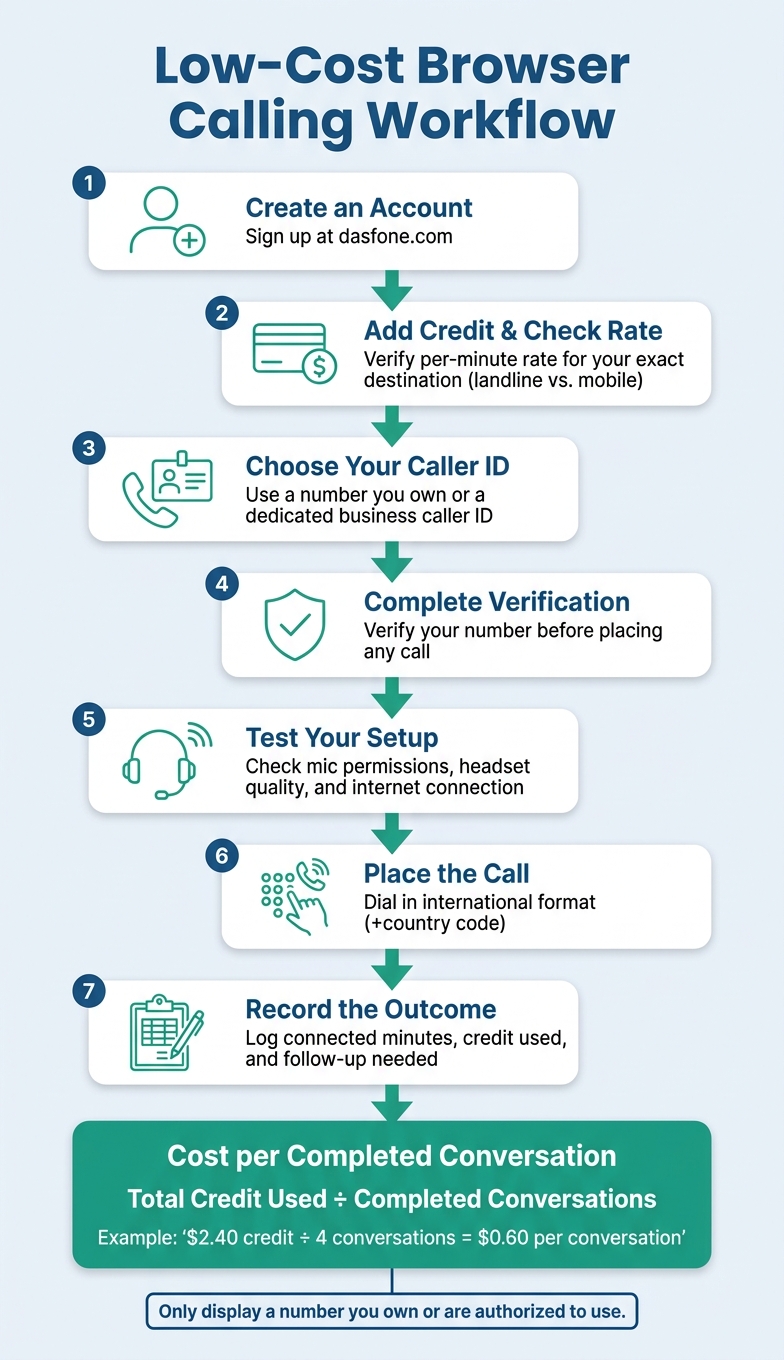
For example, if 12 attempts use $2.40 in credit and produce 4 completed conversations, your real cost is $0.60 per conversation - not the headline rate. If you only make calls now and then, a simple spreadsheet with one row per call is enough. If you handle business outreach, group results by caller ID, destination, and campaign so you can spot patterns over time.
Set up a low-cost calling workflow with dasfone
Use this workflow to keep costs predictable:
- Create an account at dasfone.com.
- Add credit and check the current rate for your exact destination, including whether it’s a landline or mobile number.
- Choose your caller ID - verify a number you already own, or use a dedicated caller ID for repeated outbound business calling.
- Complete verification before placing any call.
- Test your setup - check browser microphone permissions, headset or speaker quality, and a stable internet connection.
- Place the call using international format (+country code).
- Record the outcome - note connected minutes, credit used, and whether a follow-up is needed.
Only display a number you own or are authorized to use.
Conclusion: The cheapest call is the one that gets answered
The cheapest call is the one that gets answered. That’s why caller ID choice is the next place to cut cost.
Use a verified personal or business number for account calls. Use a dedicated caller ID for repeat outreach. Use a local number only when it actually matches the call. The idea is simple: make the call look like it belongs before you place it.
Measure caller ID success by cost per completed conversation, not by per-minute rate.
When you pair pay-as-you-go pricing with a legitimate caller ID, your costs stay tied to answered calls. The right caller ID, measured by completed conversations, is what lowers total spend.
FAQs
How do I know which caller ID to use?
Choose based on your goal: trust or consistency.
For cold calling or business outreach, use a local number that matches the recipient’s area code. It can make your call feel more familiar, which may help people pick up.
For regular contact with banks or offices, use a dedicated permanent number. That way, your identity stays recognizable no matter where you are.
In your dasfone account, you can set a default outbound caller ID or pick a specific number for each call.
Does a local number always improve answer rates?
Not always, but it often helps. People tend to pick up calls from area codes they know. Unknown or unfamiliar numbers get answered only about 11% to 15% of the time, while a local number can push answer rates up to 40%.
On the flip side, toll-free or out-of-state numbers often look like sales calls or robocalls. And that can lead to fewer connections.
What should I track to measure real calling cost?
Track your call duration, call frequency, and the places you call most often. Because pricing is charged by the minute, even shorter calls can help cut costs over time.
It also helps to keep an eye on your prepaid credit balance in real time. Check your call logs too - they can show patterns in your calling habits and help you confirm the per-minute rates for the landlines or mobile numbers you dial.
Related Articles
Ready to Make International Calls?
Try dasfone today and make your first international call in seconds. No app download, no subscription—just instant, affordable calling from your browser.
Start Calling Now