International Call Pricing Models: Ultimate Guide
International Call Pricing Models: Ultimate Guide
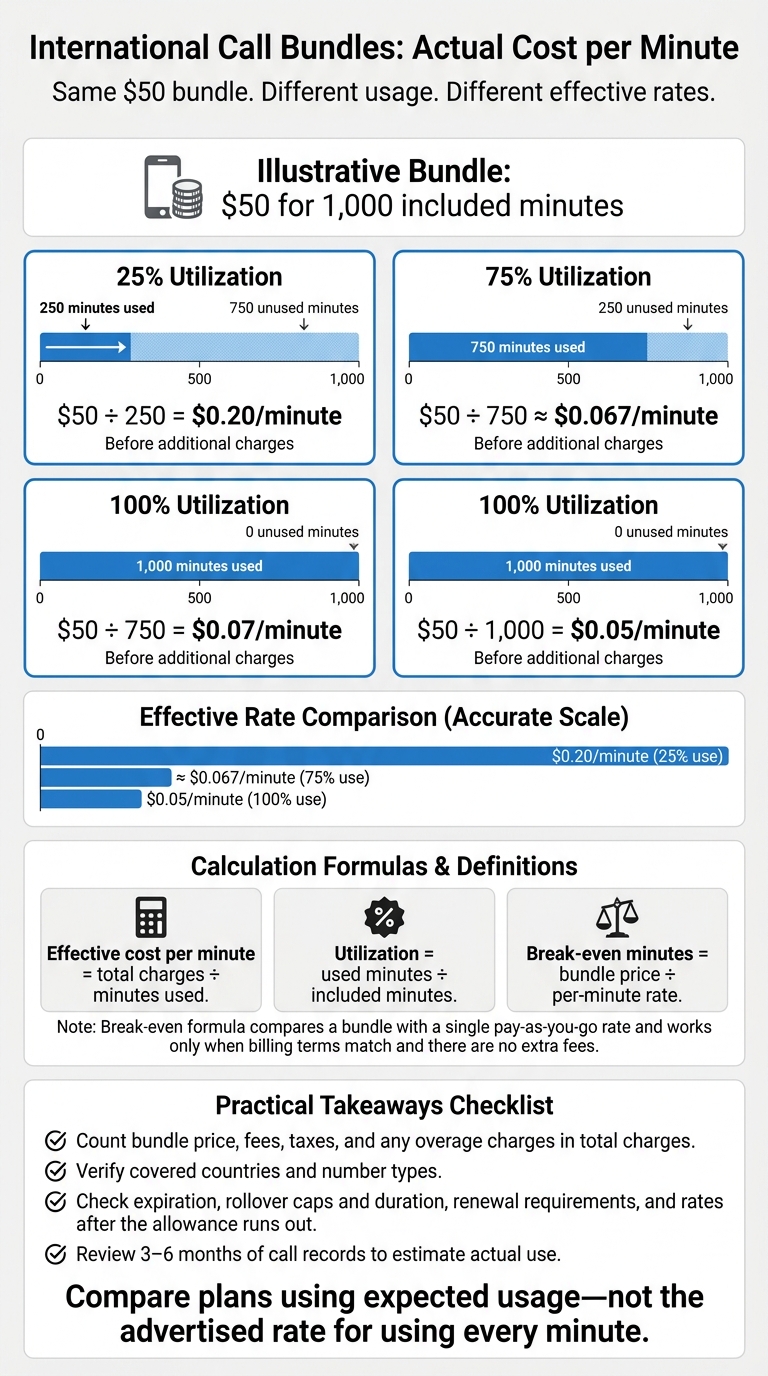
I’d choose the plan with the lowest total cost for the calls I expect to make - not the lowest advertised rate. A $50 bundle with 1,000 minutes costs $0.20 per minute if I use only 250 minutes: just 25% of the allowance.
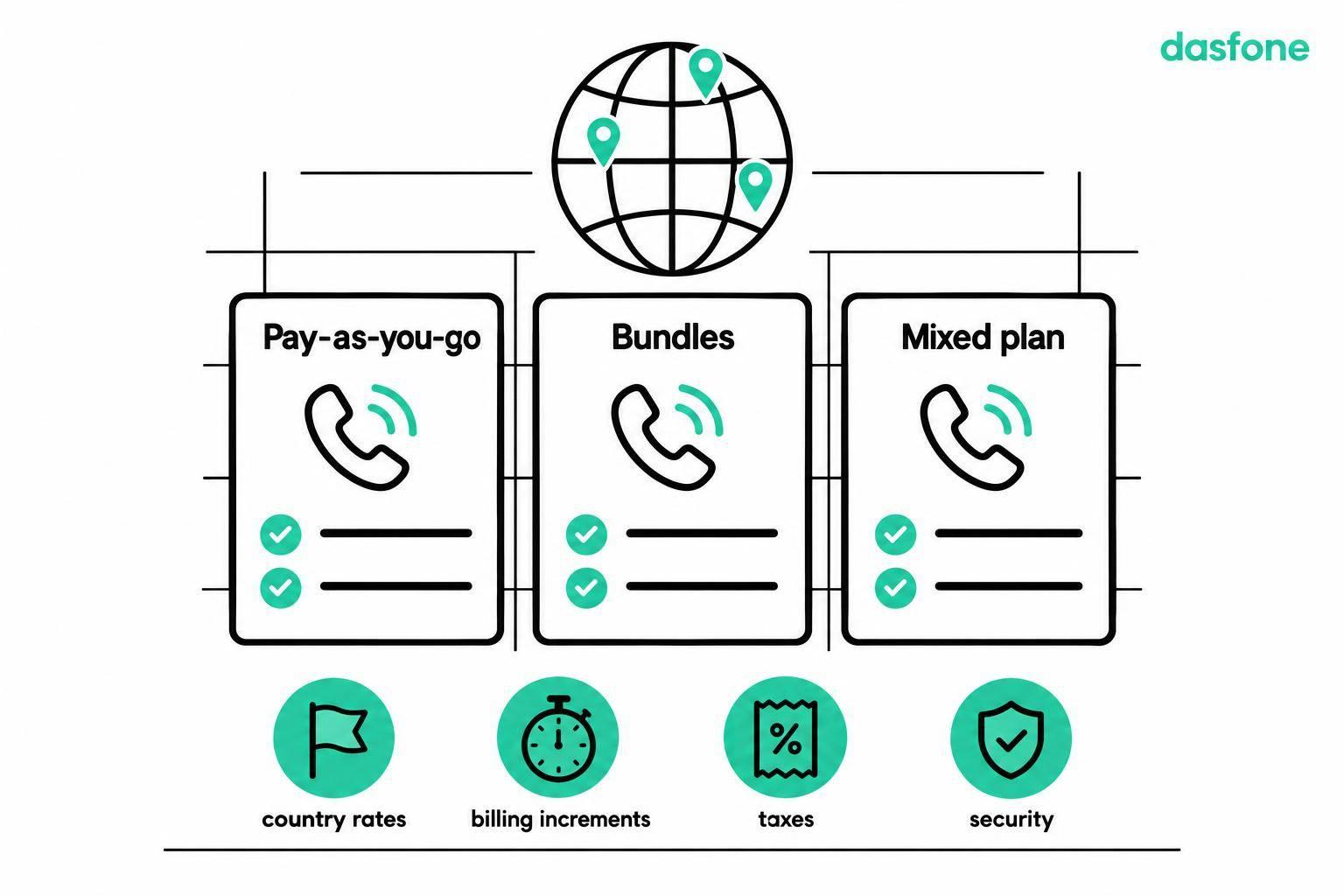
Here’s how I’d narrow the choice:
- Pay-as-you-go: For occasional or uneven calling, I’d check destination rates, credit expiration, and top-up settings.
- Minute bundles: For steady usage, I’d check covered countries, unused-minute rules, and charges after the allowance runs out.
- Mixed plans: For regular calls with busy months, I’d compare the recurring fee, included minutes, and overage rates.
Country and number type affect pricing in all three models. Before paying, I’d check billing increments, connection fees, taxes, account security, spending controls, and caller-ID costs. Browser-based services like dasfone aren’t a substitute for emergency calling.
My final check: estimate low-, normal-, and high-use months, make a test call, and compare the charge with my estimate.
Minute Bundles and Monthly Costs
A minute bundle gives you a fixed pool of calling minutes for a set price, usually billed monthly. It can suit callers whose usage stays steady from month to month. But unused minutes and overage charges change what you actually pay per minute.
Calculate Effective Rates and Break-Even Usage
Effective cost per minute = total charges ÷ minutes used. Count the bundle price, fees, taxes, and any overage charges.
In a $50, 1,000-minute bundle, the effective rate depends on actual usage.[1]
Minutes used Calculation Effective rate before additional charges 250 $50 ÷ 250 $0.20/minute 750 $50 ÷ 750 About $0.067/minute 1,000 $50 ÷ 1,000 $0.05/minute
For a single pay-as-you-go rate, break-even minutes = bundle price ÷ per-minute rate. This calculation works only when billing terms match and there are no extra fees.
If rates differ by country or number type, calculate your expected call costs for each destination. Then compare that total with the bundle price plus charges for calls the bundle excludes. The comparison only helps if the bundle covers your destinations and calling pattern.
Check Bundle Limits and Unused Minutes
Check which countries and number types qualify, whether staff share the allowance, and when minutes expire. Rollover may have a cap or require renewal by a certain date. Also confirm the renewal date, cancellation deadline, and whether calls stop or switch to another rate once you use all your minutes.
Compare plans using expected usage, not just the advertised rate for using every minute.
Bundle cost Included minutes Rate at full use Rate at expected use Overage rate Expiration or rollover $50 1,000 $0.05/minute $0.20/minute at 250 minutes Check destination rate Confirm expiration date $50 1,000 $0.05/minute About $0.067/minute at 750 minutes Check destination rate Confirm rollover cap and duration $50 1,000 $0.05/minute $0.05/minute at 1,000 minutes Check rate after exhaustion Confirm renewal requirements
For regular callers, past call records give the clearest estimate of actual costs. Review 3–6 months of call records by employee, destination, and number type to help avoid unused minutes or exceeding the allowance.
Utilization = used minutes ÷ included minutes. Don’t buy more minutes than staff regularly use unless rollover makes the extra cost worthwhile.[2] Next, compare these bundles with mixed plans that add country-based pricing and overage fees.
Mixed Plans and Country-Based Pricing
After comparing pure bundles, look at plans that combine recurring fees with destination-specific charges. Mixed plans charge a recurring fee plus usage-based charges. Country-based pricing is a rate structure that can apply to any plan, not a separate billing model.[5][6][4]
Compare Base Fees and Overage Costs
Compare pay-as-you-go, fixed, and mixed plans using the same destinations and monthly call volume.
| Model | Billing | Cost predictability | Unused-minute risk | Coverage | Best calling pattern |
|---|---|---|---|---|---|
| Pay-as-you-go | Actual minutes multiplied by the applicable destination rate | Varies with usage | None | Rates vary by country and number type | Occasional or uneven usage |
| Fixed bundle | Recurring fee for a set allowance | Predictable until the allowance runs out | High if minutes expire or go unused | Listed countries, regions, or number types | Frequent calls to eligible destinations |
| Mixed plan | Recurring fee with included minutes, plus overage charges | Predictable base fee, variable overage | Depends on allowance use | Included and overage destinations may differ | Regular core calls plus changing outreach |
Country-based rates apply within each model, rather than replacing it.
Monthly cost = recurring fee + usage charges not covered by the allowance + overage charges + taxes and fees. Count each usage charge only once. Included minutes don't add a usage charge.
Check what happens when the allowance runs out: overage charges, blocked calls, or standard rates may apply.[6][4] Bundles suit steady calling patterns, while pay-as-you-go or mixed plans suit changing destinations.[4][3] Before estimating total spending, verify the exact rates for each country and number type.
Check Rates by Country and Number Type
Build your budget around your exact destination mix, not the headline rate. Once you've chosen a plan structure, review its destination rate sheet line by line. A destination tier or advertised starting rate may not cover every country or number in that group. Check landline rates separately from mobile, premium, toll-free, and special-service numbers, which often have their own rates or exclusions.[4][7]
Before budgeting, group call records by country, number type, expected minutes, and call frequency. Calculate costs using billable minutes, accounting for rounding and minimum billing increments. Then add connection fees, taxes, and other applicable charges.[5][6][4]
Security, Billing Details, and Caller ID
After comparing rates, check the account controls and billing rules that affect your final charge. A low rate doesn’t always mean a lower bill - billing terms, account settings, or caller-ID fees can add to the cost.
Check Account Security and Spending Controls
Review these details before adding credit:
- Secure access: Look for HTTPS, documented encryption, protected credentials, and two-factor authentication where available.[8][9]
- Account visibility: Check for call history, transaction records, and alerts when someone uses your account without permission.
- Spending controls: Review auto-top-up thresholds and recharge amounts, and confirm how to turn auto-top-up off.
- Billing terms: Check the terms or FAQ for balance deductions, receipts, and account-level charges.
After a test call, compare the recorded charge with the amount deducted from your balance. Before adding more credit, confirm when billing starts and whether unanswered calls, failed calls, or calls sent to voicemail carry a charge.
Also check whether caller ID is included, restricted, or billed separately.
Verify Caller-ID Fees and Call Restrictions
Browser-based services like dasfone do not support emergency calling. Do not use them for 911 or 112.[8]
Caller ID may be included, cost extra, or have restrictions based on the destination. Check whether the service supports a dedicated caller ID, what it costs, and whether your number is eligible or needs verification. Use these details to compare plans against your calling pattern.
Conclusion: Choose Pricing That Fits Your Calls
Estimate One Month of Calls
Once you’ve compared rates, bundles, and mixed plans, check them against one month of expected calls. Break down your usage by country, number type, frequency, and duration. Keep personal and business calls separate when staff, accounts, or caller ID affect the bill. Estimate low-, normal-, and high-use months to account for seasonal changes or campaigns.
Apply billing increments before adding up minutes. Then calculate the full cost, including fees, call rates, connection charges, taxes, caller ID charges, and overage. For bundles, divide that total by the minutes you expect to use, not the advertised allowance.
Choose a Plan and Review Its Cost
Use this table to find the plan with the lowest realistic total cost.
| Calling pattern | Likely model | Main risk | Required checks |
|---|---|---|---|
| Occasional or variable calls | Pay-as-you-go | Rounding or minimum charges | Billing increments and security controls |
| Usage near the allowance | Minute bundle | Unused minutes expiring | Covered destinations, expiration, and used-minute cost |
| Steady base usage with spikes | Mixed plan | Fixed fees plus costly overage | Baseline usage and seat charges |
If your estimates point to subscription-free pay-as-you-go, dasfone may be a fit. Check the exact rates for each country and number type, and avoid buying minutes that will expire before you use them.
Choose the lowest realistic total cost that meets your security and spending-control needs. Compare your first bill with your estimate, then run the numbers again when destinations, staffing, or call volume change.
FAQs
How do I compare plans when my destinations change?
If your calling destinations change often, put flexibility first. Fixed-country subscriptions may cover only certain regions and charge high overage fees for calls outside them.
Pay-as-you-go (PAYG) is usually the lowest-cost, clearest option when your calling habits vary. You pay by the minute, without monthly commitments or country bundles that limit where you can call. That means you don’t pay for minutes you won’t use. Check rates for each destination, though: calls to mobile numbers can cost much more than calls to landlines.
How do short calls affect my total cost?
Short calls can cost more than you expect, depending on how they’re billed. With 60-second billing increments, a 5- or 10-second call still costs a full minute.
If you make frequent short calls, look for per-second billing so you pay only for the exact call duration. Avoid flat connection fees - they can make short calls disproportionately expensive.
How can I prevent unexpected calling charges?
Pay only for what you use with clear pay-as-you-go pricing. There are no hidden fees, subscriptions, or long-term contracts. Origin-aware pricing shows accurate rates for your destination before you dial, so you can avoid surprise costs or connection fees.
Charges come out of your prepaid balance in real time, helping you keep track of spending. Credits never expire, so you won’t lose unused minutes when a billing cycle ends.
Related Articles
Ready to Make International Calls?
Try dasfone today and make your first international call in seconds. No app download, no subscription—just instant, affordable calling from your browser.
Start Calling Now