Pay-As-You-Go Calling vs. Subscriptions
Pay-As-You-Go Calling vs. Subscriptions
When deciding between pay-as-you-go (PAYG) calling and subscription plans, the choice depends on your calling habits, cost priorities, and flexibility needs. Here's a quick breakdown:
- PAYG charges per minute, offering flexibility and no contracts. It's ideal for occasional callers, travelers, or those with unpredictable usage. Rates can be as low as $0.01/min for international calls, but you'll need to monitor your balance.
- Subscriptions charge a fixed monthly fee and often include unlimited or bundled minutes. Best for frequent callers or businesses with steady usage. Predictable costs make budgeting easier, but unused minutes can go to waste.
Key Factors to Consider:
- Cost: PAYG is cheaper for light or irregular use; subscriptions save money for high-volume calls.
- Flexibility: PAYG lets you stop anytime, while subscriptions require ongoing payments.
- Destinations: Subscriptions may exclude certain countries, while PAYG offers clear per-minute rates.
- Usage Patterns: Review your call history to match the plan to your actual needs.
Quick Comparison:
| Feature | Pay-As-You-Go | Subscription Plans |
|---|---|---|
| Cost Structure | Per-minute charges | Fixed monthly fee |
| Flexibility | No contract, stop anytime | Requires commitment |
| Best For | Light/infrequent users | Frequent callers |
| Hidden Costs | Possible hidden fees | Unused minutes wasted |
PAYG suits those with irregular calling needs, while subscriptions work better for consistent, high-volume users. Choose based on your usage and budget.
Pay-as-you-go vs Prepaid VoIP: Which Fits Your Business Best?
What Is Pay-As-You-Go Calling?
Pay-as-you-go (PAYG) calling works a lot like a prepaid debit card: you load credit in advance and pay per minute, avoiding monthly bills, contracts, or recurring fees.
Using VoIP technology and least-cost routing (LCR) [1], PAYG calls can save you up to 95% compared to traditional carrier rates. For instance, a call to the UK might cost just $0.01 per minute with a PAYG VoIP service, while a legacy phone company could charge $1.50 or more for the same call [1].
By 2007, prepaid accounts made up two-thirds of all mobile phone accounts globally [7]. The international PAYG calling market, valued at $1.58 billion, is expected to grow annually by 8.7%, reaching $1.72 billion [1]. This growth highlights a growing preference for flexible spending without the restrictions of fixed plans.
Here’s a closer look at how PAYG works, along with its benefits and drawbacks.
How Pay-As-You-Go Works
Getting started with PAYG is straightforward. You create an account, add credit (usually a minimum of $10.00 [8][10]), and start making calls. Rates depend on the destination - for example, calls to Canada cost $0.01 per minute, while calls to Cuba range from $0.60 to $1.50 per minute [1].
Calls are billed in 60-second increments, so even a 5-second call will cost a full minute [11]. If your balance runs out mid-call, most services give a warning - like a beep when you have two minutes of credit left - before disconnecting [8]. To avoid interruptions, many providers offer auto-recharge options that top up your balance once it drops below a certain amount, such as $2.00 [1][10].
It’s also important to check the provider’s credit expiration policy. Some services keep your balance indefinitely, while others may cancel unused funds after 6–12 months [1][9].
These details help define how PAYG operates and what users can expect from the service.
Benefits of Pay-As-You-Go
One of the biggest perks of PAYG is its flexibility. You only pay for the minutes you use, without being locked into a contract. This makes it ideal for people with unpredictable calling habits, like expats who occasionally call home or small business owners who reach out to international suppliers sporadically.
Another advantage is transparent pricing. You know exactly what a call will cost before you make it, with no hidden fees or overage charges. International call rates have dropped by roughly 40% in recent years [1], and PAYG services pass these savings directly to you. Traditional carriers, on the other hand, can charge up to 40 times more than PAYG rates. For example, AT&T and Verizon’s basic landline rates for international calls range from $1.55 to $5.00 per minute without a plan [5].
"The real beauty of PAYG is how it adapts to you. It directly reflects your actual usage, ensuring every cent you spend is for a real conversation, not just to keep a subscription active." - CallSky.io [1]
Another bonus? No credit checks or long-term commitments. You can stop using the service anytime without worrying about cancellation fees or penalties [1].
Drawbacks of Pay-As-You-Go
While PAYG is great for occasional users, it can get pricey if you make frequent or lengthy calls. In such cases, a subscription plan with bundled minutes might be more economical.
Another downside is the need to manage your balance manually. Unlike subscription plans that renew automatically, PAYG requires you to monitor your credit and top up when it gets low [1][2]. Forgetting to recharge could leave you unable to make calls when you need them most.
Hidden fees are another concern. In 2015, the FCC fined six companies a total of $30 million for deceptive practices related to prepaid calling cards. These included undisclosed charges like "maintenance fees", "connection fees", and "hang-up fees" that drained balances faster than advertised [9].
Lastly, PAYG services often bill in 60-second increments, meaning even a 10-second call will cost a full minute [11]. If you make a lot of quick calls, this billing method might feel inefficient.
What Are Subscription-Based Calling Plans?
Subscription-based calling plans are like a monthly membership for phone services. You pay a fixed fee each month in exchange for a specific set of benefits, such as a certain number of minutes or unlimited calls to particular destinations. Unlike pay-as-you-go plans, where you’re billed per minute, subscriptions require a regular monthly payment, whether or not you fully use the service.
These plans are typically divided into two types: "Domestic" (calls within the country where the plan is based) and "International" (calls to selected foreign countries) [3]. For instance, a plan might offer unlimited calls within the U.S. and a set number of minutes to 196 international destinations. However, calls to countries not included in the plan can lead to steep additional charges [1]. The pricing is designed to be predictable, tied to specific coverage areas. Let’s explore how these plans work and what they bring to the table.
How Subscription Plans Work
When you sign up for a subscription plan, you’re charged a monthly fee that either gives you a set number of minutes or works as a credit balance applied to per-minute rates. For example, United World Telecom's Outbound Calling Basic Plan costs $25 per month. With a rate of $0.023 per minute for calls to the U.S. or Canada, that $25 covers about 1,086 minutes [11].
Plans that advertise "unlimited" calling often come with fair usage policies to prevent misuse. Vonage, for instance, explains:
"Unlimited Calling is based on normal residential, non-commercial use. A combination of factors is used to determine abnormal use, including but not limited to: the number of unique numbers called, calls forwarded, minutes used and other factors." [12]
For businesses, many providers offer minute pooling, which allows all users within the same country to share a collective pool of minutes. For example, Microsoft Teams enables a group of 100 employees, each with a 3,000-minute plan, to share a total of 300,000 minutes per month [3]. This setup helps companies avoid individual overage fees, though any unused minutes disappear at the end of the billing cycle [1][2].
Benefits of Subscriptions
One of the main advantages of subscription plans is predictable budgeting. Knowing your monthly costs upfront makes financial planning easier, especially for businesses with steady calling needs. If you frequently call the same destinations, subscriptions can save you a lot compared to pay-as-you-go rates.
For instance, international calls without a plan can cost anywhere from $1.55 to $5.00 per minute with traditional carriers [5]. Subscriptions significantly cut these costs. AT&T’s Worldwide Value Calling add-on, at just $5.99 per month, reduces the per-minute rate for calls to Canada from $1.55 to $0.05 [5].
Many subscription plans also come with extra perks. These might include mobile hotspot data, international roaming, or even subscriptions to streaming services [14]. For example, AT&T’s Unlimited Extra EL plan offers 75 GB of priority data and 30 GB of mobile hotspot data for $76 per month [14].
For those who make a lot of calls, subscriptions remove the hassle of tracking balances or topping up credits. Once you’ve paid your monthly fee, you’re covered until the next billing cycle.
Drawbacks of Subscriptions
While subscriptions have their advantages, they’re not ideal for everyone. If you don’t make many calls, you could end up paying for minutes you don’t use. The flat monthly rate doesn’t change whether you use just 10 minutes or 1,000 [1][2].
Another downside is limited flexibility. Most subscription plans are tailored to specific countries or regions. If you need to call a destination outside your plan’s coverage, you could face high overage charges, sometimes comparable to traditional carrier rates [1]. This makes subscriptions less practical for users with unpredictable or varied calling needs.
Contracts can also be a sticking point. Many providers require you to commit to a monthly or annual plan, and canceling early may result in penalties [1]. Even without a formal contract, failing to renew on time could lead to service interruptions or lost balances [2].
Lastly, subscriptions often come with hidden restrictions. Fair usage policies, for example, can be vague, and providers might throttle or even suspend your service if your usage is deemed "abnormal" [12].
Cost Comparison: Which Model Costs Less?
Looking at the cost breakdown, the right choice depends on how often you make calls. If you're someone who only makes the occasional international call, pay-as-you-go (PAYG) is often the cheaper option. However, for those who regularly make calls - especially in high volumes - subscription plans can save money once your usage hits a certain level.
Traditional phone carriers charge steep rates for international calls, often between $1.50 and $3.00+ per minute. In contrast, PAYG VoIP services allow you to make international calls directly in your browser for as little as $0.01 per minute - an enormous difference[1]. Subscription plans, while having a fixed cost, offer predictable billing that’s useful if you have steady usage patterns.
"Data is where the money goes. The more you're allowed to use each month, the higher the price climbs." - Choncé Maddox, Personal Finance Writer, Kiplinger[2]
For those who rarely call, PAYG is the most cost-efficient. For example, topping up three times a year at $50 each time would total $150 annually - far less than a $35/month subscription, which adds up to $420 per year.
Cost Examples for Different Users
Here’s how the numbers shake out for different types of callers:
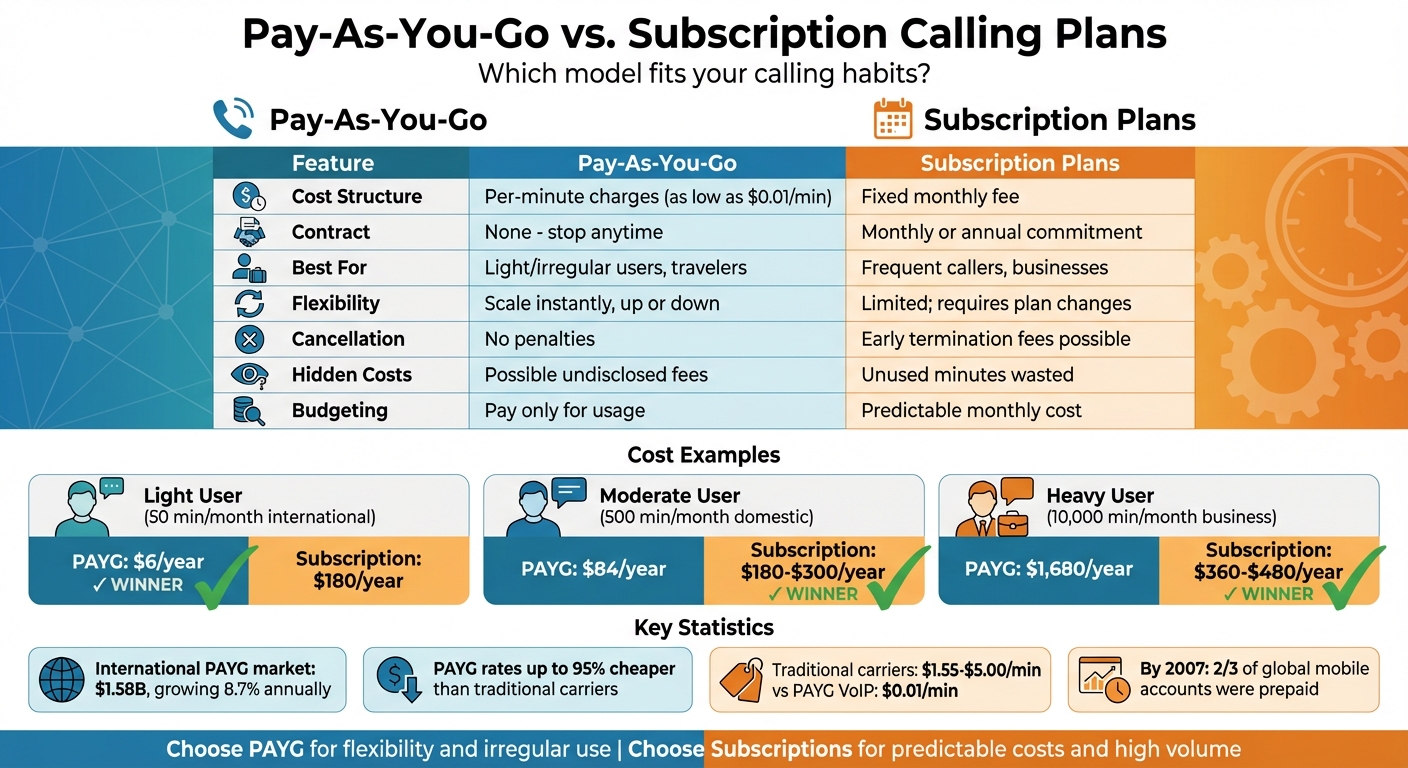
- A light user making about 50 minutes of international calls per month would spend just $6 annually with PAYG (at $0.01 per minute)[1]. Meanwhile, even a modest subscription plan at $15 per month would cost $180 per year.
- A moderate user making 500 minutes of domestic calls per month might pay $7 monthly (or $84 annually) with PAYG at $0.014 per minute[4]. A basic subscription plan in this case could range between $15 and $25 per month, or $180 to $300 annually.
- Heavy users, like businesses handling customer support or sales calls, see the most noticeable cost differences. For 10,000 minutes per month at $0.014 per minute[4], PAYG costs around $140 monthly. A business VoIP subscription, however, might cost $30 to $40 per user monthly.
| User Profile | Monthly Usage | PAYG Annual Cost | Subscription Annual Cost | Winner |
|---|---|---|---|---|
| Light | 50 min/month (international) | $6 | $180 | PAYG |
| Moderate | 500 min/month (domestic) | $84 | $180 - $300 | Subscription |
| Heavy | 10,000 min/month (business) | $1,680 | $360 - $480 | Subscription |
These examples highlight when PAYG shines and when subscription plans start to take the lead.
When Subscriptions Become Cheaper
Subscriptions generally become the better deal when your usage consistently exceeds the cost of the flat monthly fee. For domestic calls, this tends to happen at around 500 to 1,000 minutes per month[2][15]. If you’re making more than an hour of calls daily, a bundled or unlimited plan can easily beat PAYG’s per-minute rates.
For international calls, the tipping point depends on the destination. At $0.01 per minute, you’d need to make around 600 minutes of calls per month to justify an international add-on costing about $6[1][5]. On the other hand, for pricier destinations like the Philippines (at $0.11 to $0.25 per minute) or Cuba (at $0.60 to $1.50 per minute), even 50 to 100 minutes monthly can make a subscription worth it.
That said, subscriptions come with a fixed monthly cost, whether you use them or not. If your calling habits vary a lot, you might end up paying for unused capacity. PAYG, by contrast, ensures you only pay for what you actually use.
Flexibility and Commitment: Main Differences
When choosing between Pay-As-You-Go (PAYG) and subscription models, flexibility and commitment are key factors that set them apart.
Contracts and Cancellation Policies
One of PAYG's biggest perks is the absence of long-term contracts. You can stop using the service whenever you want - no strings attached, no penalties involved.
On the other hand, subscription plans usually require you to sign up for monthly or annual contracts. Canceling early? That often means paying a penalty. Timothy Jacob Hudson from How-To Geek sums it up well:
"Prepaid plans give you more freedom and flexibility, while postpaid plans are more affordable but lock you into contracts that will cost you extra fees if you break them." [16]
For those who value agility - like digital nomads, seasonal businesses, or anyone testing the waters in a new market - PAYG’s no-commitment structure is a clear winner. However, if your usage is steady and predictable, subscriptions might be more appealing, offering lower rates in exchange for a commitment.
Adjusting Your Service
The ability to adjust your service is where these models differ the most. PAYG makes scaling effortless. Traveling? Just skip topping up. Need to make more calls? Add credit whenever you want. Some providers even offer credits that don’t expire, making it a great option for light or infrequent users.
Subscriptions, however, are less forgiving. You pay a fixed fee every month, whether you use the service or not. If your call volume drops, you’re still stuck paying for the full plan until you can downgrade or cancel - often only possible at the end of your contract. While upgrading is typically easier, it often means moving to a more expensive tier that may include features you don’t need.
These differences in flexibility align closely with the cost dynamics discussed earlier.
| Feature | Pay-As-You-Go | Subscription Plans |
|---|---|---|
| Contract Requirement | None | Monthly or annual |
| Cancellation | Stop anytime, no penalties | Early termination fees possible |
| Scaling | Instant; up or down to zero | Limited; may require plan changes |
| Cost Waste | None; pay only for what you use | High; pay for unused minutes |
PAYG gives you complete control, adapting to your usage patterns - perfect for unpredictable or seasonal needs. Subscriptions, in contrast, offer stability and simplicity for those with consistent usage, but they come with the trade-off of reduced flexibility and a required commitment.
Best Use Cases for Each Model
Choosing between pay-as-you-go and subscription plans depends entirely on your calling habits. The best option comes down to how often you call, where you're calling, and whether your needs are steady or fluctuate over time.
Who Should Use Pay-As-You-Go?
Pay-as-you-go is perfect for those with unpredictable or irregular calling needs. For instance:
Digital nomads and travelers: If you're hopping between countries - making business calls from Thailand one week and checking in with clients from Portugal the next - pay-as-you-go ensures you only pay for what you use. No need to worry about SIM swaps or roaming charges.
Expats and international families: Whether it's a quick hello or a long catch-up session, pay-as-you-go offers flexibility without tying you to a plan.
Small and medium-sized businesses: Companies with seasonal or fluctuating international call volumes, such as during product launches, can benefit from this model. It’s also great for light users, like retirees or remote workers maintaining a backup line for emergencies.
For individuals making occasional international calls, this option can be incredibly cost-efficient. A single refill might last months, potentially saving up to $270 annually compared to a basic monthly plan [5].
If flexibility and no long-term commitments are what you’re after, dasfone offers a browser-based platform with clear pay-as-you-go pricing.
Who Should Use Subscriptions?
Subscriptions, on the other hand, are ideal for those with consistent, high-volume calling needs. Here’s who benefits the most:
Heavy callers and call centers: Whether it’s customer service, sales, or personal connections, subscription plans with unlimited domestic calling and texting simplify budgeting and remove the stress of tracking minutes.
Remote and collaborative teams: Many subscription plans include bundled features like video conferencing, team chat, file sharing, and analytics. These extras are invaluable for teams with steady communication needs. As SingData highlights:
"Subscription pricing works best for teams that want cost certainty." [6]
- Frequent international callers: If you’re making daily international calls, subscriptions offer lower per-minute rates. For example, in 2020, AT&T’s basic rate to China was $5.00 per minute. But with their $5.99/month "Worldwide Value Calling" plan, that rate dropped to $0.11 per minute - a savings of over 95% for regular users [5].
Businesses, in particular, appreciate the predictability of a fixed monthly fee. It eliminates surprises from unexpected usage spikes and simplifies annual financial planning.
What to Consider When Choosing a Model
After understanding cost and usage details, take a closer look at these additional factors before deciding on a calling model. Reviewing three months of call history can help you spot trends in call frequency, durations, and the countries you contact most often.
Call Frequency and Volume
If you're making daily international calls to specific countries, a subscription with a flat monthly fee can make budgeting easier by removing the stress of tracking per-minute charges. But if your call patterns are unpredictable - busy one month and quiet the next - a subscription might leave you paying for unused minutes. In such cases, pay-as-you-go may be a better fit, as you only pay for the calls you actually make [1].
Also, keep an eye on billing increments. Some providers round call durations up to the nearest minute - or even five minutes - which can inflate costs, especially if you make a lot of short calls [13].
Calling Destinations
The countries you call can greatly affect your costs. Subscriptions work well for frequently dialed, low-cost destinations like Canada, the UK, or India, where flat fees cover high call volumes. However, if your calls are spread across less common regions - such as parts of Africa, the Middle East, or the Pacific Islands - subscription plans may exclude those areas, leading to hefty overage charges.
Another key detail is whether you’re calling landlines or mobile numbers. Mobile termination fees can be 200%–500% higher [13]. Some subscription plans advertise low rates for specific countries but exclude mobile numbers or charge much higher rates for them. Pay-as-you-go, on the other hand, allows you to see exact rates upfront, so you know what you're paying before you call.
Budget Predictability and Features
Subscriptions offer a consistent monthly cost, making it easier to manage your budget. However, calls to regions outside the subscription’s coverage can quickly add up. Pay-as-you-go only charges you when you make a call, and the rate is clear before you dial.
Be sure to check for hidden fees or credit expiration policies in the fine print [1]. For business users, security features like encrypted calls may be crucial. Services like dasfone (https://dasfone.com) include built-in encryption on their browser-based pay-as-you-go platform, offering transparent per-minute rates without requiring a subscription.
Conclusion: Choosing the Right Model
There’s no one-size-fits-all answer here - the best option depends on your calling habits, destinations, and how predictable your usage is. Subscriptions are ideal if you’re consistently calling the same destinations and prefer a fixed monthly expense. On the other hand, pay-as-you-go (PAYG) is better for irregular call patterns, varying destinations, or when you want to avoid paying during months when you don’t make calls.
Your long-term costs are directly tied to these habits. Instead of focusing on monthly expenses, take a broader view and calculate your annual spend. For example, a $50 PAYG top-up that lasts four months totals $150 per year - much less than a $35/month subscription, which adds up to $420 annually [2]. That’s a big difference, especially for occasional or light users.
For international callers who value flexibility without being tied to a contract - like expats, digital nomads, or businesses with unpredictable call volumes - a browser-based PAYG service like dasfone can be a great fit. They offer clear per-minute rates, HD audio, built-in encryption, and no subscription fees, with a low $5 minimum to get started.
The key takeaway: match your plan to your actual usage, not your worst-case scenario. Review your call history, check the rates for your most common destinations, and pick the model that fits how you use the service.
FAQs
How do I calculate my break-even point between PAYG and a subscription?
To figure out your break-even point, start by calculating your total costs for a pay-as-you-go (PAYG) plan and compare them to a subscription plan. Take your average monthly usage - like minutes or units - and multiply it by the PAYG rate. The break-even point is the point where your PAYG costs match the subscription fee.
For instance, if the PAYG rate is $0.10 per minute and the subscription costs $20 per month, the break-even point happens at 200 minutes of usage. At that point, both options cost the same, so anything above 200 minutes would make the subscription plan more cost-effective.
What hidden fees or restrictions should I watch for in each plan type?
When choosing pay-as-you-go plans, keep an eye out for hidden costs like connection fees, charges for premium or international calls, mandatory minimum top-up amounts, or fees for extra features. These can quickly add up and catch you off guard.
Subscription plans come with their own set of potential fees. These might include overage charges, early termination penalties, or added costs for optional features like extra lines. Some plans may also restrict usage hours or limit international calling, which could result in extra charges if you go beyond those limits.
How do I pick the best option if I call multiple countries or mobile numbers?
When deciding how to manage calls to multiple countries or mobile numbers, think about both cost and flexibility. Services like dasfone offer pay-as-you-go plans with clear, destination-specific rates and no subscription fees. This makes them a great choice for those with irregular or unpredictable calling patterns. On the other hand, if you make a consistent number of calls, a subscription plan might help you better manage costs. That said, pay-as-you-go services give you more freedom and can help you avoid paying for unused services when your international calling needs vary.
Related Articles
Ready to Make International Calls?
Try dasfone today and make your first international call in seconds. No app download, no subscription—just instant, affordable calling from your browser.
Start Calling Now