What Sales Data Says About Multilingual Calls
What Sales Data Says About Multilingual Calls
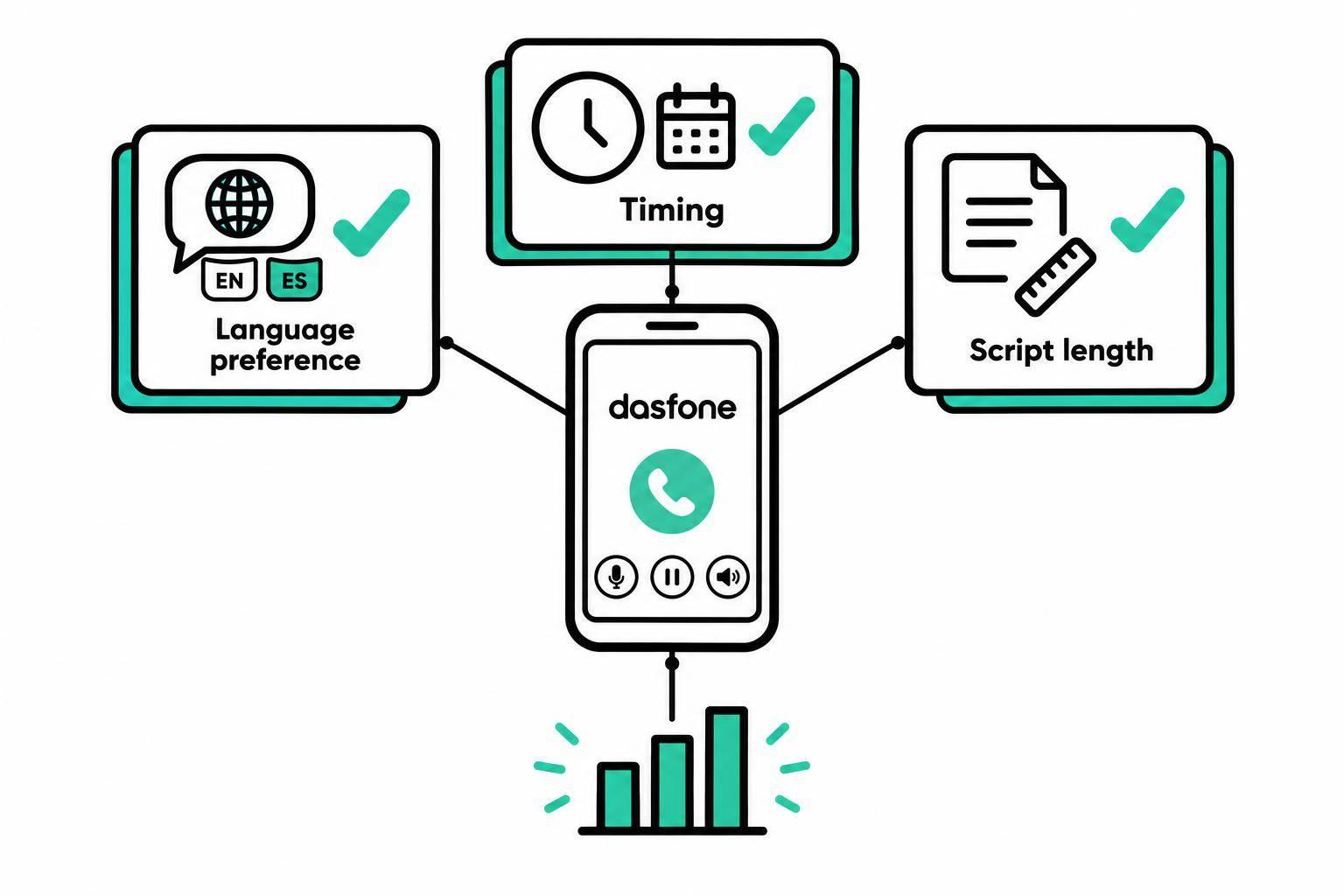
I wouldn’t treat general cold-calling data as proof that language matching leads to more meetings. Before drawing that conclusion, I’d track confirmed language preference and compare results using the same call definitions.
Here’s what I’d measure:
- Answers, conversations, and meetings: Show counts and percentages, with a clear denominator for each.
- Language and script length: Test them separately, using short, locally reviewed scripts.
- Timing and follow-up: Test local calling windows and track results by attempt number.
- Campaign reach: Count distinct prospects, not just dials, and log caller ID, list quality, and call outcomes.
The goal: find what works in your market without mistaking a timing or setup change for a language effect. I’d start with consistent tracking, not an unsupported benchmark.
Answer Rates: Compare the Same Measures
Published Answer Rates and Their Limits
Before comparing published rates, use the same answer definition from the previous section.
The supplied material provides no verifiable answer-rate benchmark. It leaves out the study, sample size, period, and answer definition. Without the original answer definition, a benchmark can't support a like-for-like comparison.
Track Answers by Market and Language
If you can't use a published benchmark, track your own answer data using the same rules.
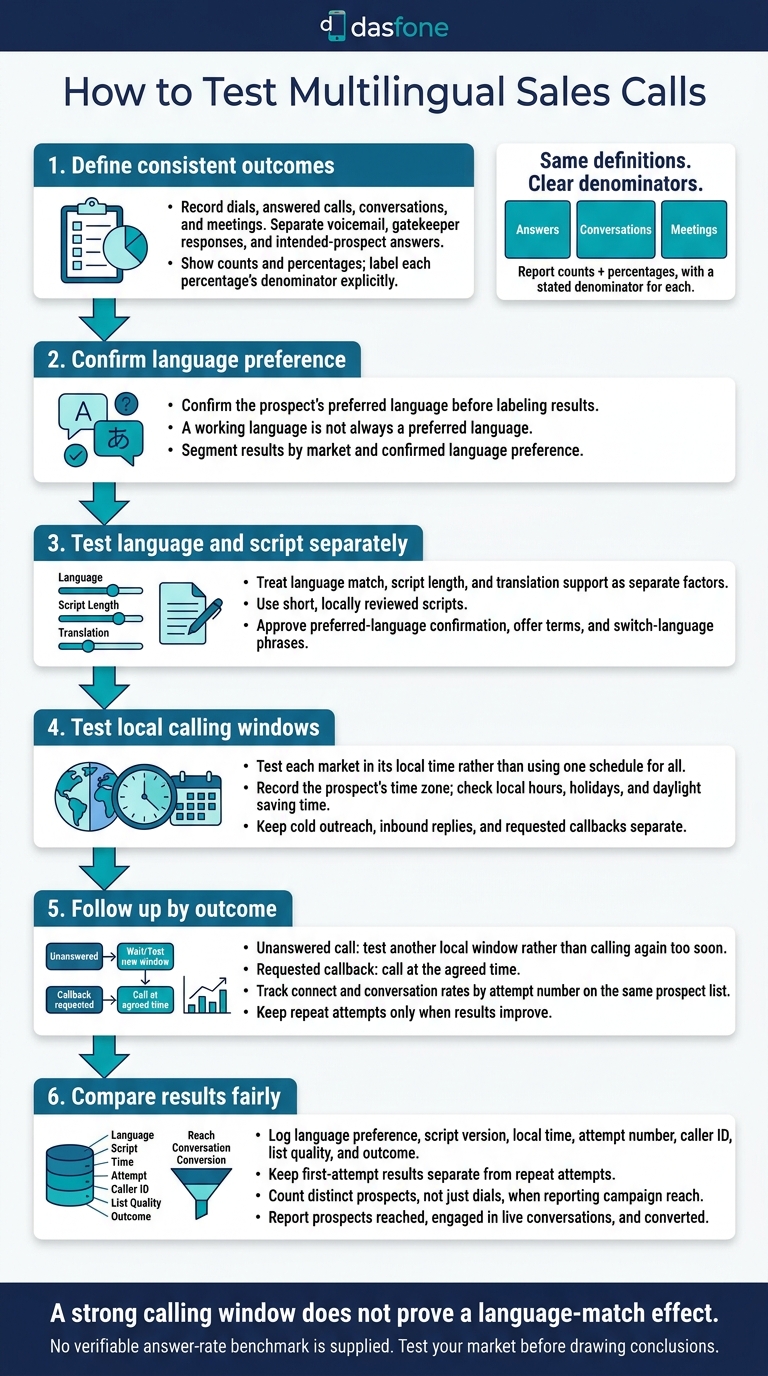
Record dials, answered calls, conversations, and meetings by market, confirmed language preference, caller ID, list quality, and attempt number. Track voicemail, gatekeeper responses, and intended-prospect answers separately. Confirm language preference before labeling a result.
Show counts alongside percentages so readers can compare the results fairly. Keep first-attempt results separate from repeat attempts, and don't credit a greeting change for higher answer rates unless you've controlled for list quality, timing, and caller ID.
Cold Calling Metrics Explained. Connects, Incompletes, and Completions
Language and Script Length: Findings vs. Tests
After tracking answer rates, test whether language choice affects what happens once a prospect picks up.
A working language isn’t always a prospect’s preferred language. The material doesn’t establish which language setup or script length works best. Test shorter, locally reviewed scripts in each market, treating language match, script length, and translation support as separate factors.
Compare Answer, Conversation, and Meeting Rates by Language Version
Track answer, conversation, and meeting rates for each language version. Keep the setup as consistent as possible and use the same measures across markets. This helps separate the effects of language choice from other factors.
Write a Short, Locally Reviewed Script
Use market-by-market tracking to distinguish script-length effects from language effects.
Keep scripts short, and have a local reviewer approve the wording before use. Focus on clarity, accurate terminology, and clear phrases for switching languages. If your workflow includes live translation, dasfone supports real-time translation in 40+ languages[1].
Prepare an Approved Phrasing Sheet
Keep one approved reference sheet for language checks, business terms, and phrases for switching languages.
| Component | What to approve |
|---|---|
| Preferred-language confirmation | Wording for confirming the prospect’s preferred language |
| Approved offer terms | Accurate terms for the offer |
| Switch-language phrases | Phrases for switching languages mid-call |
Timing and Follow-Up: Test Each Market
After reviewing the script, test when to call and how to follow up. Treat timing as a test variable alongside language preference and script length. Keep cold outreach, inbound replies, and requested callbacks separate. Test each market rather than using one schedule for all.
Compare Calling Windows in Local Time
Work in each market’s local time. Tuesday–Thursday data shows that 10:00–11:00 a.m. and 4:00–6:00 p.m. are the strongest calling blocks. The weakest is 12:00–2:00 p.m.
Use the windows below as starting points for market tests.
| Target Region | Recommended Local Window | U.S. Eastern Time Equivalent |
|---|---|---|
| North America (East) | 8:00 a.m. – 10:00 a.m. | 8:00 a.m. – 10:00 a.m. |
| North America (West) | 9:00 a.m. – 11:00 a.m. | 12:00 p.m. – 2:00 p.m. |
| UK & Ireland | 8:30 a.m. – 10:00 a.m. | 3:30 a.m. – 5:00 a.m. |
| Germany & Nordics | 8:00 a.m. – 9:30 a.m. | 2:00 a.m. – 3:30 a.m. |
| France, Spain, Italy | 9:30 a.m. – 11:00 a.m. | 3:30 a.m. – 5:00 a.m. |
| APAC | 10:00 a.m. – 12:00 p.m. | 9:00 p.m. – 11:00 p.m. (previous day) |
| APAC late window | 4:00 p.m. – 5:00 p.m. | 3:00 a.m. – 4:00 a.m. |
Record each prospect’s time zone. Before scheduling, check local hours, holidays, and daylight saving time.
Once you’ve set the timing, match your follow-up to the call result.
Plan Follow-Up by Call Outcome
Set different follow-up rules for each outcome. If a call goes unanswered, test another local window instead of calling again too soon. If someone requests a callback, call at the agreed time.
For cold outreach and inbound leads, measure whether more attempts improve both connect rate and conversation rate.
Measure Results Across Call Attempts
Track connect and conversation rates by attempt number on the same prospect list, not by total dials. Keep repeat attempts only when results improve. Otherwise, cut them and move that effort to stronger markets and time windows.
Conclusion: Turn Findings Into Call Prep
Keep evidence about multilingual calls separate from general cold-calling findings. A strong calling window doesn’t prove that matching a prospect’s language matters. Call prep is the main lever you can control.
Check Language, Timing, and Calling Setup
Before each call, confirm the language, script, and local calling window. Check caller ID, too. Log every attempt in one place, including language preference, script version, local time, attempt number, and outcome.
Measure results across all attempts using distinct prospects, not just dials. Report how many prospects you reached, engaged in live conversations, and converted. This prevents repeat calls from making a campaign’s reach look larger than it is.
Use a browser-based calling setup with pay-as-you-go pricing and caller ID options. Before every campaign, check the language, timing, and setup.
FAQs
How many calls do I need to test language matching?
The available findings don’t set a fixed number of calls for testing language matching. For general call optimization, they suggest two-week A/B tests that compare conversation rates and meetings booked [1].
Before testing a new outreach variable, make test calls across carriers and mobile operating systems to check routing and how caller ID appears [2].
How can I test language preference without bias?
Run structured A/B tests over a consistent period. Compare your current approach with a version that gives prospects another language option. Track conversation rates and meetings booked, not just connections [1].
Keep the local time, day of the week, and caller ID the same across both versions [1][2]. Review the results objectively to see whether the language option improves engagement - or whether outside factors explain the difference [1].
When should I stop following up with a prospect?
Aim for 6 to 9 call attempts - this range accounts for 90% of successful connections. Most salespeople stop after about 2 attempts. But more calls aren’t always better: going beyond 12 is counterproductive, with success rates below 0.5%.
Use follow-ups to learn what prospects need. A rejection can teach you something; it doesn’t always mean the door is closed. Dasfone’s clear, secure connections can help build trust and move prospects toward commitment.
Related Articles
Ready to Make International Calls?
Try dasfone today and make your first international call in seconds. No app download, no subscription—just instant, affordable calling from your browser.
Start Calling Now