Why Browser-Based Calling Cuts Costs
Why Browser-Based Calling Cuts Costs
Browser-based calling is a cost-effective way to make international calls directly from your web browser, with no apps, contracts, or subscriptions required. Powered by WebRTC technology, it connects users to landlines and mobile numbers worldwide at a fraction of the cost of traditional carriers. Here's why it makes sense:
- Massive Savings: A 23-minute call to Germany costs $0.71 via browser-based calling compared to $64.40 with a carrier.
- No Subscriptions or Hidden Fees: Pay-as-you-go pricing means you only pay for the minutes you use, with rates as low as $0.005 to $0.03 per minute.
- Global Reach: Call any number worldwide, including businesses and government offices, with high-definition audio quality.
- Business Benefits: Companies can cut communication costs by over 90%, avoiding hardware and maintenance expenses.
For individuals and businesses alike, browser-based calling is a simple, affordable solution to stay connected without the inflated costs of outdated systems.
Why Traditional International Calling Is Expensive
High Carrier Rates and Roaming Fees
Traditional phone carriers charge steep rates for international calls, often far exceeding the actual cost of connecting them. For instance, AT&T charges $3.00 per minute to call the United Kingdom, while the true cost to route that call is just $0.003 - a markup of 1,000 times[3]. Other U.S. carriers typically charge between $1.50 and $5.00 per minute, depending on the destination[3].
Take Elena's story as an example. In February 2026, this Chicago-based freelance translator racked up a $225 bill after making 90 minutes' worth of calls to Germany, Spain, and Argentina on her AT&T plan. That worked out to $2.50 per minute. After switching to a browser-based VoIP service, her monthly cost dropped to under $4 - a 98% reduction[3].
Roaming fees are another financial trap. When traveling abroad, using your home SIM card can result in daily roaming pass charges or sky-high per-megabyte fees. These costs, combined with inflated per-minute rates and subscription requirements, can quickly make international calling an expensive headache.
Subscription Costs and Hidden Fees
Many traditional services require mandatory monthly subscriptions, regardless of how often you use them. For example, international plans from major carriers typically cost $10 to $15 per month[5]. Some VoIP apps charge between $2.99 and $19.99 monthly - Vonage, for instance, charges $19.99 per month plus a $29.99 activation fee[4].
For occasional callers, these fees often feel like wasted money. Even if you make just a few calls a month, you'll still pay the full subscription price. Calling cards might seem like a cheaper alternative, advertising rates as low as 2¢ per minute. But hidden costs like 99¢ connection fees and 89¢ weekly maintenance charges can bring the real cost up to 15–20¢ per minute[3]. On top of that, many services bill in 3-minute increments - so a 4-minute call could cost as much as a 6-minute one[3].
These recurring charges and sneaky fees add up over time, making traditional methods far more expensive than they appear.
Missing Out on Modern Savings
The biggest financial hit comes from sticking with outdated systems and missing out on the savings modern alternatives can offer. Sure, app-to-app services like WhatsApp and FaceTime allow free calls, but they have limitations. These platforms can't connect to landlines, businesses, or government offices, forcing you to fall back on costly carrier rates when you need to make those types of calls.
Traditional phone networks rely on decades-old technology that wasn't built for the modern, global workforce. For instance, a small business with 10 employees could waste over $7,600 annually by using outdated business phone systems instead of switching to browser-based options like dasfone or ZenCall[4]. In short, old tech inflates costs and prevents you from taking advantage of affordable, efficient alternatives.
How Browser-Based Calling Cuts Costs
No Apps or Subscriptions Required
With browser-based calling, you can make calls directly from your browser - no need for downloads, installations, or recurring fees. All it takes is opening a website, entering a number, and dialing. This eliminates the hefty costs associated with traditional on-premise systems, which often require hardware, wiring, and installation fees that can exceed $20,000[7].
For companies, the cost savings can be dramatic. Take TechStart Solutions, a software development firm with 45 employees. By switching to browser-based calling, they reduced their annual communication costs from $147,600 to just $12,000. This change also saved them $800 per month in IT maintenance and slashed their international call expenses from $8,000 to $400 per month - a 92% reduction[6]. Because everything operates in the cloud, there’s no need for IT staff to handle hardware issues or emergency service calls[6]. The simplicity of this setup also allows for transparent, usage-based billing. When choosing a provider, it helps to compare browser-based calling apps to find the best fit for your business.
Clear Pay-as-You-Go Rates
With pay-as-you-go pricing, you only pay for the minutes you use - no flat fees for unused services or hidden activation costs. Rates for browser-based calling typically range from $0.005 to $0.03 per minute[6], a stark contrast to traditional carriers that charge between $0.25 and $0.50 per minute for international calls[6].
A great example of this in action is GlobalTrade Imports, an international trading company with 12 employees. They make over 200 daily calls to 15 countries and managed to cut their annual communication expenses from $151,200 to $9,000. By replacing a carrier that charged $0.35–$0.75 per minute with a browser-based service at just $0.005 per minute, they achieved a 94% reduction in costs[6]. Plus, with no subscriptions or hidden fees, even occasional users avoid paying for services they don’t need. Beyond the cost transparency, browser-based services connect to any number worldwide.
Call Anyone, Anywhere
Browser-based calling isn’t limited to specific networks - it connects to landlines and mobile phones across the globe, including businesses, government offices, and banks. In the U.S., landline call rates can be as low as $0.02 per minute, making it an affordable choice. On top of that, WebRTC technology delivers high-definition audio with 48kHz sampling, far superior to the 8kHz audio standard of traditional phone networks[2].
"Browser calls often sound better than regular phone calls. Traditional phone networks compress audio to 8kHz - technology from the 1970s. WebRTC uses 48kHz sampling." – GlobCall [2]
This combination of global accessibility, straightforward pricing, and exceptional audio quality makes browser-based calling an attractive option for those seeking reliable international communication without the high costs of outdated systems.
Cost Comparison: Traditional vs. Browser-Based Calling
How Much Frequent Callers Save
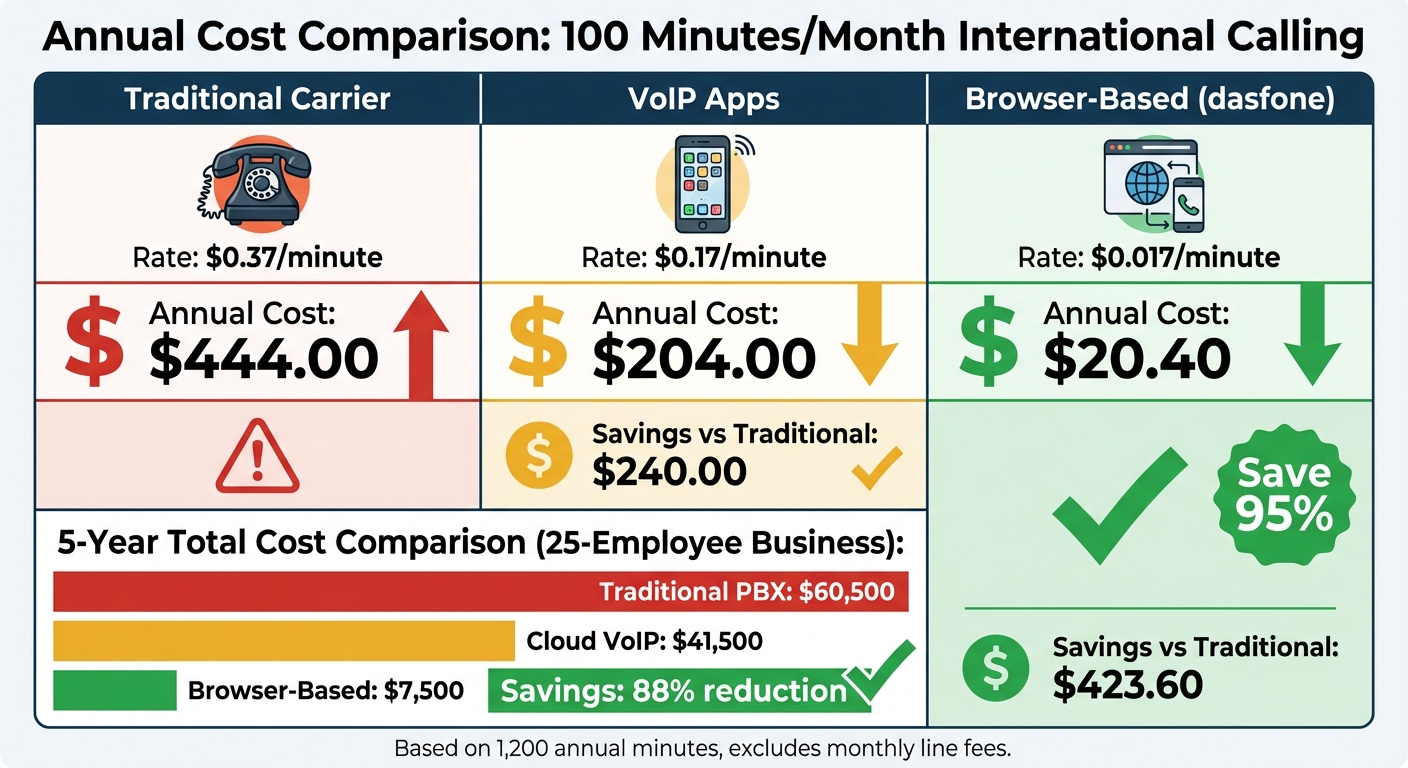
When it comes to costs, browser-based calling platforms leave traditional systems in the dust. For a business with 25 employees, a traditional PBX system typically racks up about $8,500 annually, while browser-based calling costs only $1,200 - a massive 86% reduction [6]. Factor in hidden expenses like IT support and equipment breakdowns, and the savings can soar to 91%, adding up to nearly $80,000 over five years [6]. These numbers underscore the dramatic financial advantages of switching to browser-based solutions.
Even for individual callers, the savings are undeniable. Here’s how the costs break down for someone using 100 minutes per month:
| Calling Method | Avg. Rate per Minute | Annual Cost | Annual Savings vs. Traditional |
|---|---|---|---|
| Traditional Carrier | $0.37 | $444.00 | – |
| VoIP Apps | $0.17 | $204.00 | $240.00 |
| dasfone (Browser) | $0.017 | $20.40 | $423.60 |
These calculations are based on 1,200 minutes annually and don’t include extra monthly line fees. With dasfone’s pay-as-you-go plan, you completely avoid subscription costs. You can start with as little as $5, making it a flexible and affordable option [1].
Looking at the bigger picture, the savings are even more impressive over time. Over a five-year period, a traditional PBX system costs approximately $60,500, a cloud VoIP setup about $41,500, while browser-based calling comes in at just $7,500 - an 88% reduction [6]. The numbers speak for themselves.
How dasfone Helps You Save Money
Simple and Flexible Pricing
dasfone’s pay-as-you-go pricing model keeps things simple - no subscriptions, no monthly fees, and no hidden charges. Start with just a $5 top-up and get a $2 bonus, so you can begin making international calls right away [8]. Plus, by using the discount code DF25 during your first top-up, you’ll enjoy a 25% discount, making your initial calls even cheaper [8]. With this setup, you’re only paying for the minutes you actually use.
To put this into perspective, someone making 10 hours of calls to Europe each month might spend $120–$300 with a traditional carrier. With dasfone, that same usage costs just $6–$30 per month [9]. The $5 top-up, combined with the $2 bonus, covers your first calls, letting you see the savings immediately. It’s a straightforward and budget-friendly way to stay connected.
Features Built for International Calling
dasfone makes international calling easy with browser-based access. Whether on your phone or desktop, you can start calling instantly using browsers like Chrome or Safari [10]. No complicated setup - just log in and start saving on your calls within seconds [10].
The platform uses optimized VoIP technology to deliver high-definition audio, ensuring clear calls even on less-than-perfect connections. With end-to-end encryption, your data stays secure [11]. These features also reduce call drops and retries, cutting wasted minutes by 20–30% compared to traditional lines [11]. Want to improve your call efficiency? You can use your own number or get a dedicated local caller ID for the country you’re calling, which can boost answer rates by 40–60% [12]. These tools make dasfone a smart choice for both personal and professional use.
Perfect for Expats, Remote Workers, and Businesses
dasfone’s mobile-friendly browser interface is perfect for remote workers managing calls across time zones [13]. For example, a digital nomad traveling in Europe can call U.S. clients at just $0.01 per minute, saving around $200 monthly compared to traditional phone plans [13].
For businesses, dasfone offers tools that make high-volume calling more efficient. Dedicated caller IDs can increase connection rates by 50%, transparent per-minute billing helps avoid overcharges, and global coverage reaches over 200 countries [1]. Whether you’re an individual or a business, dasfone delivers cost-effective solutions for staying connected.
Conclusion
Browser-based calling is changing how we connect across borders. Gone are the days of sky-high international calling rates - this approach removes the need for costly carrier plans, subscriptions, or app installations. With quick access from any device and straightforward pay-as-you-go pricing, you only pay for what you actually use.
Sign up with dasfone using your email to grab a $2 bonus and start connecting in under a minute through Chrome or Safari. Rates begin at just $0.02 per minute[2], and you can apply the promo code DF25 on your first top-up to enjoy a 25% discount.
Whether you're an expat keeping in touch with loved ones, a remote worker juggling international clients, or a business managing global campaigns, dasfone offers HD audio quality, secure encryption, and service in over 200 countries - with zero hidden fees. These features make it an excellent choice for simplifying international communication.
"Everything you need to make international calls is right at your fingertips in your browser - no apps to download, no complicated setup." – dasfone[1]
Start saving on your international calls today at dasfone.com.
FAQs
What do I need to make a browser-based international call?
To place an international call straight from your browser, all you need is a compatible web browser (such as Chrome, Firefox, or Safari), a stable internet connection, and access to your microphone. Just open the platform that supports browser-based calls, sign in or create an account if necessary, allow microphone permissions, and dial the number directly from your browser. It's a simple and budget-friendly option - no apps, SIM cards, or downloads required.
Will browser-based calls work to landlines, banks, and government offices?
Yes, browser-based calls can connect to landlines, banks, and government offices by linking directly to the traditional telephone network, known as the PSTN (Public Switched Telephone Network). This means you can dial any landline or mobile number globally without needing specific apps or subscriptions.
How can I estimate my monthly cost with pay-as-you-go rates?
To figure out your monthly costs with Dasfone's pay-as-you-go rates, start by checking the international calling rates listed on their website. Then, multiply the number of calls or minutes you expect to make to each destination by the rate per minute for that location. Since there are no subscriptions or hidden charges, this straightforward approach makes it easy to budget based on how often and where you call.
Related Articles
Ready to Make International Calls?
Try dasfone today and make your first international call in seconds. No app download, no subscription—just instant, affordable calling from your browser.
Start Calling Now